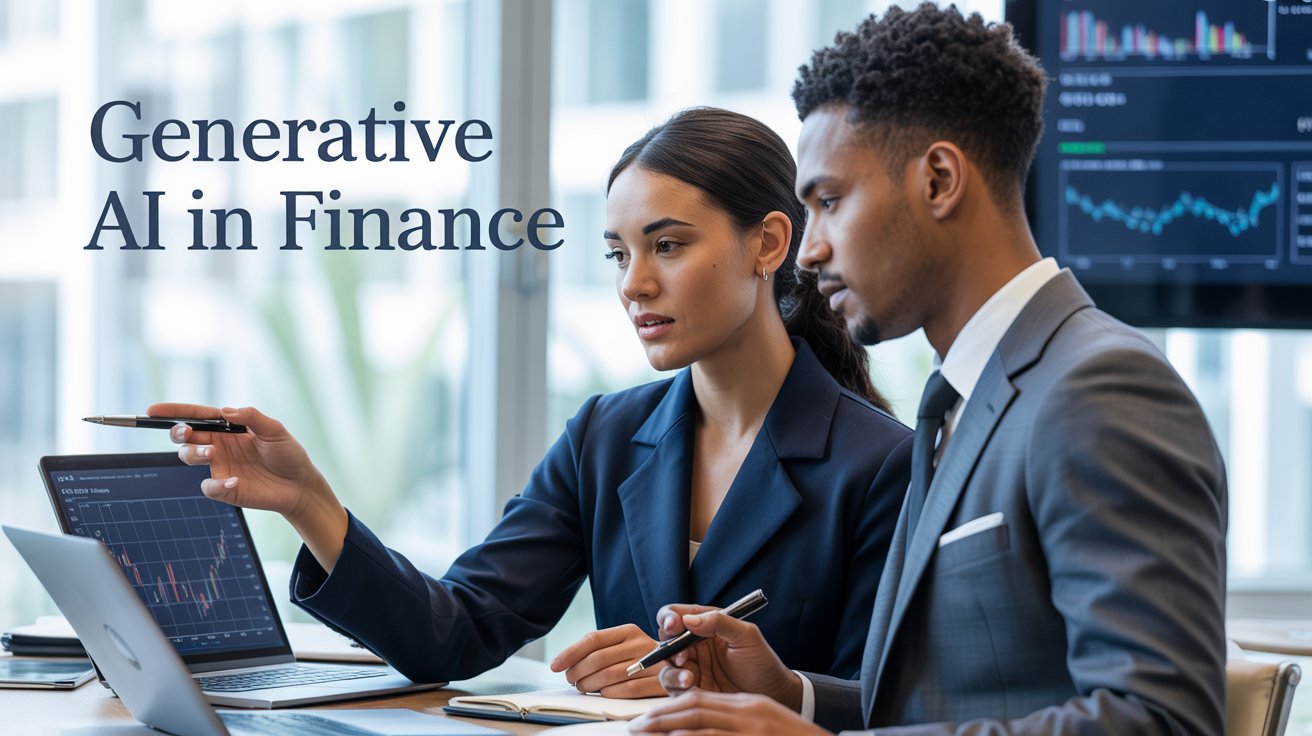
Generative AI in Finance is changing how financial institutions approach risk assessment and forecasting. In the present market, these models facilitate real-time simulations and scenario-building. Consider being able to create thousands of crisis simulations in minutes. Such capabilities speed up decision-making. Rather, it is done more accurately by synthesizing vast structured and unstructured data. From transactional records to news and regulatory filings. This shift enables financial experts to stay ahead of potential risks and proactively respond to them. Moreover, generative AI streamlines labor-intensive activities. It includes activities like risk reporting and fraud detection. Embracing Generative AI in Finance workflows shifts institutions from reactive firefighting to forward-looking resilience.
Jump ahead to
Understanding Generative AI in Finance
Generative AI uses advanced algorithms. These algorithms help in creating new financial data, simulating outcomes, and generating insights in narrative forms based on huge datasets. Traditional predictive models rely on the analysis of structured data. Whereas Generative AI provides an amalgamation of various data types. Especially textual information such as market news or regulatory releases. This is done to extend coverage in risk evaluation and forecasting.
Key Features of Generative AI in Finance
- Integration of multimodal data offers an inclusive lens to review financial risks.
- Synthetic scenario generation captures rare or complex market events beyond historical data.
- Automated narrative creation automatically converts model outputs into actionable insights.
- Continuous updates on forecasts and risk profiles support timely and agile decision-making.
How Generative AI Enhances Risk Assessment?
Traditional risk models rely on predefined assumptions and historical stress tests. Generative AI enables much richer analysis:
- Synthesizing datasets helps in the analysis of unprecedented economic conditions and policy changes.
- Generating multidimensional stress scenarios captures interconnected financial risks. It includes credit, market, and operational factors.
- Automated risk narratives in clear terminology improve communication and alignment internally.
- Data feeds integrated in real time allow risk assessments. It helps to reflect current market realities with speed.
Synthetic Data Generation and Its Impact
Synthetic data generation enables financial organizations to model ‘what-if’ scenarios without the leakage of sensitive information. It strengthens various risk models and prepares them for unanticipated events.
Automating risk narratives for Clarity
Generative AI provides narrative risk explanations. Alongside numerical outputs, it supplies stakeholders with information on the “why” behind risk scores, better serving transparency and informed decision-making.
Stress Testing for Realistic Scenarios
Simulating complex scenarios where multiple risk factors interact provides an accurate stress-testing framework. This allows organizations to anticipate cascading effects that traditional models often fail to capture.
GEN AI in Credit Underwriting and Fraud Detection
Credit underwriting benefits from:
- Synthesize diverse borrower profiles under varying economic scenarios to continually improve the risk prediction.
- Creation of concise credit memos highlighting key risk factors to fast-track analysis.
- Integrating unstructured data, such as customer communications and news sentiment, to enhance insights.
Some of the benefits derived from fraud detection include:
- Creation of synthetic fraud data to train detection algorithms on evolving threat patterns.
- Real-time anomaly detection across multiple data sets enables earlier and more precise alerts.
- Automate suspicious activity reporting to free up more of the investigators’ time without cutting corners.
Market and Liquidity Risk
Generative AI enables much more refined management of complex risks:
- Simulating a range of simultaneous market shocks, including parallel interest rate hikes combined with credit spread widening.
- Predicting sudden shifts in liquidity for multiple currencies and products to inform contingency planning.
- Embed AI-generated insights within trading platforms to inform real-time decision-making.
Integration with Trading and Risk Systems
Many firms link Generative AI outputs directly to trading dashboards. This gives traders scenario-based alerts and actionable intelligence. Moreover, enhancing portfolio resilience.
Revolutionizing Financial Forecasting
Forecasting evolves into:
- Continuous, multi-scenario predictions utilizing diverse financial, economic, and marketing data.
- Including plain-language narratives that help business teams understand the drivers and risks in the forecast.
- Frequent updates allow forecasts to reflect the evolving market and internal conditions.
For instance, one retail bank merged generative AI with traditional techniques to make better forecasts of credit card revenues. The narrative reports produced by AI improved communication with executive decision-makers.
Traditional vs. Generative AI Approaches
| Aspect | Traditional Models | Generative AI Models |
| Data Sources | Mainly structured, periodic data | Multimodal, real-time, structured & unstructured |
| Scenario Generation | Fixed, limited stress tests | Continuous, synthetic, multi-faceted scenarios |
| Communication | Numerical outputs within manual reporting | Automated, narrative-driven risk and forecast summaries |
| Fraud Detection | Rule-based with limited datasets | Synthetic fraud data, live anomaly detection |
| Forecast Updates | Infrequent, quarterly, or annual | Real-time, multi-scenario, adaptive forecasting |
Adoption and Outcomes
The financial sector is increasingly adopting generative AI. Mainly because it speeds up credit evaluation, sharpens fraud prevention, and enhances forecast accuracy. The spending on AI keeps growing at a rapid pace. Thereby driving improvements in operational efficiency and enabling smarter risk management. These technologies create measurable advantages for organizations to act faster and more confidently.
Governance and Compliance Challenges
Data Privacy and Security
Encryption and anonymization guard against the leakage of proprietary or customer data. Synthetic data lowers privacy risks when training the models.
Explainability and Transparency
Financial regulators demand that AI decisions be interpretable and auditable. Generative AI systems should provide transparent explanations and record comprehensive logs.
Regulatory Compliance
Applications need to be aligned with regulations. This involves Basel III and GDPR to maintain legal conformance and avoid fines.
Integration With Legacy Systems
Smooth AI adoption means bridging modern AI tools with existing infrastructure. This is often done through hybrid architectures.
Governance Best Practices:
| Governance Area | Recommended Practice |
| Data Security | Encryption, controlled access, anonymization |
| Model Validation | Regular bias, fairness, and accuracy scrutiny |
| Transparency | Documented audits and clear communication |
| Regulatory Compliance | Full alignment with financial and data laws |
| Human Oversight | Continuous monitoring and human-in-the-loop systems |
The Shift from Reactive to Proactive Risk Management
The biggest shift from generative AI in Finance may be cultural rather than purely technological. Risk functions are moving from reactive monitoring toward actively creating scenarios and recommending actions. Instead of focusing on what went wrong in the past quarter, teams now explore what could go wrong next. They also evaluate which measures would best reduce exposure effectively.
As AI tools become more advanced and governance frameworks mature, risk and finance teams that collaborate effectively with generative models will gain a significant advantage. They will benefit from greater accuracy, improved speed, and heightened readiness for market volatility. Conversely, organizations that delay adopting these technologies risk falling behind. Their true exposure lies in relying too long on outdated tools built for a slower, less complex financial landscape.
Summary
Generative AI brings new depth and flexibility to financial risk assessment and forecasting. It combines data from various sources to create realistic scenarios and clear explanations. This helps improve decision-making and operational work. As more firms use this technology, strong governance and transparency become very important to manage potential risks. Organizations that use Generative AI will gain a clear edge in this financial world. This shift helps financial teams work more proactively. Moreover, turning complex data into straightforward insights, they can act on effectively.
Conclusion
Generative AI marks a paradigm shift in finance. It allows institutions to move from reactive to proactive risk management and forecasting. Further, it delivers clarity of insight and speed of reaction. It is necessary to navigate markets in flux and regulatory demands. Professionals need to enroll in AI in Finance Certification Course, as those proficient in generative AI technologies are highly sought after. Ultimately, this technology fuses human expertise with advanced algorithms. Moreover, it unlocks an era of smarter, more resilient financial services.
1. What is generative AI in Finance, and how is it applied?
Generative AI in finance refers to algorithms that create new data and insights. It enhances risk assessment and forecasting through real-time simulations.
2. How does generative AI enhance risk assessment?
It synthesizes vast datasets, including unstructured information. This allows for more accurate evaluations of potential risks and unusual economic conditions.
3. Why is synthetic data crucial in generative AI in Finance?
Synthetic data helps simulate various “what-if” scenarios. It minimizes risks related to data leaks while strengthening risk models against unforeseen events.
4. How does generative AI in Finance improve fraud detection?
It analyzes diverse datasets for real-time anomalies. Additionally, it creates synthetic fraud data to train detection algorithms.
5. What challenges arise with generative AI in Finance?
Maintaining data privacy is essential. Organizations must also ensure explainability and achieve regulatory compliance without disrupting existing systems.
6. How often are forecasts updated using generative AI in Finance?
Forecasts are updated continuously. This allows businesses to adapt swiftly to changing market conditions.
7. Is generative AI a replacement for human expertise in finance?
No, it improves human judgment. Professionals skilled in generative AI will have a competitive edge in decision-making.
8. What should organizations consider before adopting generative AI?
Firms should assess data governance and compliance with regulations. Integration with legacy systems is also crucial.
9. How does generative AI transform risk management culture?
It shifts organizations from reactive to proactive risk management. Teams focus on scenario exploration and preventive measures.
10. Can generative AI in Finance improve operational efficiency?
Yes, it streamlines tasks, allowing for faster and more accurate decision-making. This creates significant advantages for financial institutions.