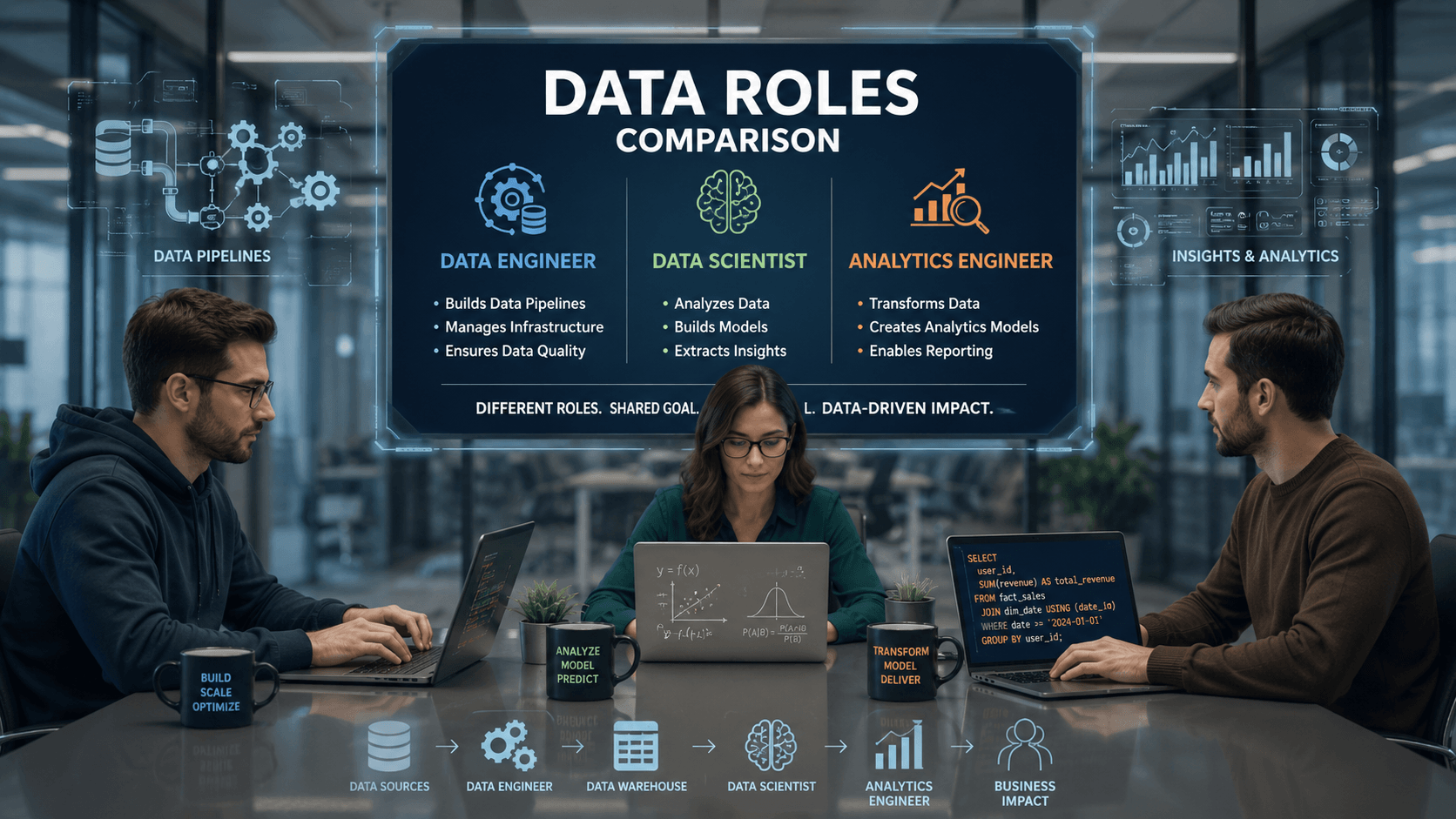
A drastic change is happening in the global job market. As per recent reports of late 2025, almost 86% of CEOs have come to consider the skill of working with data as a primary skill for daily operations. Nevertheless, a considerable disparity is still being experienced. Only around 25% of employees feel sure about their capability to use data competently for reading, analyzing, and communicating it. To remain relevant in the age of automation means needing to make every decision backed up by proof instead of intuition.
The transition requires moving from simple awareness to functional expertise. The time when data was the exclusive right of analysts and engineers is over. Now, it has become a must that marketing managers, HR professionals, and even creative designers comprehend the story behind the data. To reach this, a mix of data literacy and deep data awareness is required.

Jump ahead to
The Rising Demand for Universal Data Literacy and Data Awareness
Every professional role now touches some form of digital information. Sales teams monitor performance dashboards to track monthly targets. Healthcare workers analyze patient trends to improve care quality. Even retail staff use predictive models to manage inventory. The transformation implies that the data proficiency has moved from being an “extra” to a “needed” aspect of one’s career profile. It has become a basic condition for existence in the contemporary business world.
To excel, candidates must master the following:
- Interpreting Visualizations: Go beyond looking at pretty colors. You must understand what a specific trend line or heat map actually says about business health and where it might be failing.
- Identifying Data Gaps: Develop the “sixth sense” to spot when information is missing or skewed before making a high-stakes commitment that could cost the company.
- Communicating Findings: Bridge the gap between technical data and human strategy. You need to explain “the why” to stakeholders who may not understand “the how.”
- Filtering Signal from Noise: In a world of infinite metrics, the ability to ignore vanity data and focus on the numbers that actually drive revenue is a superpower.
Recognizing Value Through Data Awareness
Building a pronounced data awareness in employees gives them the power to notice when a figure appears to be incorrect or when a trend indicates a new possibility. In other words, it assists in challenging the status quo and making decisions on the basis of truth.
Consider a social media manager observing a sudden drop in engagement. Without data awareness, the response might be a random guess. Perhaps the manager assumes the content was poor. With the right skills, the professional pinpoints that the drop only occurs during specific hours when the target audience is offline. This level of precision saves the team from wasting hours on unnecessary creative changes.
Mastering Technical Architecture with Power BI
Turning a pile of numbers into a winning strategy is an art. It requires a specific set of skills that go beyond just looking at a chart. Technical mastery often starts with the Power BI Data Analyst Training.
Unlike shorter workshops, this format allows for a deep dive into data modeling and complex calculations. Professionals who master these areas provide immense value to their organizations. They become the “translators” who explain what the data means for the future of the company.
A Structured Roadmap to Tool Proficiency
- Foundational Ecosystem and Transformation: The first stage is about getting used to the software environment and learning how to clean and prepare raw data for analysis.
- Advanced Modeling and DAX Logic: Thorough investigation of data relationships and the very capable Data Analysis Expressions (DAX) language leads to the creation of intricate, personalized calculations.
- Project Integration and Deployment: The hands-on application via real-life situations makes it sure that the reports are not only accurate but also efficiently conveyed to the main decision-makers.
- Professional Validation: Passing the final exam is awarded with a permanent document that is a testament to a professional’s confidence in solving complex information challenges.
Bridging the Gap Between Raw Data and Business Impact
| Data Challenge | Technical Solution(Power BI) | Business Impact |
| Siloed Data | Data Mashup & Automated ETL | Creates a single “Source of Truth” for the entire company. |
| Messy Relationships | Advanced Data Modeling | Ensures cross-departmental figures match and make sense. |
| Static Reporting | Interactive Dashboards | Enables leadership to “drill down” into problems instantly. |
| Human Error | Automated Data Refresh | Eliminates manual entry mistakes that lead to bad decisions. |
Unlocking the Narrative: Translating Patterns into Profit
The ultimate goal of learning these skills is to move from Data to Insights. Simply having data is useless if no one knows what to do with it. Insights lead to better products and happier customers.
For example, a coffee shop might notice that sales of iced drinks spike on rainy days, not just sunny ones. While this seems odd, the team realizes customers view the shop as a cozy, dry place to enjoy a treat. That insight allows the business to change stock and marketing for the next storm.
Mastering Critical Thinking to Decode Complexity
This transition is exactly what the intensive Data to Insights Training covers. It pushes professionals to think critically about why things happen. The training focuses on the “why” behind the “what.” Attending this training is only the beginning. Every candidate must pass the exam conducted by the organization to receive the final certification. Key focus areas include:
- Statistical Thinking: Understanding probability and correlation without needing a math degree.
- Root Cause Analysis: Using data to find the source of a problem, not just the symptom.
- Predictive Awareness: Learning to look at current data to forecast future roadblocks.
The Power of Data-Driven Storytelling
Data alone rarely convinces people to act. To move a room, one must turn one’s findings into a narrative. This is the intersection of data literacy and communication.
- Contextualizing the Numbers: Mutual knowledge of the industry average or last year’s performance is required for a 10% growth to mean something.
- Simplifying Complexity: Good data storytellers filter out noise and allow the crucial insight to be seen clearly.
- Emotional Resonance: Make the data relevant to a human issue, such as customer satisfaction or employee burnout, thus making it compelling.
Human-AI Collaboration: The New Frontier
Today, AI can generate charts, but it cannot understand the nuance of your specific business. This is why data awareness is more important than ever. You must be the one to guide the AI, verify its outputs, and apply the “human lens” to its suggestions.
Professionals who can audit AI-generated insights for bias or errors are currently the most sought-after individuals in the market. This human oversight ensures that technology serves the business, rather than leading it astray.
Cultivating Authority through Professional Credentialing
Earning a formal certification in the data domain fundamentally redefines a professional’s internal and external standing. It serves as a verifiable benchmark of quality, signaling to leadership that an individual possesses the discipline and technical rigor required for high-stakes decision-making.
This process is more than a simple assessment. Rather, it is a holistic career upgrade that offers several distinct advantages:
- Verified Trust in Decision-Making: Certification bridges the “trust gap” between data results and executive action. Managers are more likely to approve budgets or strategy shifts when the recommending professional holds a credentialed background in analytical logic.
- Economic Advantage: With total material costs ranging from USD 50 to USD 80 and a lack of ongoing organization membership fees, this certification provides an accessible yet prestigious path to professional distinction.
- Unrestricted Career Longevity: Lifetime validity ensures that the professional remains recognized as an expert without the burden of constant renewal fees or administrative upkeep.
| Feature | Power BI Data Analyst Certification | Data to Insights Certification |
| Focus | How to build reports. | How to think about results. |
| Duration | 3 days | 1 day |
| Exam Required | Yes | Yes |
| Validity | Lifetime | Lifetime |
Summary
The transition toward a data-driven career involves a structured progression from simply viewing numbers to interpreting their strategic significance. Key takeaways from this professional evolution include:
- Increased Awareness: Recognizing that every data point represents a customer behavior or operational reality.
- Technical Proficiency: Gaining the ability to manipulate large datasets and automate reporting through specialized tools.
- Strategic Interpretation: Shifting focus from “what happened” to “why it happened,” enabling more accurate forecasting and risk management.
- Certified Expertise: Validating skills through official assessments to gain trust within a corporate environment and open doors to leadership roles.
- Establishing this comprehensive foundation ensures that a professional can speak the language of modern business with confidence and authority.
Conclusion
Securing a competitive edge in the modern economy requires a deep investment in both the technical and analytical dimensions of information management. Completing Power BI Data Analyst Certification provides the necessary technical depth to build sophisticated, interactive reporting systems that serve as a single source of truth for an organization.
Complementing this with Data to Insights Certification sharpens the critical thinking required to extract meaningful narratives and high-level strategy from those reports. Earning these lifetime certifications through rigorous examination proves a commitment to excellence and high-level decision-making. These combined skill sets transform a standard career path into a leadership trajectory, ensuring every project is guided by factual clarity and strategic foresight.
FAQS
Data literacy refers to the ability to read, understand, create, and communicate data effectively. It helps make informed decisions based on reliable data insights.
Data literacy involves the full spectrum of data skills, from interpretation to communication, while data awareness recognizes data’s role and significance in decision-making.
Data literacy has become essential in various fields, allowing individuals to extract meaningful insights, drive productivity, and help teams achieve their goals.
Those skills can be achieved through training programs, such as Power BI Data Analyst Training. Additionally, engaging workshops can provide insights and practical experience.
Advanced mathematics is not a necessity. The focus lies on logical reasoning and the ability to interpret data context, rather than performing complex calculations.
Data literacy enhances evidence-based decision-making processes. Professionals can analyze data effectively, leading to strategic insights and faster adjustments.
AI systems depend on quality data for accurate outputs, making it crucial. Professionals with data awareness can critically evaluate AI-generated suggestions, ensuring accuracy and reliability.
Data awareness fosters clearer communication within teams. A shared understanding of data improves collaboration and accelerates project outcomes.
Data literacy and awareness are increasingly valued across diverse sectors, including healthcare, finance, marketing, and education.
Organizations can promote data literacy by offering training resources and encouraging continuous learning. Building curiosity and critical thinking helps establish a culture of data-driven decision-making.