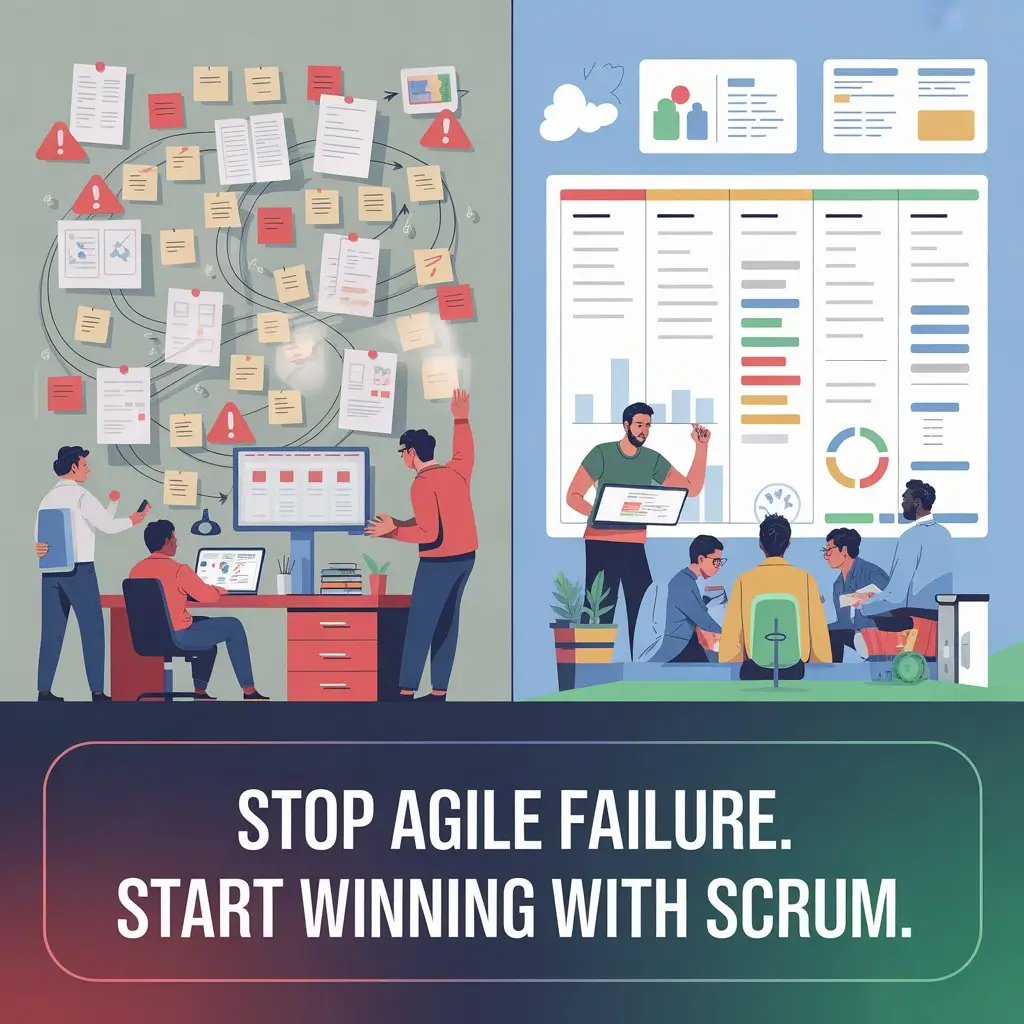
Agile was meant to be a silver bullet. It offers fast delivery, happy customers, and, moreover, empowered teams. Yet, nowadays, many organizations start quietly recognizing that Agile stumbles, stalls, or spirals into chaos. That means, Agile, when we misunderstand, becomes a paradox. It will be flexible in theory but fragile in practice. As the proverb says,” A little knowledge is a dangerous thing. With no proper Agile and Scrum awareness, teams adopt events without a mindset, tools without any discipline, and speed without direction. In fact, this happens when projects derail, budgets bleed, and most importantly, stakeholders have no faith.
However, failure is not the end road, but it is a signpost. Let’s unpack why Agile projects fail, and also Scrum fixes what’s broken.
Jump ahead to
The Real Reasons Agile Projects Collapse
Agile does not fall overnight, but it erodes silently. Below are the most common root causes behind Agile project failures.
- Agile Without Understanding– It is a truth that teams go Agile by renaming meetings and roles, but ignoring Agile principles. Actually, stand-ups become status updates, and sprints turn into mini waterfalls.
- Weak Product Ownership– A disengaged or unclear Product Owner leads to shifting priorities, bloated backlogs, and confused teams. These are classic symbols of Agile project failure.
- Poorly Defined Requirements– Vague requirements create rework loops. This implies the fact that without Agile, user stories, teams may build features no one asked for.
- Resistance to Change- Agile demands cultural change. As a matter of fact, when leadership clings to command and control habits, Agile project failures become inevitable.
- Metrics Over Meaning– Velocity obsession without customer value is like counting steps without knowing the destination. This is another contributor to Agile project failure.
Common Agile Failure Signals
- Missed sprint commitments
- Constant scope creep
- Burned-out teams
- Stakeholder dissatisfaction
- “Done” features that are not usable
As we say, “Where there is smoke, there is fire.” Therefore, you should not ignore these signals.
How Scrum Frameworks Restore Stability
Scrum is not just a framework; it’s a discipline that enforces focus and transparency.
Key Scrum Elements That Prevent Failure
| Scrum Element | How it Aids |
| Defined Roles | Clear accountability prevents confusion |
| Time-Boxed Sprints | Limit scope creep |
| Sprint Reviews | Continuous stakeholder alignment |
| Retrospectives | Encourages continuous improvement |
| Product Backlog | Creates a single source of truth |
There is no doubt that, when Scrum is practiced correctly, then, Agile project failure shifts from frequent to fixable.
The Power of Agile User Stories
It is evident that Agile user stories have the power to translate chaos to clarity. Furthermore, you can see that they shift thinking from what to build to who it’s for and why.
Anatomy of a User Story- As a [user], I want [goal], so that [value].
Benefits of Agile User Stories
- Promotes customer-centric thinking
- Reduce ambiguity
- Enable better sprint planning
- Improves collaboration between business and tech
- Prevent rework and waste
Without Agile User Stories, teams guess; on the other hand, with them, they deliver.
Scrum+ Userstories- A Winning Combination
Scrum frameworks provide structure, while user stories provide meaning. And, together, they attack the root causes of Agile project failure.
How They Work Together
| Problem Area | Scrum Solution | User Story Impact |
| Unclear Scope | Sprint Planning | Clear acceptance criteria |
| Misaligned Stakeholders | Sprint Reviews | Shared understanding |
| Low team Morale | Retrospectives | Purpose-driven work |
| Poor Quality | Definition of Done | Testable outcomes |
This synergy is something that can build Agile and Scrum awareness across teams and leadership.
Agile is not about Speed But it’s About Sense
Many organizations chase velocity like a rabbit chasing a carrot. In fact, Agile success is not the fastest delivery. It’s about smarter delivery. Scrum enforces rhythm in projects, and Agile user stories ensure relevance. In truth, they turn reactive teams into resilient ones. Agile rewards preparation, not shortcuts. Hence, “Measure twice and cut once”.
Practical Fixes to Avoid Agile Failure
Here’s how businesses can actively reduce Agile project failure.
- Invest in Scrum education, not just tools.
- Empower product owners with decision authority
- Write INVEST, compliant Agile User Stories
- Use retrospectives as improvement engines
- Focus on value, not vanity metrics
As a matter of fact, when Agile is treated as a mindset and not a checklist, then the results follow.
Summary Table- Agile Failure vs Scrum Solutions
| Agile Failure Cause | Scrum-Based Fix | Outcome |
| Unclear requirements | Agile user stories | Better clarity |
| Leadership resistance | Scrum values | Cultural alignment |
| Scope creep | Sprint boundaries | Predictable delivery |
| Poor communication | Scrum events | Transparency |
| Low customer value | Product backlog refinement | Value-driven outcomes |
This is how the teams escape the loop of Agile project failure and move toward maturity.
To Wrap Up
Agile does not fail because it’s flawed. It fails because it is misunderstood. When teams rush to adopt Agile without understanding, chaos follows. Weak execution and misplaced metrics often mask the true potential of Agile. Hence, strong Agile and Scrum awareness is pivotal, together with disciplined Scrum frameworks and meaningful Agile userstories. This can replace the confusion with teams with their confidence. Like any craft, Agile mastery takes practice and patience with purpose. Yes, as the saying goes, Roam was not built in a day but with a proper plan. Furthermore, you can take well-rounded courses like Managing Agile Projects with Scrum Certification Training, which is the smartest step toward turning Agile chaos into consistent success.
FAQs
It helps teams understand the “why” behind practices, align stakeholders, and apply Scrum frameworks. This can improve clarity, discipline, and shared purpose.
Agile User Stories connect development work to real user needs, reduce ambiguity, and enable better sprint planning. This can simultaneously ensure delivered features provide measurable value.
Yes, unclear ownership leads to poor prioritization, conflicting decisions, and backlogs filled with low-value items that slow down delivery.
Velocity only measures output, not impact. However, real success comes from customer satisfaction, usability, and business value delivered.
Scrum uses time-boxed sprints, backlog refinement, and sprint goals to manage change without disrupting delivery commitments.
Yes, Agile succeeds only when leadership supports transparency, trust, collaboration, and team empowerment.
Unclear requirements increase rework, technical debt, and stakeholder dissatisfaction. Ultimately, this delays the value realization.
Yes, with disciplined Scrum practices, clear roles, and consistent communication across teams.
Agile and Scrum Awareness Training equips professionals with practical skills, structured knowledge, and confidence to manage Agile projects effectively.