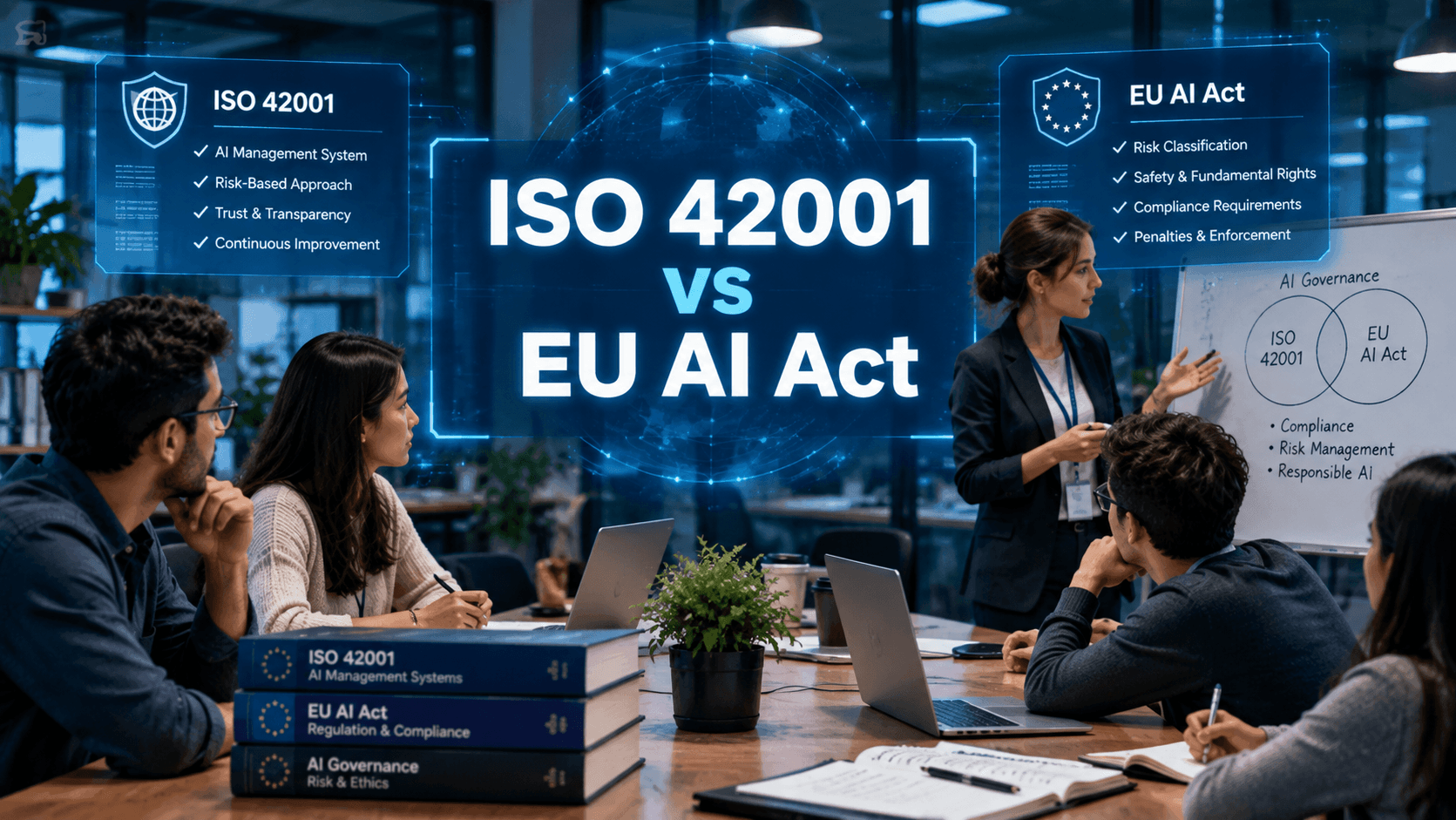
AI governance is entering a new context. Yes, the rules of the game are changing so fast. ISO 42001 and the EU AI Act have emerged as two powerful reference points for organizations steering responsible AI. Yet, they are not interchangeable. One offers a structured management system for governing artificial intelligence. On the other hand, the other forces binding requirements on AI systems legally within its scope.
Furthermore, the plot thickened in 2026 when the digital omnibus put off important high-risk AI deadlines to 2027 and 2028.For professionals. This is not a cue to hit the brakes. It is an opportunity to get ahead of the curve.
Jump ahead to
What is ISO/IEC 42001?
ISO/IEC 42001:2023 is the first international standard specifically designed for an Artificial Intelligence Management System(AIMS). Moreover, it gives organizations an orderly approach to administer AI throughout its lifecycle.
ISO 42001 at a glance
- First Global AIMS standard: It provides a methodological approach to AI governance and responsible AI management.
- Management system structure: This follows a Plan-Do-Check-Act philosophy used across established ISO management standards.
- Risk-based approach: This standard aids organizations in identifying, assessing, treating, and monitoring AI-related risks.
- Lifecycle governance: It covers AI-related processes from planning and development through deployment and monitoring.
- Organizational accountability: This standard encourages leadership involvement, defined responsibilities, policies, and continual improvement.
- Certifiable: Organizations can undergo independent audits to demonstrate conformity with the standard requirements.
ISO/IEC 42006:2025 also establishes requirements for bodies that audit and certify organizations against ISO/IEC 42001.
What is the EU AI Act?
The EU AI Act is the legally binding, risk-based regulation governing artificial intelligence within its scope. If ISO 42001 is a governance playbook, then the EU AI Act is a legal rulebook. Furthermore, it focuses on protecting fundamental rights, safety, transparency, and responsible AI deployment.
The regulatory DNA of the EU AI Act:
- Legally binding- Applicable organisations must meet relevant requirements.
- Risk-based- Different AI systems trigger different obligations.
- Broader reach- Certain organisations outside the EU can fall within its scope.
- Role-driven- Providers, deployers, importers, distributors, and other actors can have different responsibilities.
- Evidence-oriented – Relevant systems can require risk management, technical documentation, logging, monitoring, and human oversight.
- Penalty-backed – Certain violations carry significant administrative fines.
In fact, the distinction is crucial. ISO 42001 certification and EU AI Act discussions should never suggest that an ISO certificate is a universal legal passport into EU AI Act compliance.
ISO 42001 vs EU AI Act: Two Frameworks, Two Jobs
| Dimension | ISO/IEC 42001 | EU AI Act |
| Nature | International management standard | Binding EU regulation |
| Primary Focus | AI management and governance | AI safety, rights, transparency, and market regulation |
| Scope | Organizations developing, providing, or using AI | Covered AI systems and actors within the Act’s scope |
| Structure | Management system approach | Risk-based regulatory framework |
| Certification | Certification can be obtained through an audit | “No general EU Act” certificate replaces legal compliance |
| Enforcement | No statutory AI fines under ISO itself | Administrative penalties apply |
| Conformity | Certification demonstrates conformity with the standard | Harmonized standards can support presumption of conformity where applicable |
| Relationship | Governance foundation | Legal compliance framework |
The phrase “ ISO 42001 certification EU AI Act” therefore needs careful handling. Definitely, certification can strengthen an organization’s governance framework. However, it does not automatically establish compliance with every applicable AI Act requirement.
The simplest way to remember it
ISO 42001= “How should we manage AI?”
EU AI Act = “ What must we legally do with covered AI?’’
They overlap, but they are not twins.
The Four Risk Doors of The EU AI Act
The AI Act does not put every AI application into the same regulatory bucket. Furthermore, its risk-based architecture is central to understanding compliance.
- Unacceptable risk: Certain AI practices are prohibited.
- High risk: Specialized systems face high requirements covering areas such as risk management, data governance, documentation, human oversight, accuracy, robustness, and cybersecurity.
- Limited risk: Certain systems face specific transparency obligations.
- Minimal or low risk: Many AI applications face limited obligations under the Act, although other laws can still apply.
For professionals, this means one thing: classification comes before compliance planning.
2026 Digital Omnibus: The Plot Twist Professionals Cannot Ignore
Here is where the regulatory journey takes an interesting turn.
The Digital Omnibus on AI, Regulation (EU) 2026/1744 was published in the Official Journal on 24 th July 2026 and entered into force on 27th 2026.
It changed important ISO 42001implementation dates for high-risk AI.
| Date | Regulatory Milestone |
| 18 December 2023 | ISO/IEC 42001 published |
| 1st August 2024 | EU AI Act entered into force |
| 2nd Februaray 2025 | Prohibitions and AI literacy provisions began applying |
| 2nd August 2025 | GPAI obligations began applying |
| 24 July 2026 | Digital Omnibus published |
| 27 July 2026 | Digital Omnibus entered into force |
| 2nd August 2026 | Main AI Act application date, subject to specific exceptions |
| 2nd December 2027 | Revised deadline for standalone Annex-III high-risk systems |
| 2nd August 2028 | Revised deadline for high-risk AI embedded into Annex I regulated products |
What does this mean?
The calendar has moved, but the compliance destination has not. Moreover, the revised deadline creates additional breathing room for creating high-risk systems. Furthermore, smart organizations can use the runway to build governance, documentation, risk controls, and evidence instead of scrambling when the deadline arrives. As the proverb goes, “ A stitch in time saves nine”.
Where ISO 42001 and the EU AI Act Meet?
This is where the two frameworks become particularly interesting.
Their shared governance territory:
- Risk management: ISO 42001 provides structured processes for identifying and treating AI risks that create useful foundations for regulatory readiness.
- Documentation: AIMS processes support systematic policies, assessments, decisions, and evidence.
- Human oversight: Defined responsibilities can aid firms in establishing clearer oversight mechanisms.
- Lifecycle governance: Both perspectives encourage organizations to look beyond the moment an AI system goes live.
- Monitoring: Continual monitoring aids businesses in detecting emerging risks and changing circumstances.
- Accountability: Leadership involvement and documented responsibilities strengthen governance ownership.
This makes ISO 42001 potentially valuable as a governance accelerator. That means, instead of starting with a blank sheet of paper, you can build an organized AI management system and then map the specific EU AI Act obligations that apply.
However, there is an important caveat. ISO 42001 Certification does not automatically equal EU AI Act compliance.
EN 18286: Why Professionals Should Watch The Fine Print?
EN 18286:2026 has become another important piece of the puzzle. Actually, the standard addresses quality management system requirements relevant to the EU AI Act. However, publication is not the same as an official journal citation. As of the current 2026 position, EN 18286 has been made available. Yet, it has not been cited in the Official Journal for the relevant Article 40 presumption of conformity.
The practical lesson:-
- Do not assume publication automatically creates a legal presumption of conformity.
- Track European Commission developments and Official Journal citations
- Use standards to strengthen governance without treating them as automatic legal shields.
- Keep legal compliance assessments separate from certification claims.
In other words, read the fine print before you cross the finish line.
AI Act Compliance 2027
Consider: AI Act compliance 2027 is on the organizational roadmap. Then, waiting for 2027 to begin preparation could turn valuable runway into a last-minute sprint.
A practical readiness checklist:
- Inventory AI: Identify models, systems, applications, vendors, use cases, and owners.
- Map risk: Assess where systems may fit within the AI Act’s risk categories.
- Clarify roles: Determine whether the organization acts as provider, deployer, importer, distributor, or another relevant actor.
- Run an ISO 42001 gap assessment: Review governance, leadership, risk, data, documentation, monitoring, and continual improvement.
- Build evidence: Maintain risk assessments, testing records, policies, monitoring results, and accountability records.
- Review Third-Party AI: Examine supplier documentation, contracts, model information, and responsibility boundaries.
- Strengthen AI literacy: Ensure relevant employees understand AI systems they use and their responsibilities.
- Monitor standards: Track EN 18286 and its official journal status.
- Prepare for Audits: Keep evidence structured, secured, and accessible.
A useful mindset shift
Don’t ask only: “When do we have to comply?” But also ask, “ What can we build today that makes compliance easier tomorrow?”
Definitely, a small shift can turn compliance from a fire drill into a repeatable business capability.
ISO 42001 and EU AI Act: Do organizations need both?
The answer depends on the organization’s AI activities, legal obligations, risk profile, and business objectives.
However, the two frameworks can be viewed as complementary layers.
| ISO 42001 can help establish | The EU AI Act can require |
| AI governance policies | Applicable legal controls |
| AI risk management processes | Risk-specific obligations |
| Defined responsibilities | Provider/deployer responsibilities |
| Documentation process | Required technical documentation |
| Monitoring and improvement | Regulatory monitoring obligations |
| Management accountability | Legally enforceable duties |
The metaphor is simple. ISO 42001 can aid in constructing the governance foundation. On the other hand, the EU AI Act determines the regulatory architecture that covered organisations must satisfy.
ISO 42001 and the EU AI Act at a Glance
| Area | Key Takeaway |
| ISO 42001 | AI management system framework |
| EU AI Act | Binding AI regulation |
| Main overlap | Risk, governance, documentation, oversight |
| Certification | Supports governance but does not replace legal compliance |
| AI Act compliance 2027 | Key revised deadline for Annex III high-risk systems |
| 2028 | Revised deadline for Annex I high-risk product systems |
| EN 18286 | Published but OJ citation remains significant |
| Practical approach | Build governance and legal compliance in parallel |
Wrapping Up
AI governance is no longer a back office checkbox. It is actually a strategic advantage. In fact, ISO 42001 and the EU AI Act offer complementary lenses. One builds a disciplined governance engine. Meanwhile, the other sets the legal guardrails.
Can organizations afford to treat them as separate journeys? As the AI Compliance Act 2027 approaches, professionals who connect governance, risk, transparency, and accountability can turn regulatory complexity into operational clarity. The smartest move is not merely to comply, but to build AI systems ready for scrutiny, scale, and trust.
FAQs
No. ISO 42001 is a voluntary AI management standard, while the EU AI Act is legally binding.
No. Certification supports governance but does not automatically fulfil every EU AI Act obligation.
It provides structured processes for AI risk management, documentation, accountability, and lifecycle governance.
ISO 42001 focuses on managing AI responsibly, while the EU AI Act establishes legally enforceable requirements based on AI risk.
Certain high-risk AI obligations have been deferred to 2027 under the 2026 Digital Omnibus. Professionals should track the revised deadlines while preparing governance controls.
No. ISO 42001 provides risk-management principles, but organizations must separately determine applicable EU AI Act risk categories.
It can strengthen AI governance, documentation, risk controls, and accountability. However, it should complement rather than replace legal compliance.
ISO 42006 defines requirements for bodies that audit and certify AI management systems against ISO 42001.
Yes. Organizations can map ISO 42001 controls against applicable EU AI Act requirements to streamline governance and compliance activities.
AI governance is becoming increasingly structured and regulated. Understanding both frameworks helps professionals connect responsible AI practices with compliance and risk management.