Total Quality Management, or TQM for short, is a process improvement methodology that helps organizations aim to improve the quality of their products and services in the long run. It provides policies and techniques to develop effective strategies suitable for the continuous improvement of various processes in the business enterprise.
Organizations that want to achieve and sustain their goals and objectives for a long time must understand the importance of TQM. They hire quality management professionals trained and knowledgeable in total quality management to improve their business processes by applying all principles of totla quality management. Also, these professionals have a detailed comprehension of the 8 fundamental principles of total quality management.
Jump ahead to
What is Total Quality Management?
The term TQM or Total Quality Management originated in the 1950s in Japan. It is a management approach that aims to achieve long-term success through continuous quality improvement. In TQM, all organization members play a vital role in improving the business processes. This also includes building a different value of culture at all levels, from junior staff to senior managers. Every person in the enterprise has a role to play. The main objective of total quality management is sustaining the continual improvement of the business processes to deliver “quality” products and services that effectively meet the requirements of their customers.
Importance of Total Quality Management for Continuous Improvement
The role of quality management in any organization is to improve the delivery of quality products and services to their customers. To achieve this, each quality development process must be improved by identifying defects or reducing variation. In TQM, this is given priority. Here, every professional works towards the common goal of attaining organizational objectives. Total quality management promotes continuous improvement by encouraging the whole organization to adopt quality management principles.
One of the essential advantages of total quality management is reducing the cost of quality improvement processes. It helps in identifying and mitigating risks. TQM also helps in resolving problems before they occur and during operations. And it increases customer satisfaction by delivering products and services with low costs and meeting their expectations. Every employee feels like they are contributing to the success of their organization. Thus, we can conclude that total quality management helps achieve organizational objectives by increasing the organization’s overall productivity.
Principles of Total Quality Management
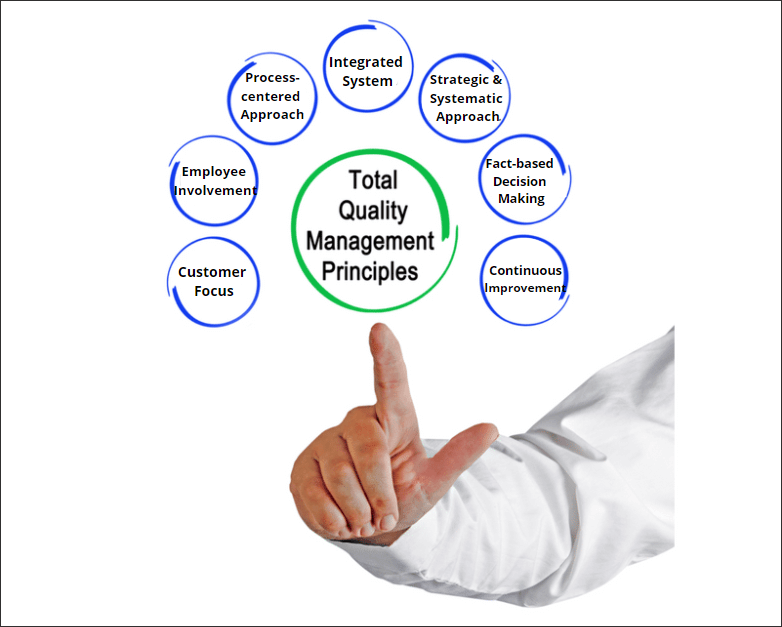
TQM has several elements that, when adopted together, help organizations attain their goals and objectives. Listed below are the 8 fundamental principles of total quality management that are required for quality improvement:
Customer Focus
TQM emphasizes the end-users or customers of the products and services delivered by the organization. This means the customers determine the quality of these products and services. This can be known by taking customer feedback and communicating with them about their requirements.
Employee Involvement
This is a vital aspect of total quality management that focuses on the involvement of every member of the organization in the quality improvement process. From entry-level employees to the leaders of the organization, everyone feels empowered. This increases their satisfaction level with their work, reflecting the organization’s overall productivity.
Process-centered Approach
Total quality management cannot be implemented without a definite and consistent process-centered approach. Processes are predetermined and predictable, thus limiting variation. Monitoring and assessing predefined processes are easy and lead to increased performance or production.
Integrated System
Organizations that adopt total quality management have an integrated system that allows them to run a flow of communication and understanding in a horizontal process. In this system, every employee understands the organization’s policies, strategies, and objectives. This will also help quality management professionals identify the areas that need improvement.
Strategic and Systematic Approach
Policymaking and strategic planning are integral parts of total quality management. It provides a systematic approach to carrying out various operations involved in the quality improvement process. Quality forms the core component of the strategic plan. Thus, helping attain the visions and missions of the organization.
Fact-based Decision Making
In TQM, decisions are made using facts or statistical data collected. These inputs are then analyzed to reach the required consensus. This allows organizations to make informed decisions based on data which can be sales and revenue figures, market research, customer retention rates, etc. It leads to making predictions based on past figures and producing accurate results.
Communications
Improvement cannot take place without effective communication within the organization. TQM allows every member of the organization to communicate the organization’s objectives and the requirements of the project effectively. Every strategy and policy aligned with objectives are communicated with the employees. This ultimately helps adopt the principles of total quality management in the organization.
Continuous Improvement
Attaining business efficiency and customer satisfaction is the primary objective of total quality management. This is done systematically through continuous improvement. Quality improvement is a continuous process in TQM. This helps organizations attain their objectives and sustain long-term success over their competition.
In organizations adopting the principles of total quality management, the leaders and decision-makers, growth, support, training, and communication are emphasized. Thus, every employee is trained and made aware of the goals of continuous quality improvement. Their actions must align with the need of the organization. This is how quality products and services are delivered, by building an environment of continuous improvement through effective communication.
Summary
Total Quality Management (TQM) is a continuous improvement approach that enhances product, service, and process quality across an organization. It is built on key principles such as customer focus, employee involvement, process optimization, and data-driven decision-making to achieve excellence. TQM creates a quality-first culture where every employee contributes to problem-solving and performance improvement. By applying TQM principles, businesses can minimize errors, reduce costs, and improve productivity. It strengthens customer trust by consistently meeting and exceeding expectations. TQM also promotes teamwork, effective communication, and innovation for long-term growth.
Conclusion
By following the fundamental principles of total quality management, organizations can become analytical and creative in formulating strategies to meet the expectations of their stakeholders as well as stay ahead of their competitors. TQM helps organizations adapt to the changing dynamics of the global economy. To implement total quality management, the organization must invest in training employees in quality management professional certifications and clearly defining the goals. It is a lengthy process and should be approached in phases to build a culture of continuous improvement.
FAQs on Principles of Total Quality Management
1. What is meant by Total Quality Management?
Total Quality Management is a continuous improvement approach where the entire organization works towards enhancing product, service, and process quality to meet customer expectations.
2. What are the 4 steps of TQM?
The four key steps are Plan, Do, Check, and Act (PDCA cycle).
3. What are the 5 principles of TQM?
Customer focus, continuous improvement, employee involvement, process-centric approach, and fact-based decision making.
4. What are the 5 elements of Total Quality Management?
Leadership commitment, customer focus, training and empowerment, continuous improvement, and process management.
5. What is the main goal of TQM?
To achieve long-term success through customer satisfaction and continuous improvement of all organizational processes.
6. Why is TQM important for organizations?
It enhances quality, reduces waste and defects, improves customer satisfaction, and boosts business competitiveness.
7. What are the key principles of TQM?
Customer focus, employee involvement, process approach, integrated systems, effective communication, continuous improvement, and data-driven decisions.
8. How does TQM improve customer satisfaction?
By aligning products, services, and processes to meet or exceed customer needs consistently.
9. Is TQM still relevant today?
Yes, TQM remains highly relevant as organizations focus on quality, efficiency, digital transformation, and customer experience.
10. What are the main tools used in TQM?
Fishbone Diagram, Pareto Chart, 5S, PDCA, Control Charts, Flowcharts, and Check Sheets.
11. How does employee involvement support TQM?
Employees actively identify problems, suggest improvements, and take ownership of quality outcomes.
12. How does TQM reduce operational costs?
By preventing defects, optimizing processes, and reducing rework, errors, and resource wastage.
13. What industries use TQM?
TQM is used in manufacturing, healthcare, education, hospitality, IT, banking, and service sectors.
14. What challenges occur during TQM implementation?
Resistance to change, lack of leadership support, weak communication, and limited employee engagement.
15. Can TQM be combined with Lean and Six Sigma?
Yes, integrating TQM with Lean and Six Sigma accelerates continuous improvement, efficiency, and quality excellence.