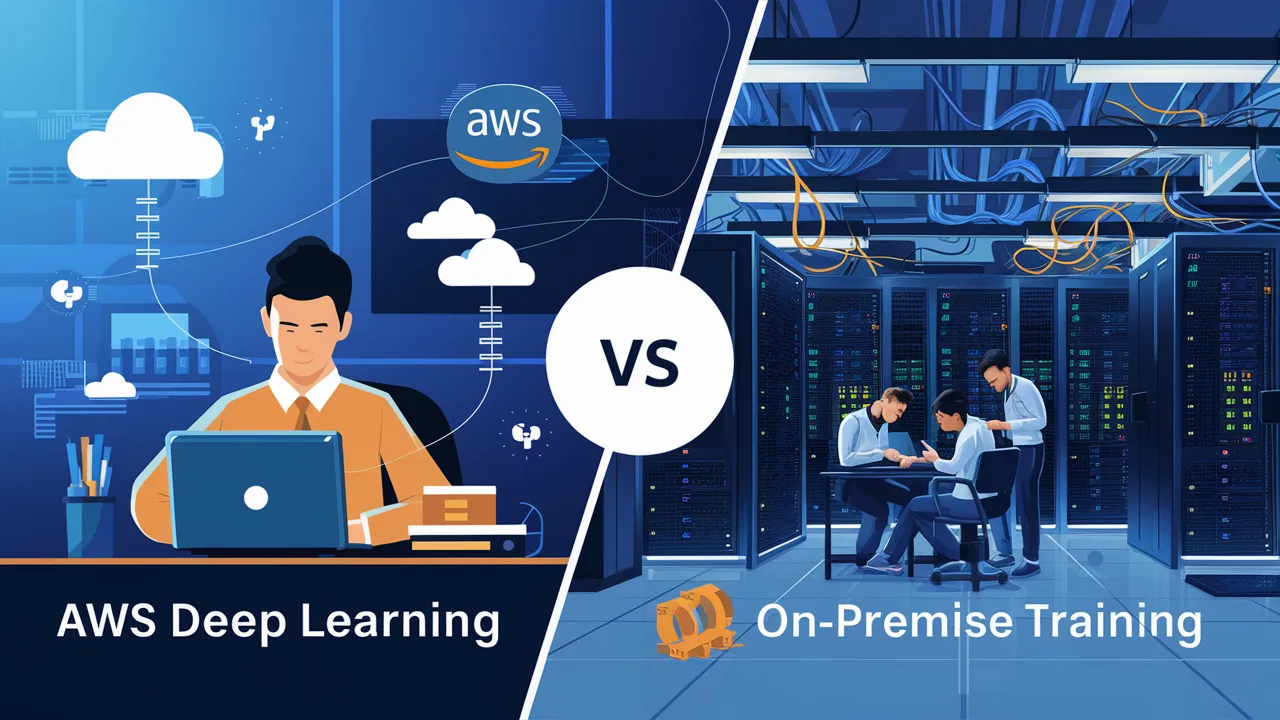
When working with Artificial Intelligence and deep learning, a strategic decision is often seen in today’s rapidly evolving tech landscape. Some important questions arise as a techy, if you are evolving yourself in today’s tech landscape. Should deep learning models be trained on cloud platforms like Amazon Web Services (AWS) or on traditional on-premise infrastructure?. In this article, we’ll explore the key differences between AWS Deep Learning vs. on-premises training approaches, highlighting the pros and cons of each. This guide points you toward the right training courses you need to master cloud-based deep learning paradigms.
Jump ahead to
What Is Deep Learning?
Deep learning is a powerful subset of machine learning. This is actually employing advanced neural networks to effortlessly coordinate processing and pattern-based forecasting while analyzing vast amounts of data. These neural networks are configured to simulate human-like learning and self-optimizing feature extraction without extensive manual intervention.
It necessitates marked computational power, interface with optimised libraries and frameworks, and an efficient data delivery track to train these models. This guides us to create a core debate: cloud versus on-premises training.
Course Spotlight: Deep Learning on AWS Training
Let us compare both kinds of training and check which is most outcome-oriented. Before any juxtaposition, let’s look at one of the most relevant training offerings for professionals keen to advance cloud-based deep learning skills:
What You Learn
The Deep Learning on AWS Training spans the entire process spectrum for building, training, and deploying deep learning models on Amazon Web Services, including:
- The full workflow from data collection and preprocessing to model training, retraining, tuning, and deployment.
- Highly optimized AWS technology components, covering compute, storage, software, and networking aspects for deep learning.
- Code, data, and model versioning using tools like Git and Amazon S3.
- Automation workflows with AWS Step Functions, Apache Airflow, and Kubeflow pipelines.
- Scalable training patterns with Amazon SageMaker and Kubernetes on AWS.
This kind of training equips data scientists, machine learning engineers, and AI professionals with hands-on, cloud-native expertise that is rapidly becoming essential in industry today.
What Does On-Premise Training Look Like?
Traditional on-premise training is typically centered on internal infrastructure, servers, and GPU clusters physically owned and operated within an organization. In academic or enterprise settings, this involves:
- Buying and managing expensive hardware (GPUs, servers, cooling systems).
- Setting up networking and storage systems that support high-volume data processing.
- Handling system updates, security patches, and hardware lifecycle management.
Deep learning on-premise often requires advanced knowledge of system administration and manual optimization of software stacks, from PyTorch/TensorFlow environments to GPU drivers and custom schedulers.
AWS Deep Learning vs On-Premise Training: Key Differences
Let’s break down the major differences between cloud-based training with AWS and traditional on-premise setups across several critical dimensions.
Scalability and Elasticity
AWS:
AWS offers virtually unlimited scalability. You can provision thousands of CPU or GPU instances on demand, enabling you to train massive neural networks in hours instead of weeks, especially useful when experimenting with hyperparameter tuning or large datasets.
On-Premise:
Scaling on-premise infra involves buying more hardware, which is a cost-heavy and slow-moving process. Putting off purchasing and setting up new servers may become a hindrance if the volume of work abruptly surges.
Winner: AWS Deep Learning for elastic scaling.
Cost Structure
AWS:
Cloud providers operate a pay-as-you-go model, where you pay only for the compute and storage you consume. This eliminates large upfront investment in physical hardware but requires careful cost monitoring to avoid bill surprises.
On-Premise:
Upfront costs for GPUs, servers, power, and cooling can be enormous. However, once the hardware is bought, the ongoing cost may be lower for predictable, steady workloads over many years.
Verdict: For startups and variable workloads, AWS is usually more cost-effective; for predictable, large-volume training, on-premise may be cheaper in the long run.
Performance and Hardware Access
AWS:
Amazon Web Services is preferred as one of the best as it provides access to the upgraded high-performing hardware without any requirement for capital investment. For large-scale training jobs and parallel processing, AWS instances can speed up the model training.
On-Premise:
On-premises gives full control over hardware selection and configuration. But if you require cutting-edge performance, hardware can age and become obsolete.
Conclusion: Cloud wins for cutting-edge performance access; on-premise wins for highly specialized, tuned hardware
Management, Security, and Compliance
AWS:
The operational load on internal teams is lessened by AWS’s robust integrated security tools, compliance certifications, and AWS-managed services. However, employing a third-party cloud service entails sharing accountability for access control and data protection procedures.
On-Premise:
Corporations with stringent standards for compliance may be drawn to complete control over data and systems. However, internal security maintenance calls for specific knowledge and ongoing attention to detail.
Choose: When selecting between them, select on-premise when regulatory compliance is extremely strict; and choose cloud when you value robust managed security and compliance support.
Real-World Use Cases
Here’s how different scenarios influence the choice:
Startups & SMEs: AWS Deep Learning is a go-to option due to lower upfront costs and easy access to cloud GPU clusters.
Large Enterprises: Often use hybrid strategies – on-premise for sensitive data and routine workloads, cloud for peak loads and experimentation.
Academics & Researchers: Cloud platforms reduce infrastructure bottlenecks, letting researchers focus on model innovation instead of hardware hassles.
To Train on Cloud or DIY?
If you are a professional looking to upgrade your skills in cloud-based Deep Learning on AWS Training is critical. The learners are skilled to use important tools like Amazon SageMaker, Kubeflow pipelines, and intelligent process automation.
In the meantime, shared perspective on-premise strategies remain vital for engineers working in heavily policy-driven industries or in companies with deep investments in internal infrastructure.
Summary
In the final analysis, AWS Deep Learning and on-premise training depend on scalability needs, cost strategy, compliance requirements, and long-term AI goals. AWS creates opportunities for elasticity, modern hardware access, and regulated services ideal for innovation and experimentation. On-premise suits organizations requiring high-level supervision and predictable workloads. All things considered, hybrid and cloud-centric implementations are, with rising frequency, shaping sustainable, future-ready AI infrastructure strategies.
Final Thoughts
There is no universal solution when choosing between on-premise training and AWS Deep Learning. The size, budget, long-term objectives, and regulatory requirements of your company all play a role. For projects that require responsive scalability, quick learning, and access to cutting-edge AI gear at an affordable price, go with AWS.
In essence, the emerging landscape of deep learning centers on multi-architecture and cloud-based models. With persuasive training programs available that focus on AWS Deep Learning techniques, professionals and organizations alike are poised to make more progress than ever in innovating and competing in the AI era.
FAQs
AWS uses cloud-based infrastructure with elastic scalability, while on-premises relies on internally owned and managed hardware.
AWS follows a pay-as-you-go model, ideal for variable workloads, whereas on-premise may suit predictable long-term usage.
AWS provides near-unlimited scalability on demand, while on-premise scaling requires hardware expansion.
On-premise offers full internal control, but AWS provides strong managed security and global compliance certifications.
Startups, researchers, and teams needing flexibility and rapid experimentation benefit most from AWS.
It is suitable for organizations with strict regulatory requirements or steady, high-volume workloads.
Yes, AWS offers modern GPU and AI-optimized instances without upfront hardware investment.
Yes, many enterprises adopt a hybrid model for flexibility and compliance balance.
Knowledge of services like Amazon SageMaker, Kubernetes, and workflow automation tools is essential.
Yes, cloud-native and hybrid architectures are increasingly shaping scalable and innovation-driven AI strategies.