Quality Assurance (QA) is no longer just about finding bugs at the end of development. Traditionally, QA focused on defect detection through manual testing and post-development validation. Today, rapid release cycles, Agile practices, DevOps pipelines, and AI-driven systems demand a smarter approach. Quality Control to Quality Intelligence – QA Shift evolution, a data-driven, automation-powered strategy that predicts risks, prevents defects, and continuously improves software quality. Instead of asking whether a test passed or failed, modern QA asks: Where are the highest risks? How does quality impact business performance? What should be tested next?
Jump ahead to
Be Honest: QA is No Longer about Finding Bugs
Quality Assurance has had its past as a stage in the software development cycle that is considered as a last stage in the process, which is usually concerned with the detection of defects before release. The role that QA teams played over the last few decades involved manual test cases, scripted validation, and post-development testing.
But with the current digital ecosystem, all that has changed. There is a new definition of quality that is required by agile development, DevOps pipelines, cloud-native architectures, applications powered by AI, and continuous delivery. It is no longer possible to have reactive, isolated, and slow testing.
Today, QA has been transforming into Quality Intelligence, a field that involves automation, analytics, AI, and business insights to anticipate risks and maintain ongoing quality, and accelerate innovation. Those organisations that are aware of this change are taking a decisive competitive advantage.
Quality Intelligence: What Is It?
The concept of quality intelligence can be defined as the intelligent usage of test data, automation measurements, AI models, and real-time feedback to constantly evaluate and enhance the quality of the software. It helps QA teams to go beyond the execution and become strategic product contributors.
Rather than inquiring about the test itself, quality intelligence inquires:
- Where are the areas of the greatest risk?
- What are the defects that are likely to recur?
- What is the effect of quality on customer experience and business KPIs?
- What is the next question to be tested, and why?
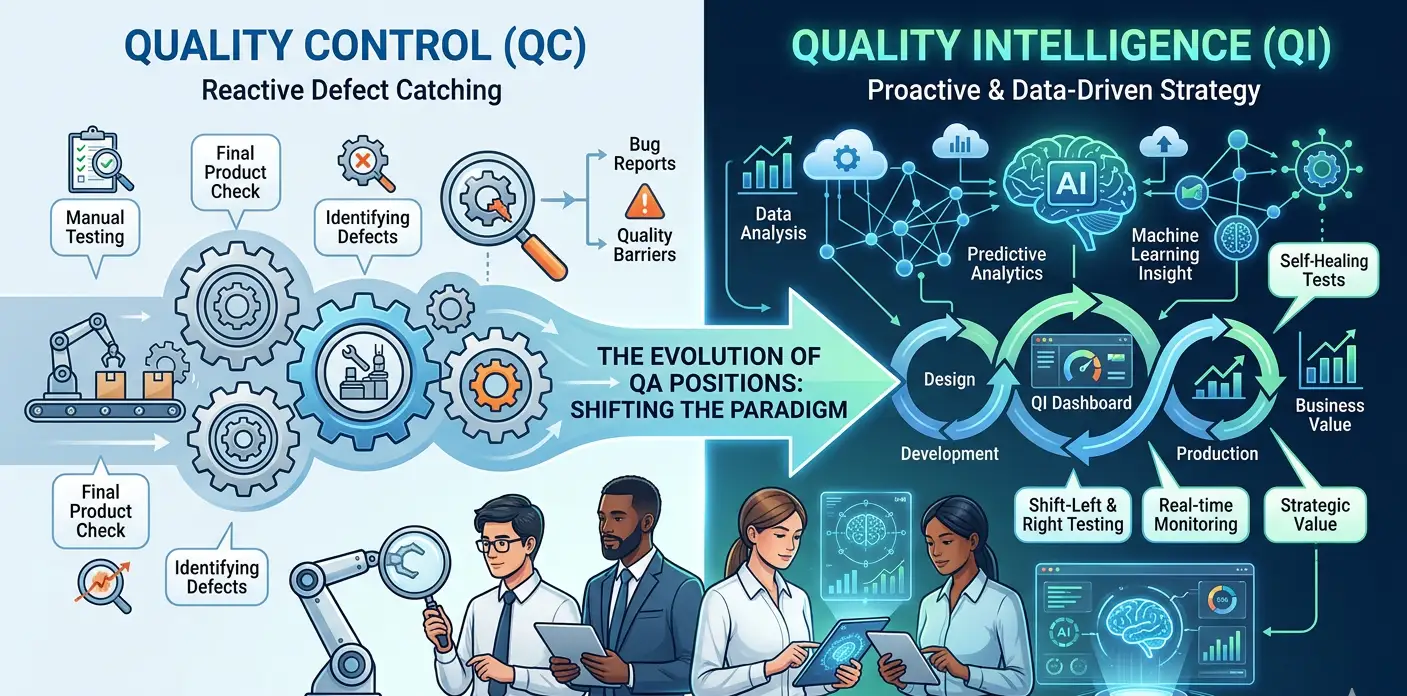
Quality Control to Quality Intelligence – QA Shift
The conventional quality control was concerned with post-development validation. Quality intelligence, on the other hand, integrates quality across the lifecycle, from requirements to monitoring of production.
This Quality Control to Quality Intelligence – QA Shift evolution is driven by:
- Accelerated release cycles and constant delivery.
- More integrations and complexity in the system.
- Increasing use of information, artificial intelligence, and robotics.
- Increased customer demands for reliability and performance.
Quality intelligence focuses on prevention rather than detection, insights rather than reports, and collaboration rather than silos.
The Shifting Role of QA Professionals
The functions of the QA engineers are changing fast as they are turning into quality strategists rather than manual testers. In current QA, practitioners are now supposed to:
QA professionals are expected to design and maintain intelligent automation frameworks that improve efficiency, scalability, and test coverage.
- Apply testing to pipelines of CI/CD: QA teams must integrate automated testing seamlessly into CI/CD pipelines to enable continuous validation and faster releases.
- Test and production data analysis: Modern QA engineers analyze test results and production data to identify patterns, predict defects, and improve product quality.
- Work hand in hand with programmers and product owners: QA professionals collaborate closely with developers and product owners to ensure quality is embedded throughout the development lifecycle.
- Use the ideas of AI and machine learning in experimentation: QA practitioners leverage AI and machine learning techniques to enhance test generation, defect prediction, and intelligent decision-making.
- This transformation needs new skills, resources, and lifelong learning: The evolving QA landscape requires continuous upskilling, adoption of advanced tools, and a commitment to lifelong learning.
Key Drivers Behind the QA Transformation
Agile and DevOps Adoption
DevOps and Agile have done away with protracted testing. QA is integrated with agile in the sprint cycles, and fast feedback and constant validation are needed.
Test Automation at Scale
Test Automation is no longer a choice. Scalable automation structures allow speedy regression examination, performance validation, and security tests.
AI in Testing
Testing is being redefined by artificial intelligence because it allows
- Self-healing test scripts
- Predictive defect analysis
- Generation of intelligent test cases.
- Computer vision and anomaly detection.
AI testing is capable of serving better coverage and less-toxic maintenance, thus smoothing the Quality Management process.
Advanced QA Software Driving Quality Intelligence
As a matter of fact, organizations move toward Quality Intelligence, and advanced QA tools play a critical role in enabling data-driven and automated testing strategies. Modern QA software goes beyond basic validation and supports continuous quality improvement across the entire development lifecycle.
Now the QA ecosystem consists of:
- Functional and non-functional testing automation.
- CI/CD integrations of continuous testing.
- Quality measurement analytics systems.
- Artificial intelligence-based testing solutions.
Undoubtedly, these tools allow the QA teams to not only provide test results but also insights.
QA Comparison Snapshot
| Aspect | Traditional QA | Quality Intelligence |
| Focus | Defect detection | Risk prediction |
| Testing Phase | End of cycle | Continuous |
| Approach | Manual-heavy | Automation & AI-driven |
| Metrics | Pass/Fail | Quality insights |
| Business Alignment | Limited | Strong |
Quality Assurance Governance, Compliance, and Risk
QA is an important aspect of governance and risk management due to the expanding regulatory demands and dangers to security.
Modern QA ensures:
- Adherence to the industry standards.
- Confidential and trustworthy releases.
- Requirements and tests traceability.
- Automation of audit preparedness.
Quality intelligence enhances trust in the digital systems.
How QA Roles Are Changing
The role of QA professionals is evolving significantly in the era of Quality Intelligence. Evidently, QA is no longer limited to executing test cases and reporting defects. Instead, it has become a strategic function that contributes directly to product quality, customer experience, and business outcomes.
Traditionally, QA engineers focused on manual testing, documentation, and end-of-cycle validation. Today, they are expected to be involved from the early stages of development — participating in requirement analysis, sprint planning, and continuous feedback loops.
Modern QA roles now include:
- Designing and maintaining automation frameworks
- Integrating testing into CI/CD pipelines
- Performing API, performance, and security testing
- Analyzing test data and production metrics
- Applying AI-driven tools for predictive defect analysis
- Collaborating closely with developers, DevOps teams, and product managers
QA professionals are transitioning from “bug finders” to quality strategists. Definitely, they are required to understand business goals, assess risk proactively, and use data to guide testing priorities.
In short, QA roles are becoming more technical, analytical, and business-aligned. Those who continuously upskill in automation, DevOps, cloud, and AI technologies will remain highly relevant in the future of software quality.
Why Quality Intelligence Will Become the Future of QA
As software systems grow more complex and release cycles become faster, traditional QA methods are no longer sufficient. In fact, organizations need continuous visibility, predictive insights, and intelligent automation to maintain high standards of quality. Moreover, Quality Intelligence enables proactive risk management, data-driven decision-making, and stronger alignment between technology and business goals. For these reasons, it is set to become the foundation of modern QA practices.
In summary:
- The speed of the delivery of software is increasing.
- QA models that are manual only are not sustainable.
- There is faster and more precise automation and AI.
- QA functions are turning out to be more strategic.
- Quality intelligence matches quality with business worth.
QA should not be a support department anymore- it can be a main engine of digital success.
Summary Table
| Quality Area | Without Quality Intelligence | With Quality Intelligence |
| Testing Speed | Slow | Continuous |
| Defect Detection | Reactive | Predictive |
| Automation | Limited | Scalable |
| Business Impact | Unclear | Measurable |
| Risk Management | High | Controlled |
Conclusion
At the close of the day, quality portrays the excellence of an organization. The replacement of quality control with quality intelligence is a significant change that will change the perception of software quality and its implementation.
The companies that invest in recent QA practices, automation, and AI-enhanced testing are enhancing the stability of their products and enabling the QA professionals to become partners in innovation. To succeed in this new environment, training and upskilling in testing, QA, and AI are necessary. Therefore, participating in AI Quality Assurance Course is highly recommended for all quality management professionals.
Quality does not come with technology but with intelligence, strategy, and competent professionals.
FAQs
Quality control concentrates on the identity of defects, whereas quality intelligence is concerned about forecasting, averting, and data and artificial intelligence insights.
No, manual testing remains important, particularly for exploratory and usability scenarios. However, repetitive test cases are increasingly automated to improve speed and efficiency.
Aspects of AI that are supported by it include smarter test selection, defect prediction, self-healing scripts, and better coverage.
Any QA engineer, automation tester, quality engineer, or test manager who wants to be able to future-proof their career.
Simple scripting and automation knowledge are becoming more and more significant, particularly in the current QA jobs.
Quality Engineering enhances QA by extending to the lifecycle of quality throughout development.
Yes. QA functions are not being eliminated, but they are becoming more and more professional and functional as they are automated and trained on AI.
Modern QA professionals need automation knowledge, basic scripting skills, and an understanding of Agile and DevOps practices. Analytical thinking and familiarity with AI-driven tools are also becoming important.
Quality Intelligence connects testing data with business metrics to enable better decision-making. It reduces defects, improves release speed, and enhances customer satisfaction.
Yes, small organizations can adopt Quality Intelligence gradually. Starting with automation and CI/CD integration helps build a strong foundation for data-driven quality.