Have you ever noticed how sometimes a job application goes silent after it’s been submitted? Chances are that your resume underwent analysis by an algorithm long before it was examined by any human. It’s all about deciding a person’s fate in seconds, taken by a system that nobody can explain. And that is where AI Ethics and Responsible AI comes in: the distance between the power these systems hold and the attention they receive.
Up until now, that has been a topic discussed in papers and conferences. This is no longer the case. According to the benchmark study conducted by Ethisphere and Ethena in 2026, 67% of companies achieved some level of AI implementation, while only 22% of Ethics and compliance teams managed to keep pace. It is obvious that implementation is in front of the oversight process by a big margin.
That’s why there is a rapid growth of promising careers in Responsible AI. Regulations are tightening, algorithms make headlines, and companies fail to have employees who can prevent issues before hitting the market. Now let me show you how AI Ethics is defined, what is the reason why companies can no longer ignore it, and how a person from the technical world or not can develop a career in the field.
Jump ahead to
Defining AI Ethics: Fairness, Transparency, and Accountability
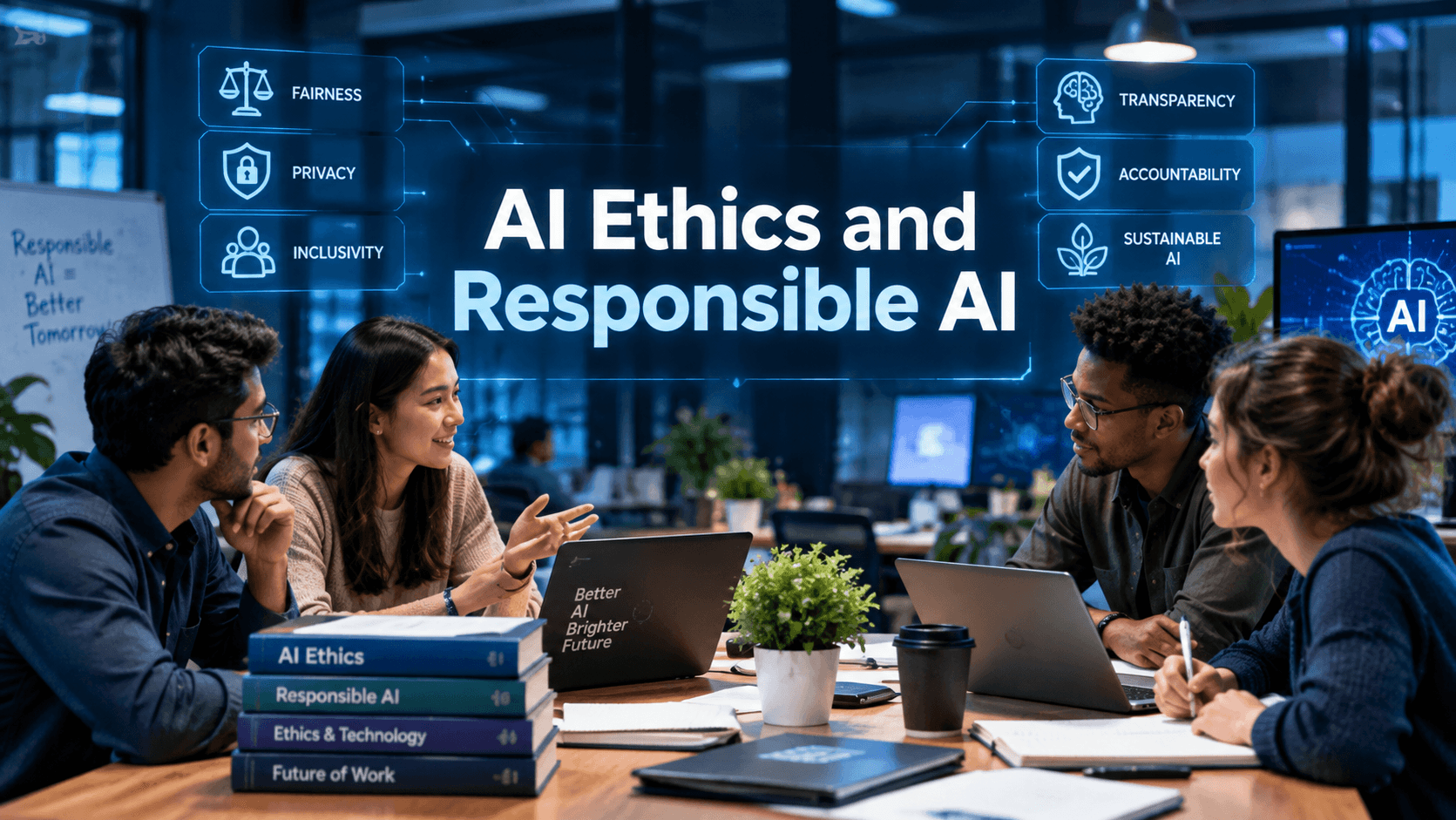
AI Ethics refers to the way AI systems are designed and trained to prevent them from causing damage. Importantly, there is no universal set of principles to adhere to. AI Ethics is to introduce and gather practices and knowledge from philosophy, law, and computer science into a number of everyday issues. For example, choosing what data should be used for training, who needs to approve the system for practical usage, and what the course of action should be in case of an accident.
Four Critical Questions for Building an AI System
- Is the system capable of ensuring justice toward the people regardless of their race, gender, age, and so on?
- Can someone actually walk through why it made a particular call?
- Does someone own it, who is willing to be held Responsible if it doesn’t go well?
- Is it secure for users while being a risk-free option nobody expects?
AI Ethics and Responsible AI vs. AI Security Compliance
The terms ‘AI Ethics’ and ‘Responsible AI’ are frequently used without differentiating between them. They are related concepts but not the same, as hiring managers have pointed out to candidates who cannot explain the differences.
| Term | What Does It Stand For | Example |
| AI Ethics | Values behind the decision | Identifying any bias in hiring software |
| Responsible AI | Putting those values into practice | Having a review board approve the algorithm |
| AI Security Compliance | Technical and legal implications | Following the guidelines of HIPAA regulation or following encryption rules |
Nearly all job advertisements require all three. The ad for a “Responsible AI Lead” will usually require a person knowledgeable in ethical frameworks, capable of producing governance documents, and able to cope with AI security compliance in one position.
Why AI Ethics Has Become a Business Priority
The concept of Ethics in AI used to remain silent and unnoticed. However, today it is a part of important discussions in the boardrooms and hearings due to several changes taking place simultaneously.
Confidence in AI Is Outpacing the Skills to Use It Well
According to research by Informatica, 47% of companies have used AI agents first. Effectively, people expressed their outlook on AI capabilities. The catch is that 65% of managers claimed that employees trusted this data, whereas 71% of them admitted that their staff didn’t have enough skills to make use of it effectively.
Regulators Are No Longer Watching From the Sidelines
The practice of government authorities regarding AI accountability has evolved. The introduction of groundbreaking regulations such as the European Union AI Act, requiring strict compliance with protocols for high-risk AI operations, and various similar jurisdictions across the US all contribute to the increasing recognition of AI accountability by companies, thus prompting the necessity of hiring personnel who can translate complicated legal jargon into operational procedures for projects in the AI space.
One Public Failure Can Undo Years of Trust
According to a survey by Morning Consult and AWS, 77% of business leaders now admit the importance of ethical usage of AI by companies. However, studies demonstrate that 56% of organizations believe AI has increased their reputational risk even although 60% keep considering it a beneficial venture. The situation demonstrates how easily trust can be lost after one but one mistake.
Real Cases That Show What Happens Without Oversight
- A recruitment app developed by a major tech firm was discarded by the company because the app ignored resumes containing the word “woman”. Based on training on a dataset from the last ten years that was fully male-oriented.
- Facial recognition tools used in law enforcement have shown noticeably higher error rates on darker-skinned faces, and that gap has already led to wrongful arrests.
- Healthcare algorithms designed to allocate care ended up shortchanging Black patients, simply because they used past spending on care as a stand-in for actual medical need.
An appropriate Ethics review was never conducted before activating operations.
The Pillars That Hold a Responsible AI Framework Together
The implementation of Responsible AI takes place in the full course of a model’s life cycle, starting from its early batch of training data until the moment of decommissioning.
| Pillar | What It Means |
| Fairness and Bias Mitigation | Checking data and outputs for discriminatory patterns |
| Transparency and Explainability | Making decisions understandable to the people affected |
| Accountability and Governance | Making sure someone owns the outcome |
| Privacy and Data Protection | Protecting personal information at every stage |
| AI Security Compliance | Meeting standards like GDPR, HIPAA, and ISO 42001 |
| Human Oversight | Keeping a person in the loop for high-stakes calls |
| Continuous Monitoring | Watching for drift and new risks after launch |
AI Security compliance belongs right inside this list, not off to the side somewhere. A model can look fair on paper and still fall apart badly if the data behind it leaks or breaks a privacy law somewhere. That’s part of why more organizations are pairing AI Ethics Training with AI Security Compliance Training these days. Each one catches a different kind of failure, and honestly, you need both to cover the full picture.
Regulations Pushing AI Ethics Into Every Hiring Plan
Regulation usually crawls along at its own pace, but AI has been the exception to that rule. A few frameworks in particular are already changing how companies staff up their compliance teams.
| Regulation | Region | What It Requires |
| EU AI Act | European Union | Risk-based rules for high-risk systems, enforced through August 2026 |
| GDPR | European Union | Data minimization and a right to explanation for automated decisions |
| NIST AI Risk Management Framework | United States | Voluntary, though widely followed, risk guidance |
| ISO/IEC 42001 | Global | A certifiable standard for managing AI systems |
Any organization with operations in Europe views the EU AI Act as a strict compliance deadline. Moreover, this pressure has already been exported to concerns about hiring strategies beyond Europe as well.
Career Paths Opening Up in Responsible AI
This entire field barely existed three years back. Now it’s one of the fastest-growing corners of tech hiring. Georgetown’s Center for Security and Emerging Technology counted more than 100,000 US AI industry job postings a year asking specifically for Ethics or governance skills, with the heaviest demand coming from finance and information sectors.
The growth numbers make the case even clearer. The need for skills in AI governance has grown by about 150% from last year, while skills in AI Ethics have grown by about 125% in the same period. Research done by IAPP suggests that almost all organizations answering the survey feel that they lack the people required to do this work. That shortage is exactly the kind of opening someone breaking into the field wants to hear about.
The Skill Combination That Gets Candidates Hired
No one is expecting anyone to be a philosopher, lawyer, and engineer at the same time. Most employers seek two skills to be combined, rather than everything at once.
- Some technical grounding, whether that’s data science, engineering, or product work
- Some regulatory grounding, whether that’s law, policy, or risk management
- Formal training in AI Ethics or governance
- Actual proof of work, like an audit someone ran, a framework they wrote, or a breakdown of a real failure
Steps for Entering the Field
- Start from the basics, including concepts related to bias and fairness, and how the whole mechanism of explainability works too.
- Be aware of the available legislation such as the EU AI Act and GDPR, but also NIST and ISO/IEC 42001.
- Get enrolled in formal AI Ethics training courses since it makes understanding the field smoother than trying to interpret various articles.
- Pair that with AI Security Compliance Training, because none of the Ethics work matters much if the underlying system isn’t secure.
- Put together a small portfolio. A bias audit, a mock governance policy, or a write-up analyzing a real failure all work well.
Choosing the Right Training Path for This Field
Reading up on the topic helps build awareness, but interviews tend to test for something deeper than that. Two training paths matter most here.
- AI Ethics Training usually walks through fairness frameworks, explainability, and governance models in a way that builds logically, one idea leading into the next.
- AI Security Compliance Training usually covers data protection law, risk assessment, and the technical safeguards regulators expect documented properly.
Put together, these two tracks line up almost exactly with what governance job postings are asking for these days. And there’s a genuine window open right now for people who get moving early. Around 84% of Ethics and compliance teams currently work without a dedicated AI budget, and only 4.5% measure AI’s impact using any defined metrics at all. That gives great potential to someone who can step in and create that missing framework.
Closing Thoughts on Building a Future in Responsible AI
AI isn’t slowing down anytime soon, nor is the amount of scrutiny surrounding it. Every automated decision, such as whether to approve a loan, a medical triage score, or a hiring recommendation, raises the same question: was it done the right way? Companies that have a positive answer to that question and stand by it already gain a level of trust that cannot be restored by any competitor’s effort.
If anyone is thinking about making this move, then now would be a good time. Regulations have progressed much faster than the talent pool. Building that expertise now, through focused AI Ethics Training and AI Security Compliance Training, positions a career firmly on the right side of a shift that shows no sign of slowing down.
FAQs on AI Ethics
AI Ethics looks at how AI systems are built so they avoid harm. It centers on fairness, transparency, and accountability.
Responsible AI reduces legal risk and protects a company’s reputation. It also builds user trust in automated decisions.
AI Ethics defines the values behind a decision. Responsible AI turns those values into daily governance practices.
It covers data protection, access controls, and standards like GDPR and HIPAA. This keeps AI systems secure across their lifecycle.
A blend of technical and regulatory knowledge works best. Bias testing, governance writing, and risk assessment stand out.
The EU AI Act, GDPR, and ISO/IEC 42001 lead the way. The NIST framework also guides many US companies.
Common titles include Ethics specialist, governance consultant, and compliance analyst. Many roles blend fairness auditing with security compliance.
Certifications like AI Ethics and AI Security Compliance offered by Unichrone carry real weight with recruiters. They validate governance knowledge alongside practical experience.
It is not mandatory, but it helps considerably. It builds structured knowledge employers actively screen for.
It covers data protection law and technical safeguards. Paired with ethics knowledge, it strengthens candidacy for governance roles.