You have probably heard DevOps and Platform Engineering tossed around like free swag at a tech conference. Are they rivals, cousins, or the same fish in a fancier bowl? Definitely, understanding DevOps vs Platform Engineering can aid you in choosing a career that matches your ambitions and technical strengths.
Let’s make it clear with an example. Imagine building a high-speed train while coordinating its tracks, signals, and operations. It’s true that modern software delivery presents a similar challenge. Here enters DevOps and platform engineering. They are the two approaches transforming how businesses build, test, deploy, and manage applications. Although both aim to deliver reliable software faster, their methods and career opportunities differ. So, ready to untangle the knot and find your own path? Grab your coffee and let’s dive in.
Jump ahead to
DevOps: The Culture that Knocked Down The Wall
Remember when developers threw code over the fence, and the operations team had to catch it? DevOps ended that blame game. Precisely. DevOps combines development and operations through collaboration, automation, and continuous improvement. That means that, rather than treating teams as separate islands, it encourages shared responsibility throughout the software development lifecycle.
Key DevOps practices include:-
- CI/CD: Automating code integration, testing, and deployment to accelerate releases.
- Infrastructure as Code: Managing infrastructure through version-controlled code.
- Monitoring and observability: Tracking performance and identifying issues before they escalate.
- Automation: Eradicating repetitive tasks across the infrastructure and software delivery.
- Collaboration: Breaking down silos and encouraging shared accountability.
Platform Engineering- Infrastructure Wearing a Product Hat
Now, here is the twist. As companies grew, DevOps hit a problem. Furthermore, Platform Engineering focuses on building internal platforms that simplify software development. It provides reusable tools, infrastructure, and self-service workflows. In addition, it allows developers to concentrate on delivering business value.
Imagine entering a fully equipped kitchen instead of sourcing every ingredient and appliance yourself. Platform Engineering creates a similar experience through an Internal Developer Platform (IDP).
Its core components include:-
- Internal Developer Platforms– Enabling developers to access infrastructure and services independently.
- Golden Paths– Offering standardized, reusable workflows for common engineering tasks.
- Developer Portals– Centralizing tools, documentation, and service catalogs.
- Automated Guardrails– Embedding security and compliance into development workflows
- Developer Experience– Reducing complexity and unnecessary cognitive load.
The Big Comparison- DevOps vs. Platform Engineering
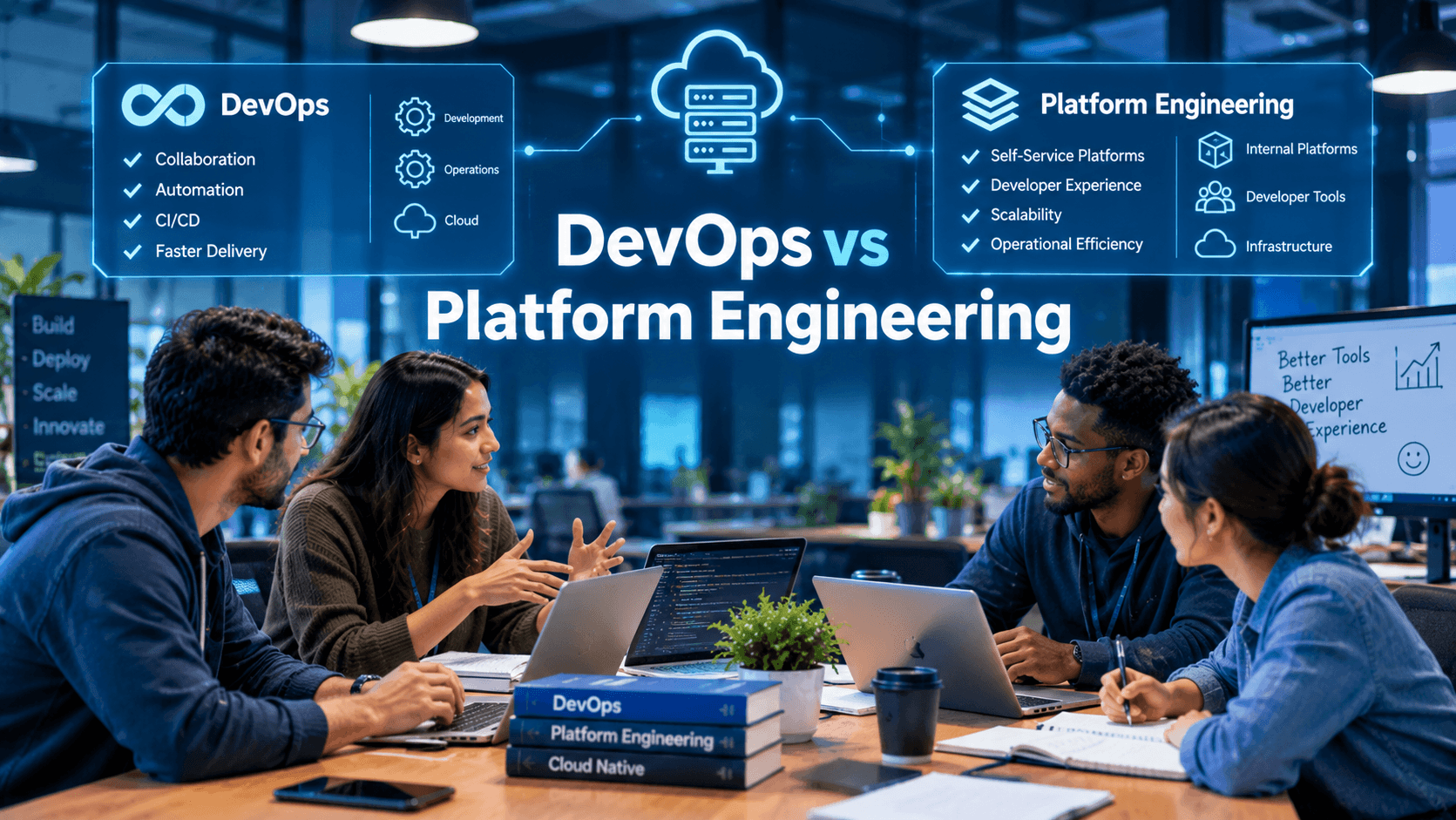
Both approaches improve software delivery. However, their priorities differ. DevOps emphasizes collaboration and delivery practices. On the other hand, platform engineering makes effective workflows reusable and scalable.
| Comparison factor | DevOps | Platform Engineering |
| Primary Focus | Collaboration and delivery | Developer experience and self-service |
| Main objective | Improve delivery speed and reliability | Reduce developer friction |
| Approach | Shared responsibility across teams | Dedicated platform team |
| Deliverables | CI/CD pipelines, automation, monitoring | IDPs, golden paths, reusable templates |
| Typical users | Development and operations teams | Product development teams |
| Success measures | Deployment frequency, recovery time | Platform adoption, developer satisfaction |
The difference between DevOps and Platform Engineering is not a competition. In fact, they complement each other. DevOps improves how teams deliver software. On the other hand, Platform Engineering aids teams in repeating successful practices consistently.
How Do Their Daily Responsibilities Differ?
Wondering what your workday might look like? Here is how responsibilities typically compare.
DevOps Engineer
DevOps Engineers streamline delivery pipelines, automate infrastructure, and maintain application reliability. Their responsibilities include:-
- Building CI/CD pipelines using Jenkins or GitHub Actions.
- Automating infrastructure provisioning with Terraform.
- Managing containers using Docker and Kubernetes.
- Monitoring systems and resolving production incidents.
- Collaborating with developers to improve deployment processes.
Platform Engineer
Platform Engineer builds and maintains internal systems that developers use to deliver software. Their responsibilities include:-
- Developing self-service portals and internal platforms.
- Creating reusable deployment templates and golden paths.
- Integrating cloud services, security controls, and monitoring tools.
- Automating infrastructure provisioning through platform services.
- Gathering developer feedback to improve platform usability.
For instance, a DevOps Engineer might automate an application’s deployment pipeline. Meanwhile, a Platform Engineer creates a reusable deployment service for multiple development teams.
Skills and Tools You Need
It is factual that both careers require technical expertise. However, their emphasis varies.
| Skills Area | DevOps | Platform Engineering |
| Programming | Python, Bash, PowerShell | Python, Go, APIs |
| Cloud | AWS, Azure, Google Cloud | AWS, Azure, Google Cloud |
| Containers | Docker, Kubernetes | Kubernetes, Platform architecture |
| Automation | CI/CD, IaC | Self-service workflows, APIs |
| Additional Strengths | Troubleshooting, collaboration | System design, product thinking |
For DevOps, you can begin with Linux, Git, scripting, cloud fundamentals, and CI/CD. On the other hand, for Platform Engineering, build those foundations and explore Kubernetes architecture, developer portals, APIs, and reusable services.
However, you do not need to master every tool before starting. Remember, Rome was not built in a day.
DevOps or Platform Engineering: Which Career is Better?
The right choice depends on what energizes you and what problems you enjoy solving.
Choose DevOps Engineering if you:-
- Enjoy automating deployments and solving infrastructure challenges
- Prefer hands-on troubleshooting and improving system reliability.
- Like collaborating across development and operations.
- Want to strengthen your cloud automation expertise.
Choose Platform Engineering if you:-
- Enjoy designing systems for multiple development teams.
- Want to simplify complex workflows through reusable services.
- Like combining infrastructure expertise with product thinking.
- Are interested in developer portals and self-service capabilities.
A useful rule of thumb:-
- DevOps may suit you if you enjoy making delivery pipelines work better.
- Platform Engineering may be your calling if you want to build systems that make those pipelines easier for many teams to use.
It’s true, neither career is universally better. Instead, your interest, experience, and, moreover, target job market should guide your decision.
Career Growth and Future Opportunities
Both these disciplines are evolving. They are advancing alongside cloud adoption, Kubernetes, automation, and AI-assisted development.
| DevOps Engineering | Platform Engineering |
| Senior DevOps Engineer | Senior Platform Engineering |
| DevOps Architect | Platform Architect |
| Site Reliability Engineer | Platform Engineering Lead |
| DevSecOps Specialist | Developer Experience Specialist |
DevOps offers opportunities in release engineering, cloud automation, reliability, and DevSecOps. Meanwhile, Platform Engineering offers pathways into platform architecture and developer experience. And internal infrastructure strategy.
Can You Move From DevOps to Platform Engineering?
Yes, of course. Definitely, experience in DevOps provides a useful foundation. This is because both careers involve automation, cloud infrastructure, containers, and CI/CD.
To make the transition:-
- Strengthen your foundations- practice cloud infrastructure, Kubernetes, and IaC
- Learn Platform Architecture- Explore APIs, service catalogs, and developer portals.
- Build a small IDP- Create a self-service application deployment workflow.
- Develop Golden Paths- Standardize common tasks with reusable templates.
- Measure Improvements- Track setup time, platform adoption and gather feedback.
Furthermore, you can also move from Platform Engineering to DevOps by developing deeper experience in deployment operations, incident response, and delivery automation.
Wrapping Up
Technology never stands still. Hence, your career should not either. DevOps or Platform Engineering, whichever holds your interest, it is the right time to build the right skills. So that your ambitions can turn into your achievements. With training in DevOps and Platform Engineering, you can definitely strengthen your technical expertise and build an exciting career advancement.
Don’t adapt to the future of engineering, but help build it. Be the engineer who sets the pace. Your next career breakthrough could begin with the skills you build today.
FAQs on DevOps vs Platform Engineering
DevOps emphasizes collaboration and software delivery automation, while platform engineering builds self-service platforms that simplify developer workflows.
No. Platform engineering complements DevOps by standardizing tools, automating workflows, and improving developer productivity.
Neither is universally better. Your choice depends on your technical interests, experience, and career goals.
Yes. DevOps experience provides a strong foundation for learning platform architecture, developer portals, and self-service automation.
DevOps engineers benefit from Linux, scripting, cloud computing, CI/CD, Infrastructure as Code, and containerization skills.
Platform engineers need cloud infrastructure knowledge, Kubernetes, programming, API integration, automation, and system design skills.
Yes. Coding skills help platform engineers build automation, integrate services, develop APIs, and create reusable workflows.
Both careers offer competitive opportunities. Salaries depend on experience, location, specialization, and employer requirements.
Yes. Beginners can start with Linux, Git, scripting, cloud fundamentals, and CI/CD before exploring advanced tools.
Gain hands-on experience, build practical projects, and explore Unichrone’s professional training courses to strengthen your technical expertise.