You just imagine managing five deadlines and juggling stakeholders all at a time. Or chasing updates while your inbox keeps growing. Sound familiar? Now, imagine having an intelligent copilot helping you with all of this. This is the promise of artificial intelligence in project management. In fact, Project management is entering an exciting era. It is where artificial intelligence meets human cleverness. Yes, AI has the power to reshape the entire domain. AI for Project Managers is changing the game by automating tasks and supporting smarter decisions.
Yet, remember every tool is only as good as the person using it. Therefore, to stay ahead of the curve, you need the right skills and suitable tools. Moreover, you need a clear understanding of responsible AI implementation.
Jump ahead to
How is AI Transforming Project Management?
Project management often feels like spinning plates. This is because one missed deadline or overlooked dependency can throw the entire plan off balance. AI for Project Managers helps you keep those plates moving. It does this by processing information, identifying patterns, and highlighting potential problems before they snowball.
Here is where AI can make a difference:
- Smarter scheduling: Analyze dependencies and resource availability to develop more realistic timelines.
- Predictive risk management: Spot warning signs of delays, budget overruns, and resource shortages.
- Automated reporting: Turn scattered updates into crisp reports and stakeholder summaries.
- Resource optimization: Identify workload imbalances and make better use of available resources.
- Meeting intelligence: Convert lengthy discussions into decisions, action items, and follow-up tasks.
- Scenario planning: Explore alternative outcomes when project requirements or budgets change.
Essential AI Skills Every Project Manager Needs
You do not need to become a data scientist overnight. However, developing the right capabilities can aid you in turning AI from a shiny new toy into a practical business advantage.
| Essential Skills | How You Can Use It |
| Prompt engineering | Create project charters, risk registers, and executive summaries. |
| Data literacy | Interpret forecasts and evaluate project performance. |
| AI ethics and governance | Protect confidential information and validate outputs. |
| Critical thinking | Challenge assumptions and identify inaccurate recommendations. |
| Stakeholder communication | Explain technical insights in business-friendly language. |
| AI adaptability | Adjust plans as requirements and project conditions evolve. |
How Can You Build These Skills?
Start small; Rome was not built in a day.
- Practice writing clear prompts with specific tasks, context, and expected outputs.
- Compare AI-generated forecasts with actual project results.
- Double-check important recommendations before acting on them.
- Learn how biased or incomplete data can affect AI outputs.
- Practice explaining AI-driven insights to technical and non-technical teams.
The more you practice, the better equipped you become to make AI work for you rather than the other way around.
Pivotal AI Tools and Their Applications
New AI tools are popping up everywhere. Hence, it is tempting to jump on every bandwagon. Then resist the urge. The best tool is not necessarily the most popular one. In fact, it is the one that solves your problem.
| Tool Category | Examples | How You Can Use Them |
| Generative AI assistants | ChatGPT, Claude | Draft project documents and summarize complex information |
| Productivity and task management | Microsoft Copilot, Asana, monday.com | Organise tasks and streamline project updates |
| Data analysis | Julius AI, Google AI Studio | Explore datasets and identify performance trends |
| Visual content creation | Gamma, Napkin AI | Build presentations and process diagrams |
| Research and document analysis | NotebookLM, Perplexity | Summarize lengthy documents and support research |
Note: Features, integration, and availability vary by product and subscription. Moreover, validate outputs and follow your organization’s data policies.
Before choosing a tool. Ask yourself:-
- Does it solve a real project challenge?
- Can it integrate with your existing workflow?
- Does it protect your confidential information?
- Can you measure the time or cost saved?
Remember, don’t put all your eggs in one basket. Definitely, choose the tools tactically. Moreover, testing them on manageable tasks and expanding their use when the results justify it is also important.
Benefits and Limitations of AI in Project Management
AI for Project Managers can aid you in working smarter but it is not a magical wand. Therefore, understanding both sides of the equation helps you in setting realistic expectations.
Where AI Shines
- Time savings– Automate repetitive administrative tasks and routine reporting.
- Early risk detection– Highlights patterns that may signal emerging problems.
- Faster communication– Converts complex information into concise summaries.
- Resource planning- Helps you evaluate workloads and allocation options.
- Knowledge discovery– Makes a larger volume of project information easier to analyse.
Where You Need to Stay Alert
- AI can generate convincing but incorrect answers
- Poor-quality data can produce misleading forecasts
- Careless use can expose sensitive business information
- Blindly following recommendations can weaken accountability
- Implementation may need additional training and maintenance
Then what is the golden rule? Trust, but you should verify. That implies you can use AI for Project Managers to accelerate your work. Yet, it is always pivotal to apply human judgment before making all the important decisions. Hence, measure all the actual improvements instead of assuming that automation automatically means success.
Understanding PMI-CPMAI Certification
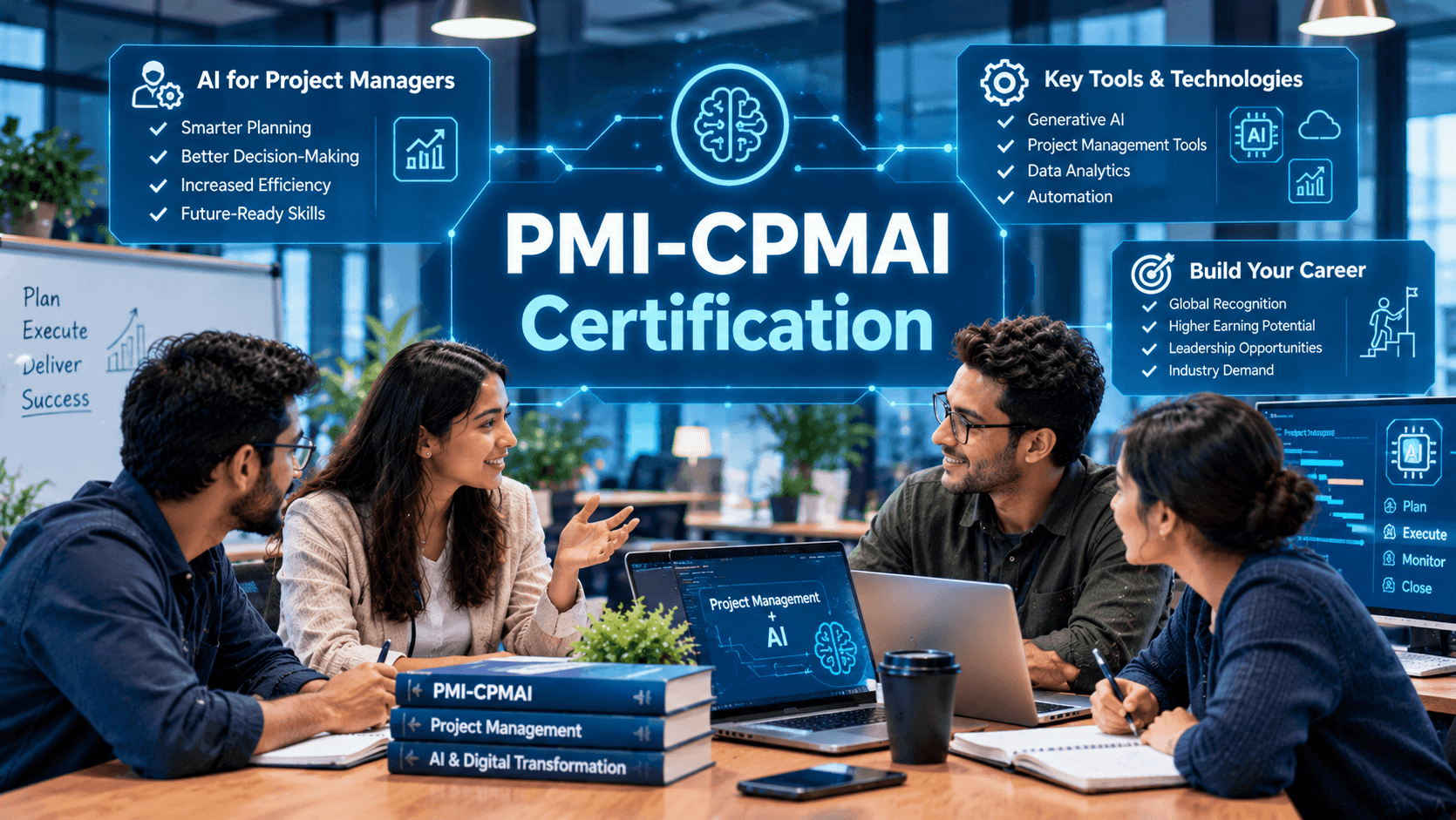
Are you ready to take your AI project management knowledge up a notch? Then, the PMI Certified Professional in Managing AI (PMI-CPMAI) certification offers a specialized pathway for professionals who want to manage AI initiatives in a systematic way.
Furthermore, it is a credential developed by the Project Management Institute (PMI). This is a credential that focuses on the Cognitive Project Management in AI (CPMAI) methodology. In addition, it addresses the distinctive challenges of AI projects. The challenges include data, experimentation, model performance, and continuous refinement.
What Does This Certification Cover?
The learning pathway focuses on several important capabilities.
- AI fundamentals– Understand artificial intelligence, machine learning, and generative AI.
- Business alignment- Connect AI initiatives with organizational goals and measurable outcomes.
- Data readiness- Evaluate data availability, quality, and suitability.
- Iterative development- Manage experimentation, feedback, and model evaluation.
- Risk and governance- Address technical, operational, ethical, and organizational concerns.
- Deployment and monitoring- Support implementation and ongoing performance evaluation.
In fact, AI initiatives rarely follow a straight line. That means it is not like traditional projects. Hence, CPMAI methodology aids you in navigating uncertainty through structured and also iterative development.
Who Should Consider PMI-CPMAI?
This certification may be useful if you are:-
- A project or programme manager leading AI initiatives.
- An IT professional exploring AI project leadership.
- A business analyst working with AI development teams.
- A consultant supporting digital transformation.
- A manager responsible for organizational AI adoption.
Moreover, PMI’s published guidance indicates that prior AI or project management experience is not mandatory. However, you should check PMI’s official website for the latest training, examination, and registration requirements before enrolling.
Career Opportunities of AI-Skilled Project Managers
Organizations are exploring digital transformation and intelligent automation. Therefore, professionals who understand both business needs and AI implementation can bring valuable skills to the table.
| Career Role | What You Could Do |
| AI Project Manager | Coordinate AI development, delivery, and project risks. |
| AI Programme Manager | Oversee multiple connected AI initiatives |
| Digital Transformation Manager | Integrate AI into business processes |
| AI Product Manager | Align AI products with customer and business needs. |
| AI Implementation Consultant | Help organizations adopt and deploy AI solutions |
| Technology Project Manager | Lead technology projects incorporating AI capabilities. |
Final Thoughts
The future of project management is not waiting around the corner. On the other hand, it is already knocking at your door. Therefore, with the right AI for project managers skills you can turn complex challenges into smarter strategies. Yes, you can lead projects with renewed confidence. In addition, PMI CPMAI Certification can aid you in taking the next step.
Don’t just keep pace with change. But be the driving force behind it. Invest your AI capabilities today and make your next career milestone your most powerful one yet.
FAQs on PMI CPMAI Certification
AI helps automate scheduling, reporting, risk identification, resource allocation, and meeting summaries.
Prompt engineering, data literacy, critical thinking, AI governance, and stakeholder communication are valuable skills.
ChatGPT, Microsoft Copilot, Asana, monday.com, Gamma, and NotebookLM support various project activities.
No. AI supports routine tasks, while human leadership, negotiation, and accountability remain essential.
It is a PMI credential focused on managing AI initiatives using the CPMAI methodology.
Project managers, business analysts, IT professionals, consultants, and managers involved in AI projects may benefit.
PMI’s published guidance indicates that prior AI or project management experience is not mandatory. Check current official requirements before enrolling.
AI can improve efficiency, accelerate reporting, support risk detection, and enhance resource planning.
AI may generate inaccurate outputs, reflect data bias, and create privacy risks if used carelessly.
Yes. AI expertise can help you pursue roles in AI project management, digital transformation, and AI implementation.