Artificial Intelligence is no longer knocking on the door of project management. On the contrary, it has already walked in. It’s true that the digital era is evolving so quickly, and we cannot rely completely on traditional methodologies. In fact, depending on old methodologies is like bringing a compass to a rocket launch. This is the reason why the conversation PMI-CPMAI VS PMP is gaining momentum.
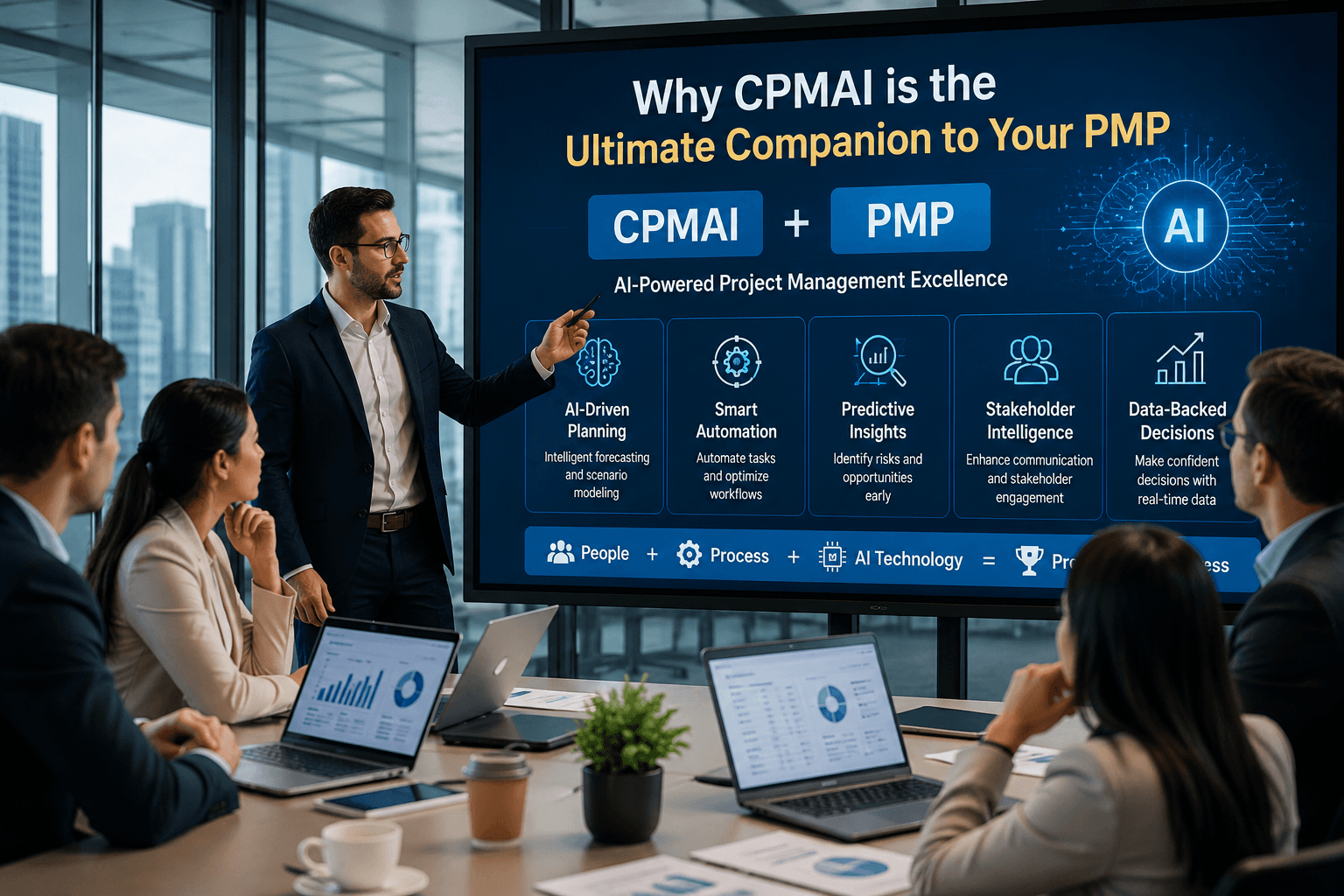
No doubt, PMP is the backbone of project leadership. But CPMAI is needed to inject the intelligence that is pivotal for AI-driven transformation. Combining PMP and CPMAI professionals can ride the wave of innovation, instead of being swept away by it.
Jump ahead to
Understanding the AI blind Spots in Traditional PMP Frameworks
It’s true that the PMP framework has been celebrated for its strong and well-rounded methodologies in managing scope, cost, quality, procurement, and stakeholder engagement. However, AI Projects are introducing some variables that traditional frameworks are not designed to manage.
AI initiatives rely heavily on:-
- Data quality
- Machine learning validation
- Ethical governance
- Iterative model refinement.
That means, unlike conventional projects in software, Artificial Intelligence systems evolve continuously on new data inputs. The frameworks that rely on today may not fully prepare you for the complexities of AI-driven initiatives. Naturally, this creates a blind spot within many standard project methodologies.
That’s where the discussion around PMI-CPMAI vs PMP is highly imperative.
Why Traditional PMP Frameworks Face Challenges in AI Projects
- AI projects depend heavily on the quality of data. Definitely, this requires stronger governance and validation practices.
- Machine learning models need continuous retraining and also fair evaluation even after the deployment.
- There are ethical concerns like bias, transparency, and trustworthiness. AI introduces entirely new categories of project risks
- AI initiatives demand iterative workflows instead of purely linear execution models
- Cross-functional collaboration between business teams, data scientists, and also IT operations becomes truly essential.
- Traditional project frameworks usually prioritize project timelines and deliverables over AI model accuracy and impact on business.
- AI systems continuously evolve with new data. This means that project management becomes an ongoing operational responsibility.
When you look at these differences, it becomes clear why many firms are looking for professionals who understand both worlds.
Why CPMAI Complements Your PMP
You can think of the Project Management Professional Certification as a sturdy engine for your project management career. Meanwhile, CPMAI is the turbocharger that prepares you for the AI revolution.
Definitely, pairing these credentials transforms you from a general project manager into a highly sought-after AI project leader. In fact, the reality is that businesses no longer need managers who simply track deadlines. On the other hand, they want leaders. As a matter of fact, they should be capable of bridging the gap between business strategy, AI innovation, and also the operational execution.
The conversation PMI CPMAI vs PMP is not about choosing one certification over the other. It is about understanding how they strengthen each other.
| PMP Focus Areas | CPMAI Focus Areas |
| Traditional project delivery methodologies | AI and Machine Learning Project Lifecycle |
| Scope, schedule, and resource management | Data preparation and model evaluation |
| Stakeholder communication | AI governance and ethical deployment |
| Predictive and Agile frameworks | Cross-functional AI collaboration |
| General business projects | Specialized AI transformation initiatives |
Specialized AI Lifecycle Mastery
Your PMP Certification teaches you how to manage projects efficiently with predictive and Agile methodologies. However, when it comes to PMI-CPMAI vs PMP, CPMAI takes a step further. Henceforth, it aids you in understanding six specialized phases in AI Projects:
- Business understanding
- Data understanding
- Data preparation
- Model development
- Model evaluation
- Operationalization
These are the phases that aid you in understanding how AI projects evolve from raw business problems into intelligent operational systems.
In fact, without lifecycle understanding, administering AI initiatives is a laborious process. It is like trying to solve a puzzle with missing pieces.
Focus on Business Value Over Technology
One of the biggest reasons why AI projects fail is that organizations become obsessed with technology. In point of fact, they forget the actual business goal.
This implies that CPMAI teaches you to focus on outcomes and not just algorithms.
With CPMAI, you learn to:
- Connect AI outcomes directly to business KPIs
- Measure ROI and long-term business value
- Align technical model performance with organizational objectives
- Ensure AI initiatives solve real customer and operational problems
Positively, this business-first mindset is one of the strongest differentiators in the PMI-CPMAI VS PMP discussion.
Mapping CPMAI Methodology to PMP Process Groups
| PMP Process Groups | CPMAI Methodology Phases |
| Initiating | Business understanding |
| Planning | Data understanding and preparation |
| Executing | Model development |
| Monitoring and Controlling | Model Evaluation |
| Closing | Operationalization |
If you are already PMP-certified, you will quickly notice how CPMAI fits smoothly into the project management structures you already know.
Hence, it’s sure that instead of replacing your PMP knowledge, CPMAI expands it.
AI Governance, Ethics and Risk Management
It is visible that project managers are expected to do more than manage schedules and budgets. Certainly, organizations expect you to lead responsible AI innovation.
That means understanding AI ethics, governance, compliance, and trustworthiness.
CPMAI helps you to manage modern AI risks such as:-
- Data privacy and security concerns
- Bias in machine learning models
- Ethical AI deployment practices
- Regulatory compliance requirements
- Data representativeness and fairness
- Explainable and trustworthy AI systems
As the proverb goes, “Prevention is better than cure”. In AI projects, small governance mistakes can create massive reputational and financial consequences.
This is the reason PMI-CPMAI vs. PMP has become an important conversation in contemporary project management.
Cross-Functional Team Allignment
AI projects bring people from completely different professional worlds.
You may find yourself coordinating with:
- Business executives focused on ROI
- Data scientists focused on model accuracy
- IT teams focused on deployment and scalability
- Compliance teams focused on governance and regulation
Definitely, CPMAI gives you the vocabulary, frameworks, and collaboration techniques that you need to deal with diverse teams.
It aids you in becoming a bridge between technical innovation and business execution.
The No-Coding Relief for Non-Technical Project Managers
Here is the good news. You do not need to be a programmer or data scientist to earn a CPMAI credential. We are seeing that many professionals hesitate because they assume AI certifications require advanced coding skills. Thankfully, CPMAI is specifically designed for AI project managers and business leaders.
The certification path focuses on:-
- AI projects, workflows, and governance
- Strategic implementation methodologies
- Business value realization
- AI lifecycle management
- Ethical and operational oversight
Therefore, if you are a non-technical professional, you can confidently step into AI project management with this credential.
Double DIP Benefit- Earning PDUs to Renew Your PMP
Doubtless, sometimes maintaining certifications feels exhausting. Fortunately, CPMAI offers some practical advantages that many professionals appreciate.
The CPMAI credential requires you to have 30 PDUs over a three-year cycle. Here, the best part is that many of the educational activities you complete for your PMP renewal can also count toward your CPMAI maintenance.
This gives you several benefits:-
- One can save time on certification renewal activities
- You reduce duplication in continuing education efforts
- A professional can stay updated on emerging AI trends continuously
- You maintain both credentials efficiently
For busy professionals, this double-dip advantage makes the PMI-CPMAI vs PMP pairing even more attractive.
Career ROI: Salary Boost and the AI Project Manager Market
Let us face it, career growth is pivotal.
Businesses across industries are aggressively investing in AI transformation. As a result, organizations are actively searching for professionals who can manage both traditional projects and intelligent automation initiatives.
Professionals with PMP and CPMAI often gain:
- Strong career differentiation
- High salary potential
- Better leadership opportunities
- Increased demand across industries
- Enhanced credibility in digital transformation programs
If you want to secure your career, combining these certifications could be one of the smartest moves you can make.
How Can You Add CPMAI to Your Toolkit
Do you hold a PMP Certification? Then adding CPMAI is the natural next step. This is because automation and machine learning have become standard business practices.
Getting started is straightforward:
- Complete the required preparation course bundle
- Learn AI lifecycle methodologies and governance concepts
- Schedule and pass the certification exam
- Maintain 30 PDUs every three years for renewal
In short, you do not need a technical background to begin. What you really need is a willingness to adapt while learning and leading.
Summary Table
| Aspect | PMP | CPMAI | Combined Benefit |
| Core Focus | Traditional project management | AI project lifecycle management | End-to-end intelligent project leadership |
| Key Strength | Scope, schedule, cost, and stakeholder management | Data, AI models, governance, and ethics | Balanced technical and strategic expertise |
| Methodology | Predictive and Agile frameworks | AI-specific six-phase methodology | Seamless AI project execution |
| Risk Management | Standard project risks | AI bias, privacy, and ethical AI risks | Stronger governance and compliance |
| Technical Requirement | No coding required | No coding required | Accessible for non-technical PMs |
| Career Impact | Global PM credibility | AI specialization | High demand and future-ready leadership |
To Wrap Up
The future of project management does not belong to professionals who can manage simply schedules and spreadsheets. They should think beyond all. The growing importance of PMI-CPMAI vs PMP proves that modern organizations need leaders who can understand both project execution and AI innovation. PMP gives the compass to navigate the projects successfully. Meanwhile, CPMAI equips you with a radar to foresee disruptions before they arrive. Together, these certifications create a zestful leadership formula. Definitely, this aids you in staying relevant in a world where technology is evolving faster than ever before.
FAQs on CPMAI VS PMP
No, the exam is designed for project managers and focuses more on AI project workflows than technical coding skills.
Yes, many PDUs earned for CPMAI can also count toward your PMP renewal requirements.
CPMAI focuses specifically on AI project lifecycles, including data, model evaluation, and AI governance.
No, coding knowledge is not required. The certification is built for project managers and business professionals.
The exam covers AI lifecycle phases, governance, ethics, risk management, and business value alignment.
AI Project Managers often earn higher salaries due to the growing demand for AI leadership expertise.
Yes, it helps PMP-certified professionals specialize in AI-driven transformation projects.
Most professionals complete their preparation within a few weeks to a few months.
Healthcare, finance, retail, manufacturing, and IT industries are rapidly adopting AI project leadership roles.
AI governance helps organizations ensure ethical, transparent, and trustworthy
AI implementation.