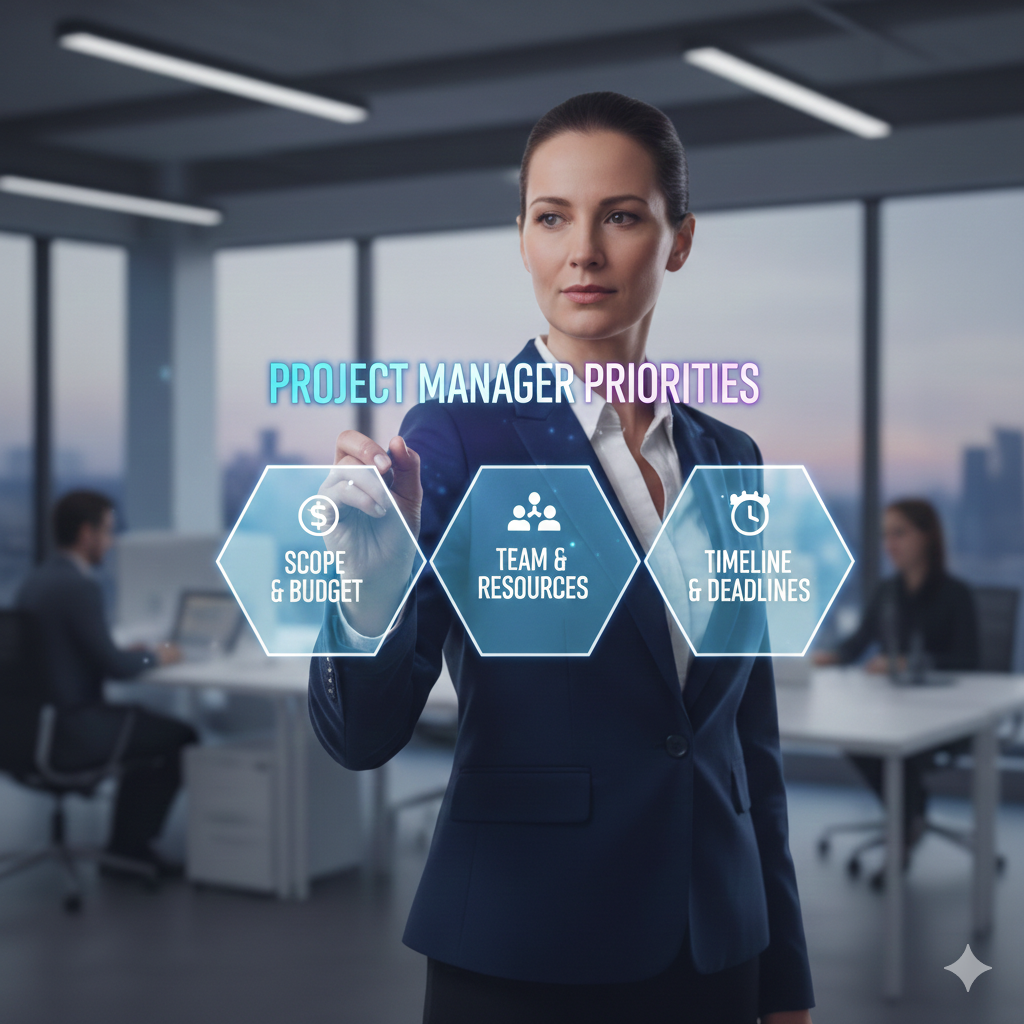
The role of a project manager is multifaceted, requiring both hard and soft skills. In today’s rapidly changing landscape, organizations are defined by how well they adapt to evolving business environments. This article explores the key project manager priorities in 2026 and how they align with modern project expectations. Focusing on these critical areas helps project managers stay ahead and deliver consistently high performance. Let’s dive in:
Jump ahead to
Project Manager Priorities
Deliver Value and Impact
Focus more on outcomes than outputs
A project manager should move beyond the “on-time, on-budget” mentality. They should focus more on the outcomes that their product or service provides. One should not consider the completion of a project a success but should also keep a check on its outcome. If there was only a positive outcome to the project, then it would be considered successful. To ensure a better and more positive outcome, measuring progress throughout the project cycle is necessary.
Strategic alignment
While managing a project, one should be more focused on the needs and preferences of the stakeholders. In addition, he/she should be able to ensure that the project addresses their pain points. Professionals need to understand what the stakeholders expect and what their set objectives for the project are. They can further convert those objectives into actionable project plans. Active communication about the impact of the project on the goals of the organizations proves to be motivational and encouraging for the team members also.
Decisions based on data analysis
Relying solely on intuition or gut feelings could prove hazardous for the project. These gut feelings or intuitions are not always true, and they do not always tell us what challenges we can face in the future. This necessitates that the decisions of a project manager should be based on data analysis. Leveraging data analytics tools proves to be highly beneficial. These tools track trajectory performance, potential risk identification, and informal decision-making for outcome optimization.
Agility and Adaptability
Agile methodologies
Traditional project management approaches struggle to keep track of the project implications of today’s market, which tends to change at a rapid pace. These traditional approaches were introduced when the technology was not well developed. To keep up with today’s changing market, project managers should focus more on agile and hybrid approaches to project management, i.e., agile project management. These approaches were made in compliance with today’s ever-changing market and improved technology. These approaches allow iterative development, feedback (internal and external), and quick answers to requirements.
Continuous improvement
One should not be afraid to try and experiment with new methods or technologies. Professionals can continuously experiment with new technologies and approaches to carry out what proves to be the best. As a manager, one should encourage a culture of continuous improvement. Adapting to emerging trends and changing market trends and demands is the key to continuous improvement. Always keep a check on the changing and improving market conditions and trends.
Resilient team building
A project manager should foster a culture where the members feel safe to be vocal about their thoughts and opinions. They should feel comfortable sharing their ideas and voicing their concerns. When team members feel comfortable in a workplace, they adapt to new things and face and overcome unexpected challenges. To equip a team with the required skills, project managers must invest in their agile for teams training and skill & leadership development. With this, they get the mindset to navigate changes effectively.
Emerging Technologies
Knowledge of AI and automation
Artificial intelligence is not just science fiction anymore; it has the potential to do things way beyond just that. AI is truly helpful in getting things done in the project management world. We can get a lot of our tasks done with accuracy with the help of AI-powered tools for project management. AI tools propel tasks like risk assessment, project planning, and resource allocation. By leveraging AI tools and GenAI for project management tasks, one can gain insights from data and automate repetitive tasks. The best use of AI is its optimized decision-making process.
Data security and privacy measures
In this new era of technology, data has become more central to project management with the adoption of the cloud. The first and foremost priority is data security and privacy. Implement strong security protocols, follow important rules, and teach team members about responsible data handling. When the team is not aware of the security protocols, we cannot expect them to follow them. It is the duty of the project manager to make everyone aware of the security, Data Privacy Awareness and privacy protocols and adhere to them.
Technology leverage
In this modern world, almost everything is done with the involvement of technology. How can we forget its contribution to project management? Project managers can leverage technology to implement their effective managerial skills and ensure the successful outcome of a project. Use of project management software like Smartsheet, teamwork tools, and communication platforms makes information sharing easier. This helps people work from different locations and allows for instant updates, discussions, and feedback.
Conclusion
While core principles continue to be firm, modern project managers in 2026 must highly value outcomes, strategic alignment, and data-informed planning. Agility, change in improvement, and adaptable team building are vital for every employee in transition. Keeping up with the latest technology, such as artificial intelligence and robust data protection, is crucial in this situation. Professionals can also opt for PMP Certification Training to get their priorities straight. With this training program, project managers would be able to guarantee that projects would not only succeed on schedule and within budget constraints but also have a remarkable influence on customers as a final result.
Summary
Project managers need to focus on achieving quantifiable results and aligning projects with corporate goals. Prioritizing effective communication and teamwork ensures that teams remain motivated and well-coordinated. Data-driven insights make informed decision-making easier and help improve project efficiency. Implementing agile practices allows managers to respond swiftly to changes and uncertainties. Leveraging emerging tools and technology enhances planning, execution, and resource management. Continuous learning and skill development strengthen leadership capabilities. To succeed and stay competitive in 2026, managers should enroll in professional project management certifications.
FAQs on Project Manager Priorities
1. What is the priority in project management?
Priority is the order of importance assigned to tasks, ensuring critical work is completed first. It helps in meeting deadlines efficiently.
2. What are the 5 C’s of project management?
The 5 C’s are Communication, Collaboration, Commitment, Creativity, and Critical Thinking, guiding managers to achieve project goals effectively.
3. What are some good goals for project managers?
Good goals include completing projects on time, optimizing resources, improving team performance, and satisfying stakeholders.
4. How does agile methodology help prioritize tasks?
Agile allows teams to adapt quickly, focus on high-impact tasks, and adjust priorities as project needs evolve.
5. What is the role of data in managing priorities?
Data-driven insights help managers make informed decisions, allocate resources wisely, and improve project outcomes.
6. How can technology improve project management priorities?
Tools like project management software and collaborative platforms streamline task tracking, communication, and reporting.
7. How important is stakeholder alignment in prioritization?
Aligning priorities with stakeholder expectations ensures projects deliver real value and meet organizational objectives.
8. How do project managers handle changing priorities?
Managers reassess tasks regularly, adjusting focus based on new risks, opportunities, or shifting business goals.
9. What soft skills help manage priorities effectively?
Time management, communication, problem-solving, and leadership help managers handle priorities efficiently.
10. How do project manager priorities differ from project goals?
Goals define what the project aims to achieve, while priorities determine the order and focus of tasks to reach those goals.
11. What are the key project manager priorities in 2026?
In 2026, priorities include strategic alignment, leveraging AI and digital tools, enhancing collaboration, and continuous skill development.
12. Why are certifications important for project managers?
Certifications improve knowledge, credibility, and practical skills, helping managers execute priorities effectively and stay competitive.