The Agile certification space looks overwhelming at first glance. Multiple frameworks, dozens of certifications, and conflicting advice make it easy to feel lost before you even start. Without a clear starting point, even the most motivated professionals end up endlessly researching instead of actually finding correct agile and scrum certification learning path.
According to the Project Management Institute’s Pulse of the Profession report, organizations using Agile practices are significantly more likely to meet their original goals and finish on schedule. On top of that, demand for Agile-skilled professionals has surged globally, with Scrum-related job postings growing by over 30% in recent years. The opportunity is genuine. The need is clear.
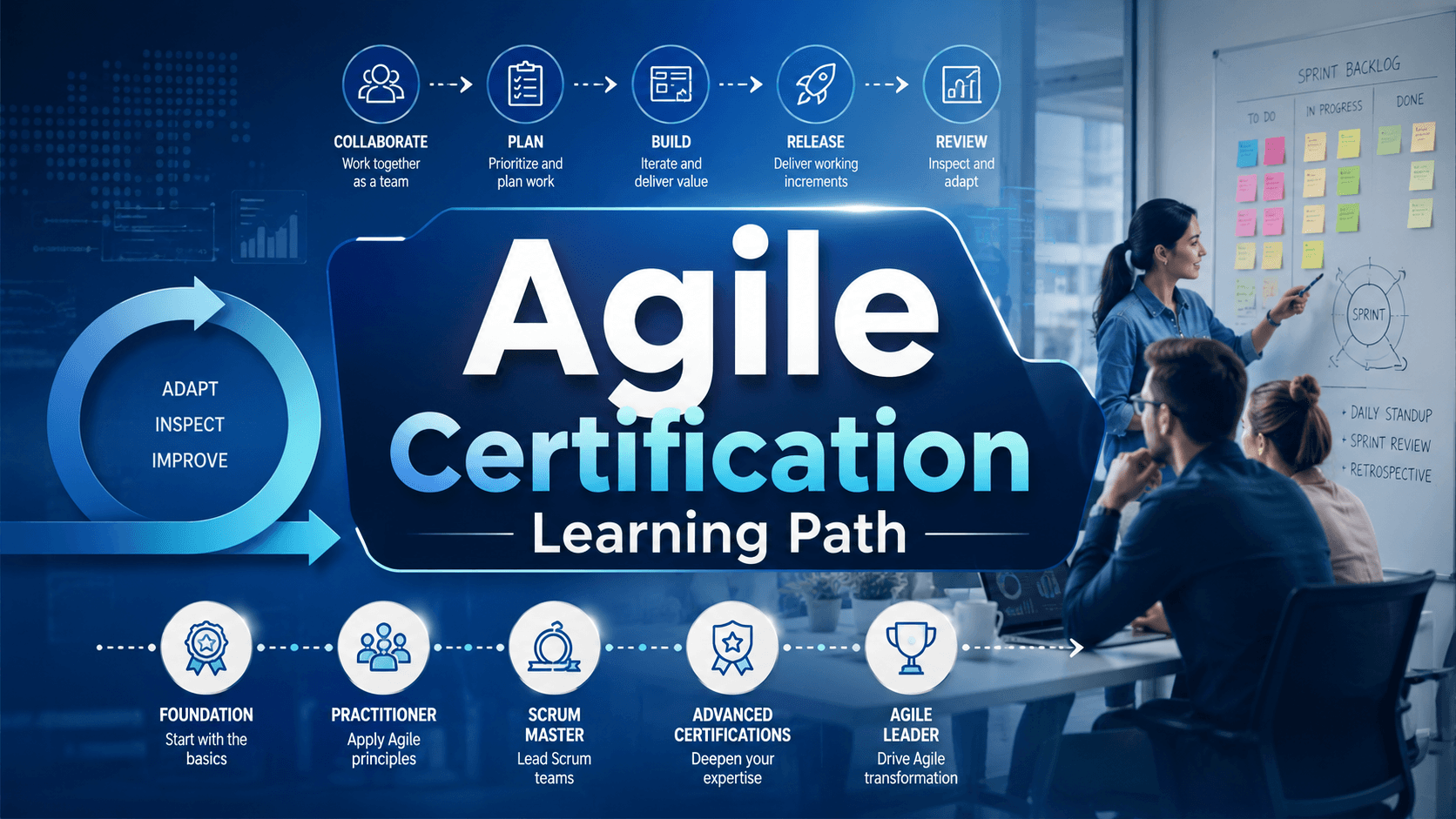
What most people are missing, however, is a structured Agile certification learning path, one that tells them exactly what to learn, in what order, and why each step matters. This blog covers four carefully sequenced certifications, each a focused training program. So let us map it all out, step by step.
Jump ahead to
Why Does a Structured Agile Certification Learning Path Change Everything?
Many professionals approach Agile without any real structure. They watch a video here, read a blog post there, and assume it will all come together eventually. Sometimes it does. More often, though, the gaps in foundational knowledge surface at the worst possible moments, mid-sprint, during a stakeholder review, or right when a team hits its first major conflict.
A well-designed Agile certification learning path solves this with one powerful advantage: sequence. Each course builds naturally on what came before it. Concepts introduced early become the vocabulary for everything that follows. Consequently, this progressive structure prevents confusion, builds real confidence, and prepares learners for actual Agile environments rather than just textbook scenarios.
Think of it like learning a new language. You would not start with complex grammar rules before mastering basic vocabulary. Similarly, jumping straight into sprint planning without first understanding why Agile exists sets learners up for frustration rather than real progress.
The Practical Benefits of Following a Structured Learning Path
Beyond clarity, a structured learning path also delivers some genuinely practical advantages. Consider what it does for a learner:
- It reduces the risk of learning things out of context, which often leads to misapplication on the job.
- It gives learners a natural sense of progression, which keeps motivation high throughout the journey.
- It builds a well-rounded Agile skill set rather than isolated pockets of knowledge.
- It makes transitioning into Agile roles far smoother because the learning mirrors how real Agile teams actually operate.
With that foundation in mind, the four certifications below follow a natural and logical progression from broad awareness all the way to hands-on project leadership.
The Four Certifications on This Agile Learning Path: A Quick Overview
Before diving into each course in detail, here is a quick overview of the full learning path and where each certification fits within it.
| Certification | Level | Best Suited For |
| Agile Overview Certification Training | Foundational | Beginners with no prior Agile exposure |
| Agile and Scrum Awareness Certification Training | Introductory | Professionals wanting structured Scrum clarity |
| Agile User Stories Certification Training | Intermediate | Teams focused on requirements and product development |
| Managing Agile Projects with Scrum Certification Training | Advanced | Project managers and practicing Scrum teams |
Step 1: Agile Overview Certification Training – Build the Right Foundation First
Every strong Agile journey starts at the same place: a solid understanding of what Agile actually is, where it came from, and why it works the way it does. The Agile Overview Certification is a focused one-day course designed for those who are entirely new to Agile, whether professionally or conceptually. It cuts through the noise and gets straight to the core ideas without assuming any prior knowledge.
What Does the Agile Manifesto Really Teach Professionals?
The training opens with the Agile Manifesto, its four core values, and its twelve guiding principles. These are not abstract philosophies. Rather, they are the practical reasoning behind every decision an Agile team makes on any given day. Consider the principle of frequent delivery: delivering working software frequently, within a cycle of a few weeks to a few months, is far more valuable than a single massive release after months of silence.
That one idea alone reshapes how teams plan their work, communicate progress, and decide what to prioritize next. Understanding it is not optional for anyone working in Agile environments. It is, in fact, the very foundation upon which everything else is built.
Core Agile Concepts: This Course Introduces
Beyond the manifesto, the course walks learners through some of the most important Agile concepts they will encounter throughout their careers:
- Iterative development: Why small, repeated cycles consistently outperform long sequential ones.
- Incremental delivery: How it keeps teams aligned with real, evolving user needs.
- Adaptive planning: How Agile teams respond to change rather than resist it.
- Customer collaboration: Why it sits at the heart of every Agile framework.
- Frameworks overview: Insights into Scrum, Kanban, SAFe, and Extreme Programming, and when each applies best.
Who Should Take This Course First?
| Professional Background | Recommendation |
| Students or recent graduates | Start here to build a strong conceptual base |
| Professionals switching to IT or product roles | Start here to bridge the knowledge gap quickly |
| Business analysts exploring Agile ways of working | Start here, as it aligns naturally with BA workflows |
| Team leaders evaluating Agile adoption | Start here to build confidence for organizational decisions |
| HR, marketing, or operations professionals | Start here for essential cross-functional context |
| Experienced Scrum Masters or practitioners | Consider starting at a higher level in the path |
Why Skipping This Step Costs More Than It Saves?
Skipping foundational learning is one of the most common and costly mistakes. Those who jump ahead often struggle to understand why Scrum ceremonies function the way they do. Without that reasoning, the rules begin to feel arbitrary and easy to dismiss. Starting with the Agile Overview eliminates that gay.
Step 2: Agile and Scrum Awareness Certification Training – From Agile Mindset to a Working Framework
Once the Agile mindset is firmly in place, the next logical step is Scrum, the most widely adopted Agile framework in the world. Agile and Scrum Awareness Certification is a course that builds directly on the Agile Overview. Consequently, it bridges the gap between Agile philosophy and Scrum’s concrete operational structure in a way that is immediately practical.
Why Scrum Is the Natural Next Step on Any Agile Certification Learning Path
According to the State of Agile Report, Scrum is used by over 66% of Agile teams globally. Its structure, defined roles, recurring events, and clear artifacts give teams a repeatable system for delivering value. If Agile is the philosophy, Scrum is the operating system running on top of it.
Breaking Down the Core Scrum Framework
| Scrum Topic | What Learners Gain From the Course |
| Scrum Roles | A clear understanding of Product Owner, Scrum Master, and Developer responsibilities |
| Scrum Events | The purpose and execution of Sprint Planning, Daily Scrum, Review, and Retrospective |
| Scrum Artifacts | How the Product Backlog, Sprint Backlog, and Increment work together |
| Definition of Done | How teams build shared alignment on what completion actually means |
| Agile vs. Scrum | Why Agile is the broader mindset, and Scrum is one specific framework within it |
| Empiricism | How transparency, inspection, and adaptation drive continuous team improvement |
The Scrum Master Misconception This Course Addresses Directly
One of the most valuable things this course does is address a widespread misconception directly. Many people assume the Scrum Master is essentially a project manager with a different title. In reality, the Scrum Master is a servant-leader. Their core responsibilities include removing impediments that slow the team down and facilitating Scrum events, so they stay productive.
Step 3: Agile User Stories Certification Training – Turning Requirements Into Real Outcomes
This is where the learning becomes remarkably hands-on. Agile User Stories Certification focuses on one of the most critical tools in Agile product development: the user story. For teams dealing with scope creep or misaligned expectations, this course addresses the root cause directly.
What a User Story Is and Why It Matters So Much
A user story is a description of a feature told from the perspective of the person who wants it. The classic format reads: As a [user], I want [goal], so that [reason]. Poorly written stories are a leading cause of sprint failure, because teams end up building exactly what was described rather than what was actually needed.
The INVEST Framework: The Quality Standard Every User Story Needs to Meet
One of the key frameworks introduced is INVEST, a quality checklist for every well-formed user story.
| Letter | Meaning | Why It Matters In Practice |
| I | Independent | Stories that depend on each other create scheduling bottlenecks |
| N | Negotiable | Details evolve through collaboration, not fixed in stone |
| V | Valuable | If a story does not deliver clear value, it should not enter the backlog |
| E | Estimable | A story the team cannot estimate is usually not yet understood well enough |
| S | Small | Large stories cause sprint overflow and incomplete increments |
| T | Testable | Without a clear test condition, there is no shared definition of done |
Additional Practical Skills This Course Builds
- Writing meaningful acceptance criteria to eliminate ambiguity.
- Story mapping techniques to visualize the end-to-end product journey.
- Backlog refinement practices to keep the roadmap actionable.
- Splitting large “epics” into smaller, sprint-ready pieces.
Step 4: Managing Agile Projects With Scrum Certification Training – Step Into Agile Leadership
This is the capstone of the Agile certification learning path. It is where the shift from Agile practitioner to Agile leader truly begins. Managing Agile Projects with Scrum Certification targets professionals ready to guide Agile teams rather than simply participate in them.
What Sets Agile Project Management Apart?
Managing an Agile Project is not simply traditional project management with shorter deadlines. It is a fundamentally different way of thinking. Success depends on three empirical pillars: transparency, inspection, and adaptation.
Traditional Project Management vs. Agile With Scrum: A Side-by-Side Comparison
| Aspect | Traditional Waterfall | Agile With Scrum |
| Planning approach | Fixed and detailed plan defined upfront | Iterative planning is refined sprint by sprint |
| Scope Management | Change is formally resisted and controlled | Change is welcomed as new understanding emerges |
| Team structure | Hierarchical with assigned roles and tasks | Cross-functional and self-organizing teams |
| Delivery Cadence | Single large release at project end | Frequent and incremental releases throughout delivery |
| Customer Involvement | Primarily at the start and the very end | Continuous and active throughout the entire delivery |
| Success Measurement | On-time, on-budget, on-scope delivery | Value delivered to real users and business outcomes |
Core Topics This Course Covers
- Sprint planning techniques that align capacity with sprint goals.
- Velocity tracking to make reliable release forecasts.
- Risk Identification within fast-moving delivery cycles.
- Coaching teams through conflict and the stages of team development (Forming, Storming, Norming, Performing).
Summary: The Full Agile Certification Learning Path: All Four Steps in One View
For anyone mapping out their own learning journey, here is the complete recommended sequence summarized for you:
| Order | Course | Core Focus | Target Learner |
| 1st | Agile Overview Certification Training | Mindset, values, and principles | Complete beginners |
| 2nd | Agile and Scrum Awareness Training | Scrum roles, events, and artifacts | Early-stage Agile learners |
| 3rd | Agile User Stories Certification Training | Requirements and backlog refinement | Product Owners, BAs, Devs |
| 4th | Managing Agile Projects With Scrum | Leadership, velocity, and releases | PMs, Scrum Masters, Leads |
Conclusion
The path from Agile newcomer to confident practitioner does not have to feel unclear. With the right sequence of certifications, learners build their knowledge systematically. The Agile Overview builds the Why, whereas the Scrum Awareness course establishes the How. Further, the User Stories Certification sharpens the What, and finally, the Managing Agile Projects Course develops the Who. Together, these four courses form a complete and cohesive Agile certification learning path that takes you from foundational awareness to project-level leadership.
FAQs
Agile is a broad philosophy based on values for flexible project delivery. Scrum is a framework implementing Agile via roles, events, and artifacts.
It lets teams work in short cycles with frequent stakeholder feedback. This cuts risk by spotting issues early, not at project end.
They are transparency, inspection, and adaptation for continuous improvement. These help teams observe and adjust processes for better quality.
A Scrum Master is a servant-leader removing blockers and facilitating meetings. They guide Scrum adherence without traditional management.
The Product Backlog is an ordered list of product needs as the work source. It’s a living document evolving with team insights.
It doesn’t depend on other stories for team work. This enables flexible planning and value delivery in any order.
It defines shared quality standards for completed work. This checklist avoids confusion on task completion and testing.
Teams review the sprint: what worked, what didn’t, and improvements. They select actions for a better next sprint.
It welcomes changes, even late, to meet user needs. Backlog refinement incorporates new priorities dynamically.
Velocity measures work completed per sprint, like story points. It aids forecasting for realistic future planning.