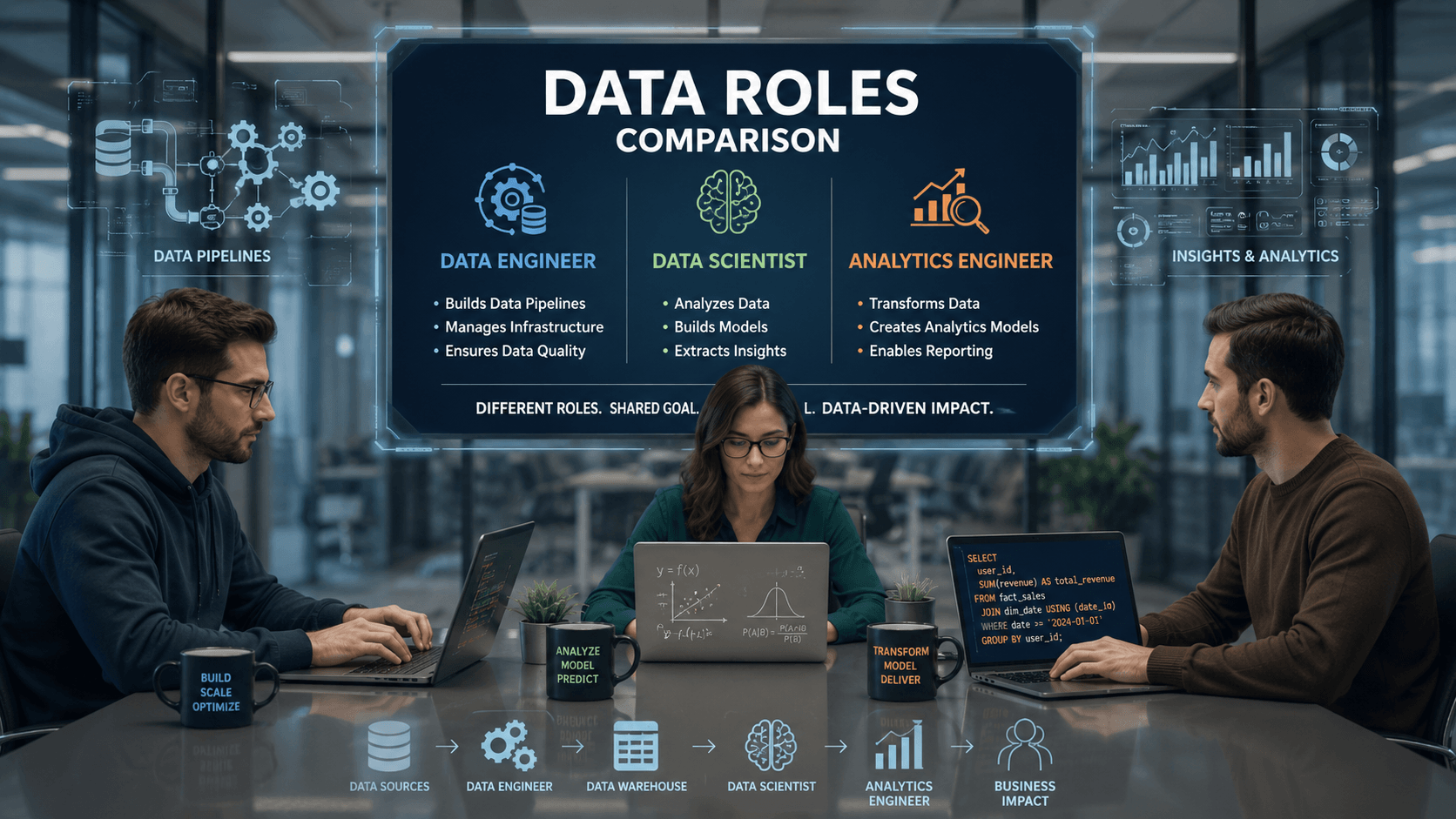
No doubt, the data revolution has created exciting career opportunities. At the same time, it has also sparked a big question: “Data Engineer vs Data Scientist vs Analytics Engineer”- Which role is best for me? It’s true that all these professionals work with data. Yet their roles and responsibilities are worlds apart. You can think of it like building a house. One lays the foundation. Another design for intelligent solutions. And the third affirms that everything is functional and ready to use.
Yes, understanding these roles will be a game-changer for you. This is because organizations are embracing the modern data stack more. After all, the right tool for the right job is more than just an old saying. It’s the secret to building a successful career path and data-centric businesses.
So let’s explore each role in more detail with this guide.
Jump ahead to
Quick Comparison Table
| Aspect | Data Engineer | Data Scientist | Analytics Engineer |
| Primary Focus | Building and maintaining data infrastructure | Extracting insights, building predictive models | Transforming raw data into clean and analysis-ready data sets |
| Core Output | Pipelines, data warehouses, clean data at scale | ML models, forecasts, statistical insights | Modeled, documented data sets, semantic layer |
| Works Closest With Him | Software/DevOps Engineers, Analytics Engineers | Business teams, Product/ML Engineers | Data Analysts, BI teams, Data Engineers |
| Best For | People who like systems architecture, scale | People who like statistics, experimentation, storytelling | People who like SQL, modeling, and business logic |
| Emerging Since | Long-established role | Long-established role | 2019-2020(popularized by dbt) |
Who is a Data Engineer?
A data engineer is the one who builds the groundwork upon which modern data teams operate. They are, in fact, the architects of the data ecosystem. Therefore, without them, analysts and scientists would struggle to access reliable information.
Their primary responsibility is collecting, processing, storing, and organizing massive amounts of structured and unstructured data. Furthermore, they design scalable pipelines that ensure that data flows seamlessly from multiple sources into centralized repositories.
Core Responsibilities
- Design scalable ETL and ELT pipelines
- Develop robust data warehouses and data lakes
- Ensure data quality and reliability
- Optimize database performance
- Automate data workflows
- Monitor pipeline failures
- Implement data security standards
- Collaborate with analytics and engineering teams
Day-to-Day Activities
A typical day may include primarily writing SQL queries and building data pipelines. In addition, you, as a data engineer, have to troubleshoot workflow failures and configure cloud infrastructures. They are responsible for optimizing the processing speed as well.
Who is a Data Scientist?
If a data engineer builds the highways, then the data scientists are the explorers who discover the valuable and prominent destinations. Their mission is to transform raw data into actionable business intelligence. This is done using statistics, programming, and also machine learning. In addition, they aid businesses in predicting customer behaviour and optimizing operations while uncovering hidden opportunities.
Core Responsibilities
- Analyze structured and unstructured datasets
- Build predictive machine learning models
- Perform statistical analysis
- Create recommendation systems
- Develop forecasting models
- Validate algorithms
- Present insights to stakeholders
- Support strategic business decisions
Day-to-day Activities
You may spend time cleaning datasets and experimenting with algorithms. Also. You are in charge of training machine learning models and evaluating accuracy. Presenting findings through compelling visualizations is also a part of a Data Scientist’s daily ventures.
What is an Analytics Engineer?
The Analytics Engineer is one of the fastest-growing jobs in the modern data stack. They are positioned between data engineers and business analysts. Majorly, analytics engineers transform raw datasets into trusted business models that everyone can understand.
The role has gained popularity with tools like dbt. This, in fact, enables firms to administer data transformation using software engineering principles.
Core Responsibilities
- Transforms raw data into analytics-ready datasets
- Develops reusable data models
- Maintain data documentation
- Build testing frameworks for data quality
- Create semantic business layers
- Collaborate closely with analysts
- Improving reporting consistency
- Standardize business metrics
Day-to-Day Activities
An analytics engineer primarily writes SQL, develops dbt models, validates data quality, and collaborates with stakeholders. In addition, they also ensure that dashboards use reliable business definitions.
Tools and Tech-Stack Comparison
One of the easiest ways to understand Data Engineer vs Data Scientist vs Analytics Engineer is by exploring their technology stacks.
| Category | Data Engineer | Data Scientist | Analytics Engineer |
| Languages | Python, Scala, SQL, Java | Python, R, SQL | SQL, Python(light) |
| Pipeline/ ETL | Airflow, dbt, Kafka, Spark, Fivetran | – | dbt(core tool) |
| Storage/Warehouse | Snowflake, BigQuery, Redshift, S3 | – | Snowflake, BigQuery, Redshift |
| ML/Stats | – | scikit-learn, TensorFlow, PyTorch, pandas | – |
| BI/Visualization | – | Jupyter, Tableau (light) | Looker, Tableau, Power BI |
| Cloud Platforms | AWS, Azure, GCP(heavy use) | AWS/GCP (moderate) | Cloud warehouse-focused |
| Version Control | Git, CI/CD | Git | Git(dbt is git-native) |
Skills Required for Each Role
Every data role requires technical expertise and workplace competencies. Definitely, when comparing Data Engineer vs Data Scientist vs Analytics Engineer, certain skills such as SQL and problem-solving, are valuable across all three roles. Yet, the level of adeptness varies with the ob responsibilities. Therefore, we can dig into the details with the table below on the skills that one should possess while handling each role.
| Skill | Data Engineer | Data Scientist | Analytics Engineer |
| SQL | Expert | Intermediate | Expert |
| Python | Expert | Expert | Intermediate |
| Machine Learning | Basic | Expert | Basic |
| Statistics | Basic to Intermediate | Expert | Intermediate |
| Cloud platforms | Expert | Intermediate | Intermediate |
| Data modeling | Advanced | Basic to Intermediate | Expert |
| Business Communication | Intermediate | Advanced | Expert |
| Problem Solving | Expert | Expert | Advanced |
Skills Level Guide
- Basic: Fundamental understanding with limited practical application
- Intermediate: Comfortable handling routine tasks independently
- Advanced: Strong expertise capable of solving complex challenges
- Expert: Deep mastery with the ability to design, optimize, and lead projects.
Salary Comparisons: Data Engineer vs Data Scientist vs Analytics Engineer(US, 2026 averages)
| Level | Data Engineer | Data Scientist | Analytics Engineer |
| Entry-Level | USD 73K-110K | USD 86K- 141K | USD 70K-95K |
| Mid-Level | USD 100K- 130K | USD125K- 140K | USD 95K-120K |
| Senior | USD 140K- 210K | USD 150K-200K | USD 90K- 140K |
Which Role is Right For You?
Ask yourself these questions:-
- Do you enjoy building systems and solving infrastructure challenges?- Choose Data Engineering
- Are you loving statistics, AI, and predictive modeling?- Consider Data Science
- Will you enjoy making business data trustworthy and understandable?- Analytics Engineering could be your ideal fit
- Do you like collaborating with both business and technical teams?- Analytics Engineering offers the perfect balance for you.
- Will you prefer coding over presentations?- Data engineering or Data science may suit you better.
- Do dashboards, KPIs, and reporting excite you?- Analytics Engineering is worth exploring.
Always remember the saying: “Different strokes for different folks”. When you consider Data Engineer vs Data Scientist vs Analytics Engineer, there is no superior role. Hence, you can choose the one that aligns with your goals and strengths.
Career Path in a Glimpse
| Starting Role | Common Next Step |
| Data Analyst | →Analytics Engineer→ Analytics Manager →Data Scientist |
| Analytics Engineer | →Senior Analytics Engineer →Data Engineer/ Analytics Manager |
| Data Engineer | →Senior/Lead Data Engineer →Data Architect/ Engineering Manager |
| Data Scientist | →Senior Data Scientist→ML Engineer/Research Scientist/Product Manager |
How do these roles work together in a Data Team?
A successful data team is like a relay race, where each person passes the baton to the next.
- Data Engineers collect, clean, and store data from multiple systems.
- Analytics engineers transform raw information into reliable business datasets.
- Data scientists use these datasets to build predictive models and advanced analytics.
- Business analysts and decision makers then leverage these insights to data growth.
Thus, this collaborative workflow ensures that firms move from raw data into informed decision-making accurately and moreover, efficiently.
Wrapping Up
Understanding the difference between a Data Engineer vs Data Scientist vs Analytics Engineer is truly essential in the present scenario. It’s not about finding the best role. On the contrary, it’s about discovering where your strengths can create the greatest impact. Definitely, behind every successful data-driven decision-making process, there is a team. In that team, engineers build the foundation, and scientists uncover hidden patterns. Meanwhile, analytics engineers transform raw information into insights that fit the businesses.
That means, if you are someone enjoying architecting data pipelines, solving challenges with AI, or even bridging technology with strategy, there is a place for you.
Importantly, master in-demand skills such as SQL, Python, Cloud platforms, and communication. Surely, you will be well -ready to thrive in a future where data is a possibility.
FAQs
Yes. Analytics Engineer has become a well-established role, particularly in organizations adopting the modern data stack. It bridges engineering and business analytics.
No. While engineering experience is beneficial, many Data Scientists come from mathematics, statistics, economics, or computer science backgrounds.
Both roles offer competitive salaries. Data Scientists often command higher salaries when specializing in artificial intelligence or advanced machine learning, while experienced Data Engineers with cloud expertise are equally well compensated.
Yes. Many Analytics Engineers begin as Data Analysts because they already possess strong SQL and business intelligence skills. Learning data modeling, version control, and dbt makes the transition much smoother.
No. Data Engineering focuses on infrastructure and pipelines, while Analytics Engineering emphasizes SQL, data modeling, and business-ready datasets.
Data Analysts interpret data and build reports. Analytics Engineers prepare and model clean, reliable data for analysis.
Yes. SQL is essential for querying, cleaning, and preparing data before analysis and machine learning.
Analytics Engineering is often the easiest starting point. Data Science usually has the steepest learning curve.
Yes. Many professionals transition as they gain skills in programming, data modeling, and analytics.
Demand for all three roles is growing rapidly with AI, cloud computing, and modern data platforms.