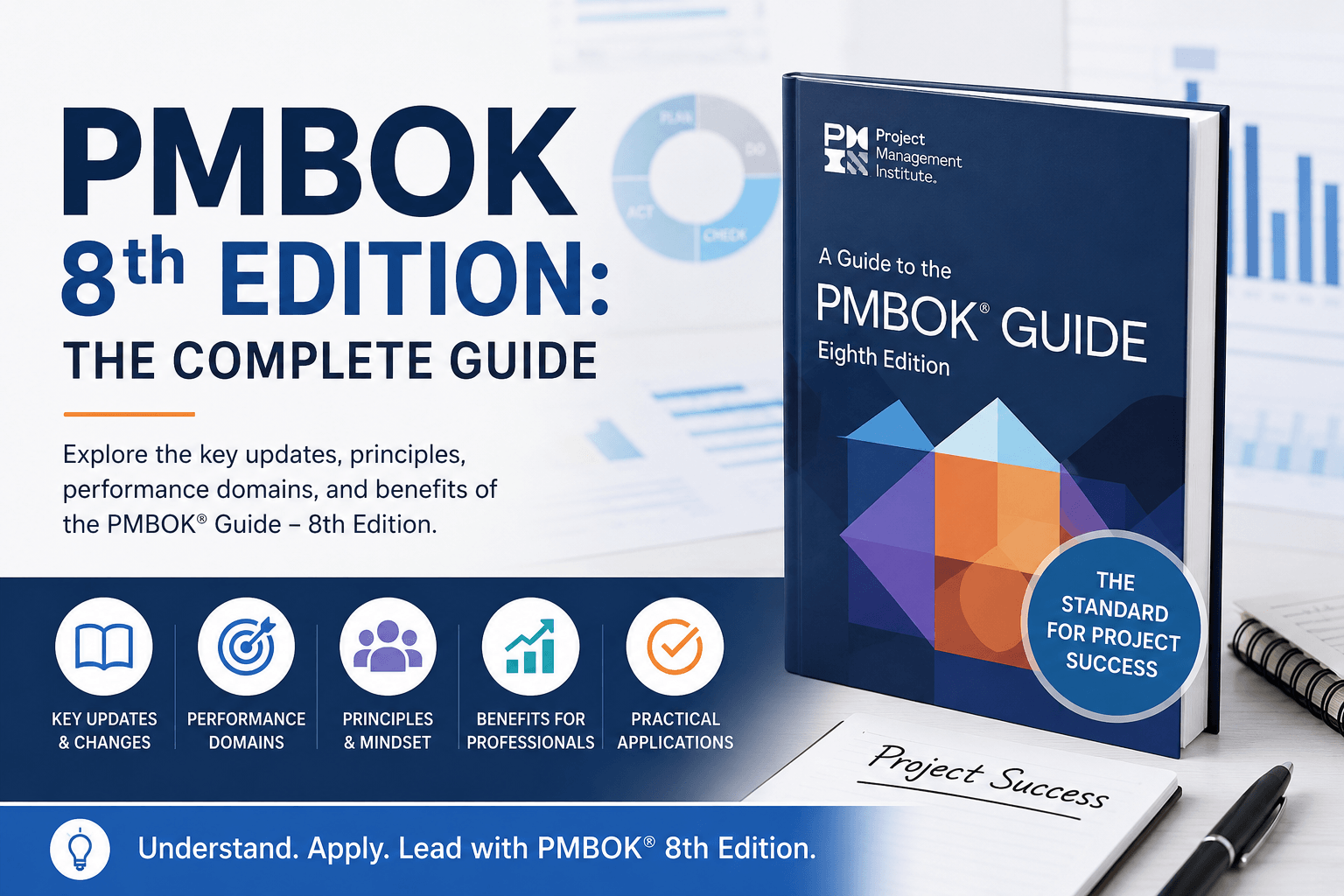
Imagine a standard set from the largest collection of international data ever created (which involved close to 48,000 Data Points that underwent 2 rounds of public review and feedback by PM professionals working across 5 continents). PMI released the PMBOK Guide’s eighth edition on November 13, 2025, with a Kindle version, and on January 13, 2026, with the paperback version. So what’s in this release?
And why does every project manager need to pay close attention? If you wondered about what was left behind in the 7th edition and felt it lacked practical applications, this release has you covered.
The 8th edition brings structure back into project management and offers real-world applications without ditching the flexibility and principles that made the 7th Edition popular with hybrid teams, or the process that fans missed from the Sixth Edition. It essentially combines both and adds them up. What makes this PMBOK edition important is the reality of project management today.
PMBOK 8 covers it all and goes in depth on each area. Below is a step-by-step breakdown of the PMBOK 8th Edition.
Jump ahead to
A Quick Look Back: Why PMBOK Needed Another Update
The transition from the Sixth to the Eighth Edition reflects PMI’s struggle to balance rigid process maps with high-level philosophy.
- The Sixth Edition (2017) was deeply process-based. It mapped out exact Inputs, Tools & Techniques, and Outputs (ITTOs). While excellent for predictable, traditional projects. Further, it was too rigid for fast-moving agile and digital work.
- The Seventh Edition (2021) pivoted to pure flexibility. PMI dropped the rigid processes for 12 guiding principles and 8 performance domains. However, this abstract shift left many traditional managers (like those in construction) frustrated and without a concrete roadmap.
- The Eighth Edition finds the middle ground. Built directly on global feedback, it retains the flexible mindset of the 7th Edition but brings back the usable, practical structure practitioners missed. Crucially, this update serves as the blueprint for foundational professional credentials, signaling a major evolution for certifications, including Project Management Professional (PMP).
Ultimately, PMBOK evolved from a rigid process manual to an abstract philosophy text,and finally into a practical guide designed for real-world choices.
PMBOK 8th Edition Structure: What’s Inside the New Guide
The PMBOK 8th Edition organises itself around four layers that build on each other, moving from mindset to action. So nothing is sitting in isolation anymore.
| Structural Layer | What It Covers | Purpose |
| Six Core Principles | Foundational behaviors and values guiding decisions | Establishes the “why” behind project management |
| Seven Performance Domains | Governance, Scope, Schedule, Finance, Stakeholders, Resources, and Risk | Defines the “what” practitioners must manage |
| Five Focus Areas | Initiating, Planning, Executing, Monitoring, Controlling, Closing | Connects domains to real execution across the project life cycle |
| Forty Non-Prescriptive Processes | Reintroduced process guidance without rigid steps | Supports the “how” in practical, tailorable terms |
This four-layer model is arguably the biggest structural shift in the new edition. It directly answers the gap that practitioners flagged up after 7th Edition’s launch. Instead of forcing a choice between principles or processes, PMBOK 8 offers both, connected through one logical flow.
The Six Core Principles
PMI trimmed the twelve project management principles from the last edition down to 6. The refined principles are:
- Take a holistic view of the project in its wider organizational context
- Focus on value as the central measure of project success
- Embed quality into processes and deliverables, instead of inspecting it later
- Act as an accountable leader, showing responsibility and ethical conduct
- Integrate sustainability (environmental, social, and economic)
- Build an empowered, collaborative project team
The Seven Performance Domains
I’m pleased that we were able to reduce the number of domains from eight in the 7th Edition down to seven in PMBOK 8. We sharpened our focus on overlapping domains and focused more closely on what is most relevant for project management. Gone is “Integration” and “Cost,” which are now rolled up into the broader “Finance” domain. Now there are seven domains: Governance, Scope, Schedule, Finance, Stakeholders, Resources, and Risk.
This time, rather than treat each domain as a silo, we draw much stronger connections between them. A schedule delay will be seen to tie directly back to stakeholder expectations and resource constraints, instead of just floating in its own little bubble.
The Five Focus Areas
Here’s something many practitioners get wrong right away: Focus Areas are not brand-new concepts. There are five Process Groups, just renamed and reframed.
- Initiating,
- Planning,
- Executing,
- Monitoring and
- Controlling
Key Changes in the PMBOK 8th Edition Guide
Several changes jump out right away if you’ve ever worked with previous versions. Compare the PMBOK 7th vs 8th edition and see what we mean.
A few of these PMBOK 8 changes underpin everything else, so let’s take a quicker peek at those on their own first.
| Area of Change | PMBOK 7th Edition | PMBOK 8th Edition |
| Guiding Principles | Twelve principles | Six streamlined principles |
| Performance Domains | Eight domains | Seven refined domains |
| Process Guidance | Largely removed | Reintroduced as 40 non-prescriptive processes |
| Process Groups | Not present in the core guide | Reintroduced as five Focus Areas |
| Quality Management | Sandbox domain | Embedded within processes and principles |
| Communications Management | Standalone domain | Folded into the Stakeholders domain |
| Procurement Management | Light treatment | Detailed in a dedicated appendix |
| AI Coverage | Minimal to none | Dedicated appendix with adoption strategies |
| PMO Guidance | Brief mention | Expanded appendix on value and maturity |
| Terminology | Broader, sometimes ambiguous | Simplified and standardized globally |
Everything rests on an evidence-based foundation, close to 48,000 data points and two rounds of public comment, to be exact, so that’s precisely why terminology now reads more consistently across regions and industries. That same research pushed PMI toward tighter integration: principles, domains, focus areas, and processes now reference each other directly, instead of sitting in sealed-off sections. Tying it all together is a new three-part “mindset” lens.
- Proactive,
- Ownership
- Value-Driven thinking
It ties principles to day-to-day decisions instead of leaving them as abstract ideals.
Blending the 6th and 7th Editions: How PMBOK 8 Bridges the Gap
The defining hallmark of the 8th Edition is balance. Instead of choosing a side between the process-heavy 6th Edition and the principle-driven 7th Edition, PMBOK 8 merges them into a single, unified framework. It takes the best elements of both models to give project managers both a safety net and room to move:
- The Structure of the 6th Edition: It restores the structured, defined processes that predictive project teams missed, bringing back a comforting sense of order and clarity.
- The Agility of the 7th Edition: It retains a strict focus on final results over rigid adherence to steps, ensuring hybrid and agile teams stay highly adaptable.
- The Non-Prescriptive Bridge: To connect the two, PMI introduces flexible “playbooks” instead of rigid checklists. These outline standard project flows while leaving room to tailor everything to the specific context.
Consider two quick examples:
- A predictive infra team can use the 40 processes much like the 6th Ed’s ITTO model, mapping inputs/outputs closely to their methodology.
- An agile software team can treat the same processes as reference points, pulling guidance only where it genuinely adds value, without forcing a waterfall mindset onto iterative sprints.
Both teams still anchor every decision in the same 6 principles. So the mindset never fragments across methodologies, no matter how we work day to day.
Emerging Focus Areas in PMBOK 8th Edition
Three themes get much more space in this edition than in any previous one – each of which reflects where project work really is going on, namely:
- Agility and Adaptability
- People, Culture, Engagement
- Collaboration, Communities, Social Media.
Project Management Offices and the PMBOK PMO Appendix
We have a whole new appendix on PMOs (Programme and Project Offices) – labeled ‘Appendix X2’! Previous editions barely touched on the PMO, treating it almost as an afterthought. This edition treats it as one of the structural pillars of organisational delivery.
The expanded guidance covers:
- The PMO value proposition – how does your PMO justify its own existence to leadership?
- Customer centricity – how a PMO serves internal teams versus “just” enforcing process
- Different PMO types, models, and organizational structures
- PMO maturity models – helping organizations assess how developed their current setup is
- Suggested resources for further learning (beyond our guide)
AI in Project Management
AI coverage marks one of the most talked-about additions in the Eighth Edition. This is the first PMBOK release to formally address artificial intelligence with its own appendix, labeled Appendix X3. As specialized AI Project Management certifications like AI for Project Manager Training, Generative AI In Project Management Training, and technical micro-credentials gain traction, the guide outlines three clear adoption strategies:
- Automation, where AI performs repetitive tasks faster, such as generating status reports
- Assistance, where AI acts as a partner supporting scheduling, resource planning, and forecasting
- Augmentation, where AI expands a manager’s own decision-making and analytical capability
The appendix breaks AI guidance into four clear sections:
| AI Appendix Section | What It Covers |
| AI in the Project Context | How AI fits into project work, plus current adoption strategies and market state |
| Common Use Cases | Practical applications across scheduling, risk, resources, and stakeholder communication |
| Responsible Use and Ethical Concerns | Bias mitigation, data privacy, transparency, and accountability guidelines |
| Suggested Resources | Further PMI publications and external references for continued learning |
Importantly, the guide never posits AI as a replacement for judgment – only ever a support system. Project managers are still on the hook for results, even when an algorithm points the way. If an AI tool forecasts an outlandish schedule, for instance, the fault lies with the manager who failed to spot it – not the tool.
That’s an important nuance. Governance and ethical accountability now sit side by side with the technical guidance, not bolted on at the end.
The PMBOK Procurement Appendix
Procurement guidance has exploded and now lives in its own dedicated appendix (Appendix X4). Global supply chains are more complicated. Vendors have become partners. Sourcing models have diverged far beyond “fixed-price.”
PMBOK 8’s procurement appendix walks through the entire lifecycle:
- Procurement overview and foundational concepts
- Make/buy analysis – helping your team decide what to build internally vs source externally
- Procurement strategy development
- Bid process and documentation requirements
- Source selection analysis – the criteria used to choose vendors
- Contract types – fundamentals as well as emerging trends, such as outcome-based agreements
- Claims admin – how to handle disputes and the ethical sensitivities
This expansion gives procurement specialists and project managers a shared reference point. For example, a project manager negotiating an outcome-based vendor contract can now reference clear guidance on risk allocation, instead of having to rely purely on legal or finance teams.
Why These Additions Matter For Practitioners Today
The three focus areas I’ve identified connect with a larger pattern of the work. It just doesn’t take place within a rigid methodology or a specific department anymore. PMOs are leading toward strategy decisions in an organization, the use of AI can impact the performance in pretty much any domain, and what happens around a purchase can ripple through cost, schedule,e and stakeholders.
PMI basically put in place, with the updated coverage of those three focus areas, what practitioners were already seeing and experiencing. The guide is basically now a little behind what the practice is doing rather than dictating it to practitioners.
Note: For anyone taking the PMP Exam 2026:
The Exam Content Outline for PMBOK 8 changed; the business environment now represents a much bigger portion of the exam, and that change reflects the changes in AI, PMO, and procurement that are covered extensively in the new guide.
Getting Ready for the Transition
For project managers currently working toward certification, or simply staying current, a few practical steps make sense right now. Continue building on PMBOK 7th Edition fundamentals if exam plans target dates before the official exam update.
- Start reviewing PMBOK 8 concepts gradually, especially the six principles and five Focus Areas, regardless of exam timing.
- Pay closer attention to the AI, PMO, and procurement appendices, since these areas carry expanded weight going forward.
- Follow PMI’s official communications for confirmed terminology, since training providers are still rolling out updated materials.
- Avoid abandoning current study plans entirely. Core skills like stakeholder management, risk handling, and hybrid delivery remain relevant across both editions.
Final Thoughts
The PMBOK 8th Edition is not a minor refresh. It represents PMI’s attempt to give practitioners both the flexibility and the practical structure many felt was missing ever since. By merging mindset, process, and emerging practice areas like AI, PMO, and procurement, this edition speaks directly to how project work actually happens today.
Whether someone leads predictive construction projects or fast-moving agile product teams, the updated guide offers a shared language and a more connected framework. After all, that is exactly what a global standard should do. It should meet practitioners where they are, while pointing clearly toward where the profession is headed next.
FAQs on PMBOK Guide 8th Edition
The Kindle version launched on November 13, 2025. The paperback version followed shortly after on January 13, 2026.
The guide introduces a connected four-layer model. This framework seamlessly links your professional mindset to day-to-day project actions.
PMI streamlined the previous twelve principles down to six refined core principles. These values establish the essential foundation for project decisions.
The performance domains were reduced from eight down to seven. Integration and cost are now rolled into the broader finance domain.
Yes, the classic Process Groups are now reframed as five distinct Focus Areas. They guide execution from initiating through closing.
A dedicated appendix details explicit AI adoption strategies for project work. It highlights key frameworks for automation, assistance, and augmentation.
The new procurement section details the entire sourcing lifecycle. It provides clear guidance on vendor partnerships and modern contract types.
It acts as a bridge rather than a total replacement. The text blends the 6th edition’s structure with the 7th edition’s agility.
The updated exam outline places significantly heavier weight on the business environment. This shift directly mirrors the new appendix topics.
Unichrone offers updated exam prep training courses like PMP. These courses thoroughly integrate the newly introduced eighth edition standards.