Organizations that thrive long term do not really have to choose between quality and innovation. Instead, they build systems that somehow deliver both simultaneously, and on purpose. According to the Global Innovation Index 2025, organizations with structured innovation systems are nearly 2.5 times more likely to achieve sustained revenue growth. Many organizations treat quality management and innovation as separate, siloed, and pulling in opposite directions.
This is exactly why ISO 56000 Innovation Management becomes essential.
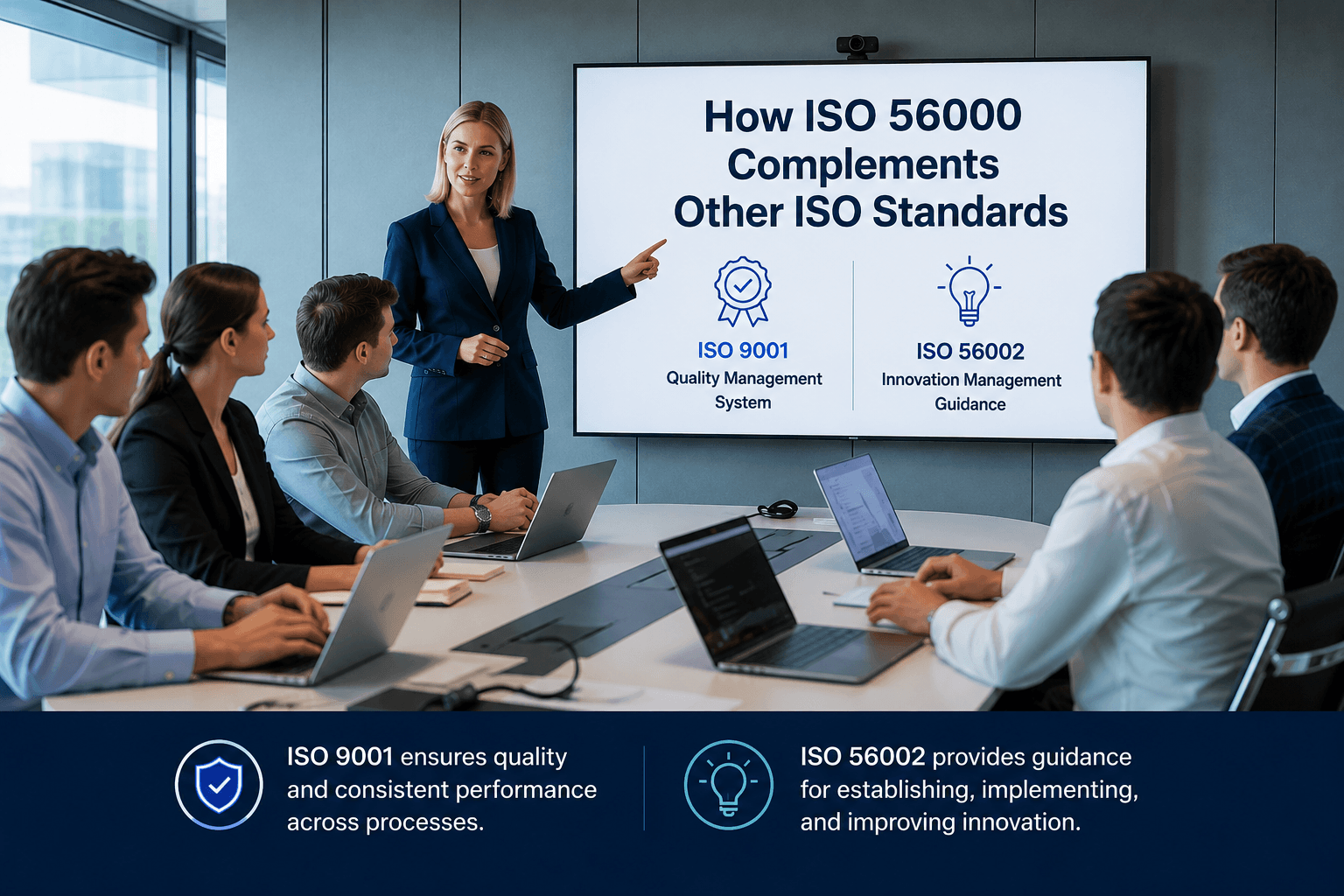
When merged with ISO 9001 and ISO 56002, these three standards together form a powerful, integrated management system that cannot be achieved by one standard alone. We will walk you through precisely how the three standards integrate and why it matters to every forward-looking organization.
Why ISO 56000 Innovation Management Matters?
The first in the ISO 56000 series is ISO 56000. It establishes the common vocabulary and core concepts underlying the rest of the standards in the series. It is essentially the common language that is needed to move innovation intent into the realm of organizational action.
Without this agreement on core concepts, working with ISO 56002 or aligning innovation efforts to ISO 9001 is similar to constructing a building without agreeing upon the blueprints. Everyone will end up working on different ones and will get stuck before the foundation can be laid.
What does ISO 56000 define?
These descriptions are not just “school terms”. In fact, they become the essential building blocks that every innovation-driven organization needs to agree on, before any structured progress can actually happen:
- Innovation: The realization of a new or changed product, service, or process that delivers value
- Innovation Management: Coordinated activities that guide an organization’s innovation pursuits
- Value Creation: Generating outcomes that genuinely matter to stakeholders
- Innovation Ecosystem: The network of people, resources, and relationships that enable innovation
Jump ahead to
Guiding principles of ISO 56000 Innovation Management
These principles are operational guidelines that impact how innovation is managed in a day-to-day sense. They also form the philosophical backbone that links ISO 56000 back to both ISO 9001 and ISO 56002.
- Achieving Value: tangible output is what we’re after
- Future-Focused Leadership: anticipates rather than responds
- Exploiting Uncertainty: Risk vs. Threat
- Adaptability: a system that evolves with organizations & market
- Systems Thinking: a network of people, processes, & technologies
ISO 56000 Core Principles and Their Relevance to Other Standards
| Principle | Description | Relevance to Other Standards |
| Realization of value | Innovation produces real, measurable outcomes | Aligns with ISO 9001’s customer focus |
| Future-focused leadership | Leadership anticipates and shapes change | Supports ISO 56002’s leadership requirements |
| Strategic direction | Innovation ties directly to organizational goals | Compatible with ISO 9001 strategic planning |
| Exploiting uncertainty | Uncertainty becomes a manageable resource | Foundational to ISO 56002’s risk approach |
| Adaptability | Systems evolve with shifting contexts | Reinforces continual improvement in ISO 9001 |
How ISO 9001 & ISO 56000 Innovation Management Work Together
ISO 9001 is the most widely recognized standard for management systems on the planet. It currently sits at just over 1.1 million registered organizations across 170+ countries. At its core, the standard focuses on the delivery of high-quality products & services through processes, consistency, and reliability.
At a glance, ISO 9001 and the ISO 56000 Innovation Management standard are addressing very different topics. The ISO 9001 system focuses on consistency; innovation necessitates experimentation, iteration, and creative risk. So how do they work together in the real world?
The High-Level Structure: The Bridge Between Both Standards
Both standards implement the High Level Structure (HLS), more formally known as Annex SL. Since they have identical clause structure (context, leadership, planning, support, operations, performance evaluation & improvement), they are seamlessly integrable, not simply integratable. If an organization is already certified against ISO 9001, they are already ahead of the curve with implementation, as they have already embraced a high level of structured thinking. Furthermore, if the question of ISO 9001 is whether we are “doing things right”, then the question that ISO 56000 and ISO 56002 attempt to answer is whether we are “doing new things right”.
ISO 9001 vs ISO 56000 Innovation Management – Complementary Roles
| Dimension | ISO 9001 | ISO 56000 Innovation Management |
| Primary focus | Quality, consistency, and reliability | Innovation principles and shared vocabulary |
| Risk approach | Risk-based thinking for quality assurance | Exploiting uncertainty for innovation growth |
| Leadership role | Commitment to quality policy | Future-focused innovation leadership |
| Customer orientation | Meeting existing customer requirements | Anticipating and creating new customer value |
| Improvement type | Incremental, continuous improvement | Breakthrough and transformational improvement |
| Knowledge management | Retaining existing organizational knowledge | Creating and building new knowledge entirely |
When both standards work inside the same organization, each one actually strengthens the other. ISO 9001 keeps innovation from turning into a messy free-for-all where nothing is tracked or controlled. ISO 56000 kind of steps in and helps make sure that quality systems don’t become too rigid, and are willing to evolve, which is a well-known, often expensive, failure mode for organizations that only chase compliance.
To illustrate it, take a mid-sized manufacturing company that is already certified under ISO 9001. Their quality processes are solid, and defect rates stay low, for real. But product development moves like it’s stuck, new ideas don’t really leave internal committees, and the innovation pipeline is basically empty.
Once the leadership team adopts ISO 56000 and ISO 56002, they build a common innovation vocabulary, cross-functional teamwork improves in a noticeable way, and structured ideation processes get introduced, then those processes are tied directly to existing quality controls. Within 18 months, the company cut the product development cycle by 35% and launched two new product lines without losing full ISO 9001 compliance.
ISO 56002 The Implementation Guide
If ISO 56000 is the “language”, and ISO 9001 is the quality backbone, then ISO 56002 is the operational engine that makes it all actually run.
ISO 56002 gives practical guidelines for setting up, putting into place, running, maintaining, and continually improving an Innovation Management System. And importantly, most of ISO 56002’s clauses refer back to ideas that were first introduced in ISO 56000. So understanding “ISO 56000 innovation management” is a logical and necessary first step before going into ISO 56002 implementation.
How ISO 56002 directly applies ISO 56000 Concepts
The relationship between these two standards is not just conceptual; it’s deeply practical, though. Like, ISO 56002 really takes what ISO 56000 says in definitions and then puts it to work, day to day. Here’s the basic way it all plays out:
- Innovation Portfolio: ISO 56000 definition, applied to the ISO 56002 planning clause, to aid organizations in planning and managing their innovations strategically.
- Innovation Ecosystem: As a new term in ISO 56000, used in the support clause of ISO 56002 to address and implement fruitful cooperation with external stakeholders
- Innovation Intent: The term, coming from ISO 56000, is what really determines the scope definition of an organization’s IMS in ISO 56002
So that layered link means organizations don’t end up running innovation work on assumptions or on personal interpretations. Each action traces back to definitions that are universally agreed upon. And that’s what gives the whole innovation management framework its credibility, plus consistency across teams, departments, and different geographies, too, even when the context changes.
ISO 56000 Concepts and Their ISO 56002 Applications
| ISO 56000 Concept | ISO 56002 Clause | Practical Application |
| Innovation intent | Clause 4 – Context | Defining IMS scope and organizational purpose |
| Innovation leadership | Clause 5 – Leadership | Building an innovation culture and a long-term strategy |
| Innovation portfolio | Clause 6 – Planning | Managing and prioritizing innovation initiatives |
| Innovation ecosystem | Clause 7 – Support | Developing and leveraging external partnerships |
| Idea realization | Clause 8 – Operations | Running structured and repeatable ideation processes |
| Innovation performance | Clause 9 – Evaluation | Setting and tracking meaningful innovation metrics |
| Learning from failure | Clause 10 – Improvement | Iterating on outcomes and scaling successful ideas |
The Unified Framework: All Three Standards Working As One
Individually, each standard adds real value. But together, they become a comprehensive innovation management framework that covers organizational language, operational quality,y and systematic innovation, all in one coherent structure that doesn’t feel disconnected.
Here’s how the three standards line up in a clear, sequential flow:
- ISO 56000 establishes a shared language, which reduces ambiguity across departments and also leadership teams
- ISO 9001 provides a disciplined, process-oriented quality foundation that the entire organization depends on
- ISO 56002 then uses the common language plus the quality structure to put a formally recognized Innovation Management System into action
The result is an organization that manages quality and fosters innovation not as competing priorities, but as deeply interconnected strengths that reinforce one another at every level.
Integration Across ISO 56000, ISO 9001, and ISO 56002
| HLS Clause | ISO 9001 Focus | ISO 56000 Input | ISO 56000 Output |
| Clause 4 – Context | Stakeholder needs and QMS scope | Innovation intent and ecosystem | IMS scope and innovation context |
| Clause 5 – Leadership | Quality policy and accountability | Innovation leadership principles | Innovation strategy and culture |
| Clause 6 – Planning | Risk and quality objectives | Future focus and uncertainty | Innovation portfolio management |
| Clause 7 – Support | Resources and team competence | Knowledge creation and collaboration | Innovation capabilities and partnerships |
| Clause 8 – Operation | Process control and documentation | Idea realization concepts | Structured innovation process management |
| Clause 9 – Evaluation | Audits and performance reviews | Value realization and measurement | Innovation KPIs and portfolio reviews |
| Clause 10 – Improvement | Corrective and preventive actions | Learning and adaptability | Innovation scaling and continual improvement |
The Business Case for Integration: Why Numbers Make it Clear
The case for integrating these three standards isn’t only strategic. Rather, also strongly backed by current data. Research by McKinsey says that organizations with formally integrated Quality and Innovation Management Systems tend to bring in, on average, around 30% higher returns on their innovation spend than those that run these functions separately. Also, ISO survey data from 2024 shows that the adoption of the ISO 56000 series standards has climbed by more than 40% across the Asia-Pacific and European markets in just 3 years.
A 2025 Deloitte study found that organizations operating structured innovation management frameworks alongside established quality systems are about three times more likely to bring new products to market within planned timelines.
Therefore, these numbers point to one conclusion, and it feels pretty obvious once you see it. Quality without innovation ends up in stagnation. Innovation without quality tends to create inconsistency. Together, they form organizations that are stable enough to deliver consistently now and responsive enough to adjust and evolve confidently for tomorrow.
Why ISO 56000 Innovation Management Training Matters for Professionals
Knowing how these standards connect is one thing. figuring out how and where to start building that knowledge professionally is another. That part is often where structured training makes a real difference.
Professionals who opt for training across ISO 56000, ISO 900,1 and ISO 56002 build the ability to:
- Lead innovation efforts using a globally recognized vocabulary and an innovation management framework.
- Merge quality management thinking with structured innovation practices across departments.
- Implement and audit Innovation Management Systems that are fully aligned with ISO 56002 guidance.
Summary
ISO 56000 Innovation Management does not work in isolation. It is designed to complement and strengthen other globally recognized standards like ISO 9001 and ISO 56002. This blog explores exactly how these three standards connect, where each fits within a unified management framework, and why their combined use yields results no single standard can achieve alone. From shared vocabulary to practical implementation, understanding this relationship is essential for any organization serious about managing both quality and innovation effectively.
Conclusion
ISO 56000 Innovation Management is not just a standalone reference. It is the cornerstone of a connected framework that, when combined with ISO 9001 and ISO 56002, gives organizations and professionals a complete, internationally recognized approach to managing quality and innovation as one.
The standards are aligned, the training is accessible, and the business case is clear. For professionals and organizations ready to stop treating quality and innovation as separate conversations, this integrated framework is exactly where that change begins.
FAQs
ISO 56000 introduces principles that treat risk as a resource. This lets teams experiment without violating established quality controls.
It is impractical because ISO 56002 directly relies on ISO 56000 definitions. Skipping it leads to confusion.
ISO 9001 drives consistency and defect elimination in current operations. ISO 56002 provides the engine for breakthrough experimentation.
High Level Structure (HLS) provides an identical high-level structure for all three standards. This blueprint allows organizations to merge procedures seamlessly.
It means viewing market uncertainty as a source of growth. The framework helps organizations leverage risks to discover value.
Integrating quality and innovation frameworks can increase returns on innovation spend by 30%. This focus eliminates wasted resources.
It is the collaborative network of internal people, external stakeholders, and resources. This network interacts to sustain innovation.
Innovation requires leaders to anticipate market changes rather than just reacting. This mindset ensures long-term strategic alignment.
ISO 9001 ensures value by consistently meeting existing customer requirements. ISO 56000 expands this by creating new stakeholder value.
It equips auditors with the framework needed to evaluate creative processes safely. This knowledge helps successfully audit integrated systems.