Every profession has its share of myths, and project management is no different. In fact, somewhere between project kickoffs and stakeholder meetings, countless assumptions are accepted as facts now. However, the trouble is these project management myths don’t sit quietly in a drawer. But they sneak into sprint planning, budget planning, and even hiring decisions. This can derail projects before you even realize it.
As the old saying” Don’t judge a book by its cover”, the same is applicable to project management wisdom. It sounds right, but it has never been stress-tested against reality. In 2026, AI Copilot, hybrid, Agile waterfall-workflow, and freshly updated PMO exam content outline are reshaping the field. Therefore, clinging to outdated assumptions is not just old-fashioned but also expensive.
Let’s roll up our sleeves and separate myth from reality in the modern project management domain.
Jump ahead to
Why Are Myths More Dangerous than Ever?
It is a truth that the profession is evolving faster than a myth can be fact-checked. New tools, new certification standards, and new working models are evolving. This means yesterday’s commonsense can be today’s costly blind spot.
Some common consequences include:-
- Missed deadlines
- Scope creep
- Poor communication
- Inefficient resource utilization
- Higher project risks
- Reduced stakeholder confidence
- Team burnout
As the proverb says, “A stitch in time saves nine.” Identifying the myths earlier can aid you avoid much bigger challenges later.
Here is the reality check, myth by myth.
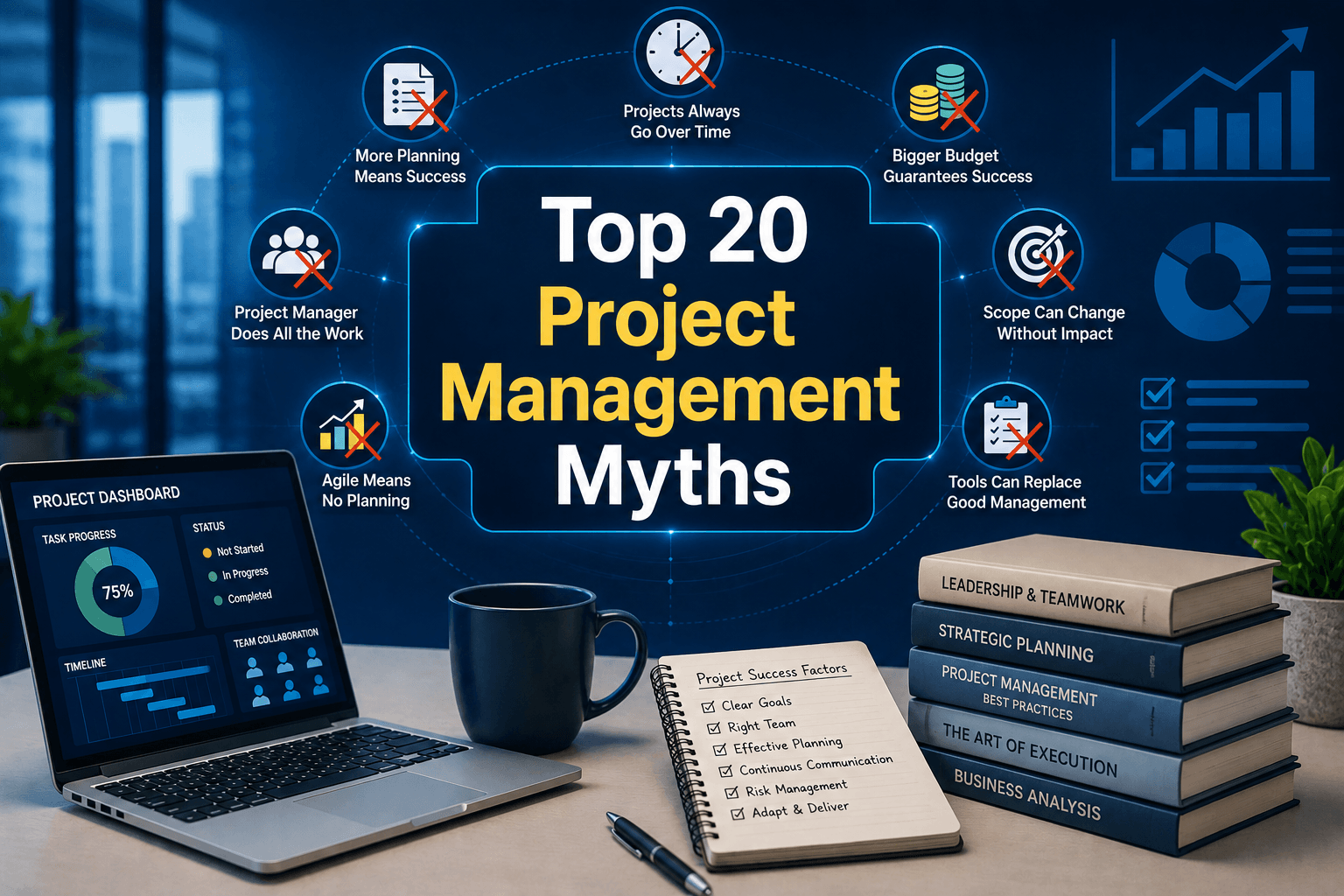
| The Myth | The Reality |
| Anyone can be a project manager | Leading a project is a craft, not a job title you inherit by default |
| PMP Certification guarantees a job | It improves your credibility, but your skills and experience secure opportunities |
| More documentation means more control | The document should support decisions and not create unnecessary paperwork |
| A perfect plan guarantees success | Plans are like compasses, not GPS. They guide but don’t predict every turn. |
| Process matters more than people | A flawless process with disengaged people is like a car with no driver |
| Risk management is a one-time task | Risks must be reviewed throughout the project. It’s like a living document, not a box that you tick once. |
| The project manager makes every decision | Empowered teams deliver better results. They outperform command and control every time. |
| Agile means no planning | Agile plans in shorter cycles. It emphasizes continuous planning and does not skip planning altogether. |
| Scrum Masters and Project Managers are interchangeable | They are not twins, and they have different responsibilities. They differ in scope and authority. |
| More meetings improve communication | Productive communication matters more than frequent meetings. |
| Adding people always speeds up a late project | Bigger teams often increase the coordination effort. This is the textbook case of too many cooks spoiling the dish. |
| Scope, schedule, and budget can all be fixed simultaneously | Trade-offs are inevitable here. Successful delivery depends on smart tradeoffs |
| PM Software is only for big enterprises. | Small teams benefit from it too. Tools like Asana, Trello, Jira, Microsoft Project is beneficial regardless of your team’s size |
| AI will replace project managers | AI replaces busy work, not judgment, negotiation, and stakeholder trust |
| Remote teams can’t be managed efficiently | Clear communication makes remote teams perform successfully. |
| Once certified, your learning is done | Certification is a launchpad, not just a finish line. |
| Technical skills matter more than soft skills | Soft skills are the load-bearing walls most PMs underestimate. Leadership and communication drive success in projects |
| PMBOK is a strict step-by-step guide | It’s a knowledge framework. How one is tailoring it is what matters |
| A project manager can fix any failing project | Sometimes ending a project is the best decision. No need for a rescue attempt. |
| Experience alone keeps you relevant | You must continue learning to stay competitive. |
Myths vs Reality – A Closer Look
Leadership And Career Myths
Great Project Managers are Not Born Overnight.
Managing projects is not simply assigning tasks. That means you must balance scope, budget, timelines, risks, stakeholders, and people. Definitely, it takes practice to become an efficient project manager.
PMP Certification is not a Guaranteed Career Shortcut
It is of no doubt that PMP Certification strengthens your job profile. At the same time, it is factual that employers look for leadership, communication, and practical project experience. Think of the certification as an opening door. You still need to demonstrate that you create value once you are inside.
Learning does not end after Certification
Passing the certification is like a milestone, but not a finishing line. New technologies, evolving methodologies, AI-powered tools, and changing business expectations are emerging. This requires you to update your knowledge regularly. Treating a certificate like a permanent trophy is not apt. Rather, treating it as a renewable license is how skills quietly go stale.
Soft skills are Your Competitive Advantage
Certainly, technical skills can aid you in understanding projects. Many project management myths place technical expertise above interpersonal skills. In reality, communication, negotiation, emotional intelligence, and leadership aid you in delivering it successfully.
Experience Needs Continuous Upgrading
One of the lesser-known project management myths is that years of experience alone keep you current. Surely, experience is valuable. Yet relying only on past practices can limit your growth. Furthermore, modern project management embraces AI, predictive analytics, hybrid delivery models, and data-driven decision -making. Therefore, to stay competitive, you need to evolve alongside the profession.
Planning and Execution Myths
Flexibility Beats The Perfect Plan
No project unfolds exactly as expected. This means that market conditions, customer needs, and sometimes business priorities change during execution. Therefore, instead of creating rigid plans, project managers build flexibility into their planning process. They adapt without losing sight of project goals.
Smart Documentation Creates Better Decisions
Documentation should simplify work. It should not be unnecessary bureaucracy. Hence, it is not necessary to create lengthy reports that nobody reads. Instead, focus on reports that back planning, communication, compliance, and decision support throughout the project cycle.
Agile Still Requires Careful Planning
One of the biggest project management myths is that Agile teams simply go with the flow. In reality, Agile relies on product backlogs, sprint planning, reviews, and retrospectives. Hence, the difference is that the planning happens continuously instead of once.
Every Project Has Constraints to Balance
Projects operate with interconnected constraints such as scope, budget, quality, resources, and deadlines. That means, when one element changes, often the other needs adjustment. Here, skilled project managers understand these trade-offs and make decisions that maximize overall project value.
Sometimes Walking Away is The Correct Decision
Not every struggling project should be rescued at any cost. Closing the project may be the most responsible decision sometimes. This includes situations where the risk outweighs the benefits or businesses change their priorities. Hence,it is true that knowing when to stop is as prominent as knowing how to lead.
Teamwork and Communications Myths
People Drive Projects More than Processes
Processes, in fact, provide structure, but people render life to projects. A motivated, collaborative team can overcome process gaps. Meanwhile, even the most detailed methodology cannot compensate for poor communication or disengagement.
Leadership is not About Making Every Decision
Effective PMs create an environment where team members feel confident making decisions within their areas of expertise. As a matter of fact, delegating responsibilities encourages innovation and strengthens accountability. This allows leaders to focus on strategic priorities.
Productive Priorities Matter More Than Frequent Meetings
A full calendar does not always mean productive collaboration. On the other hand, well-structured meetings with clear objectives, defined outcomes, and the right participants save time. It improves decision-making as well. After all, too much of anything is good for nothing.
Bigger Teams Don’t Always Mean Faster Results
When projects fall behind, adding more people may actually increase complexity. This illustrates that new team members require onboarding, coordination, and communication. This can temporarily reduce productivity.
Distance Doesn’t Define Team Performance
Hybrid and remote work have transformed project delivery. Distributed teams can achieve results with the right collaboration tools, regular communication, and also clearly defined responsibilities. This can even be those of co-located teams.
Methodology and Governance Myths
Scrum Masters and Project Managers Play Different Roles
Although both of these professionals work towards successful project delivery, their responsibilities are different. Project Managers oversee project outcomes, budgets, stakeholders, and schedules. Meanwhile, Scrum Masters focus on facilitating Agile practices, removing obstacles, and aiding Scrum Masters to improve continuously.
Risk Management Never Stops
Risk Management is not something that you complete during project initiation and forget. This implies that new risks emerge as the project progresses, making continuous monitoring, assessment and response essential for maintaining project stability and avoiding costly surprises.
PMBOK is a Guide, Not a Rule Book
PMBOK provides globally recognized best practices rather than rigid instructions. In fact, every organization has unique goals, constraints, and ways of working. Hence, project managers should tailor these practices instead of applying them mechanically.
Technology and Modern Project Management Myths
Project Management Software Benefits Every Team
The contemporary project management platforms are not reserved for large enterprises. It is beneficial whether you are managing five tasks or five hundred. Tools like Asana, Monday.com. ClickUp, Trello, etc, aid in improving collaboration, tracking progress, managing resources, and keeping everyone aligned.
AI is Your Project Partner, Not Your Replacement
Artificial intelligence can automate repetitive tasks such as scheduling, reporting, meeting summaries, and predictive risk analysis. It allows you to focus on strategic work. However, AI cannot replace human judgment, stakeholder management, empathy, or ethical decision-making. These are the qualities that define truly outstanding project managers.
A Quick Glance Action List
If you want to stay ahead in 2026:-
- Keep learning and treat certifications as an ongoing habit.
- Use AI to automate repetitive tasks, not leadership
- Review project risks regularly
- Adapt your plans as projects evolve.
- Choose the right methodology for each project
- Invest in communication and leadership skills
- Measure success by business value and not by deadlines
- Empower your team instead of micromanaging
Final Thoughts
Project Management myths survive because they are familiar. Yet familiarity does not make them true. Actually, the best project managers don’t rely on outdated assumptions. They question, adapt, and improve every project.
It holds true that in 2026, project management is about more than schedules and budgets. Whether you are an aspiring project manager or an experienced professional, it’s the best time to leave behind these project management myths. Now the PM context is more on delivering value, embracing change, utilizing technological advancements, and leading people with confidence.
In addition, building strong foundations through certifications like PMP or CAPM can also be a breakthrough. As the saying goes, proof of the pudding is in the eating. Projects that deliver continuous success are led by project managers who are always willing to evolve.
FAQs
Yes, the updated exam content keeps the certification relevant and valued by employers.
No, AI enhances project managers by automating routine tasks while leadership remains human.
Yes, even small teams benefit from structured planning, collaboration, and tracking.
Common myths include believing AI replaces PMs, Agile requires no planning, and certifications guarantee jobs.
No, the best methodology depends on your project’s goals, complexity, and requirements.
Yes, it helps teams organize tasks, monitor progress, and collaborate more effectively.
Yes, communication, leadership, and problem-solving are essential for project success.
No, some projects are better closed than continued without realistic outcomes.
No, continuous learning and adapting to new practices are equally important.
Stay updated with modern practices, embrace continuous learning, and make decisions based on evidence rather than assumptions.