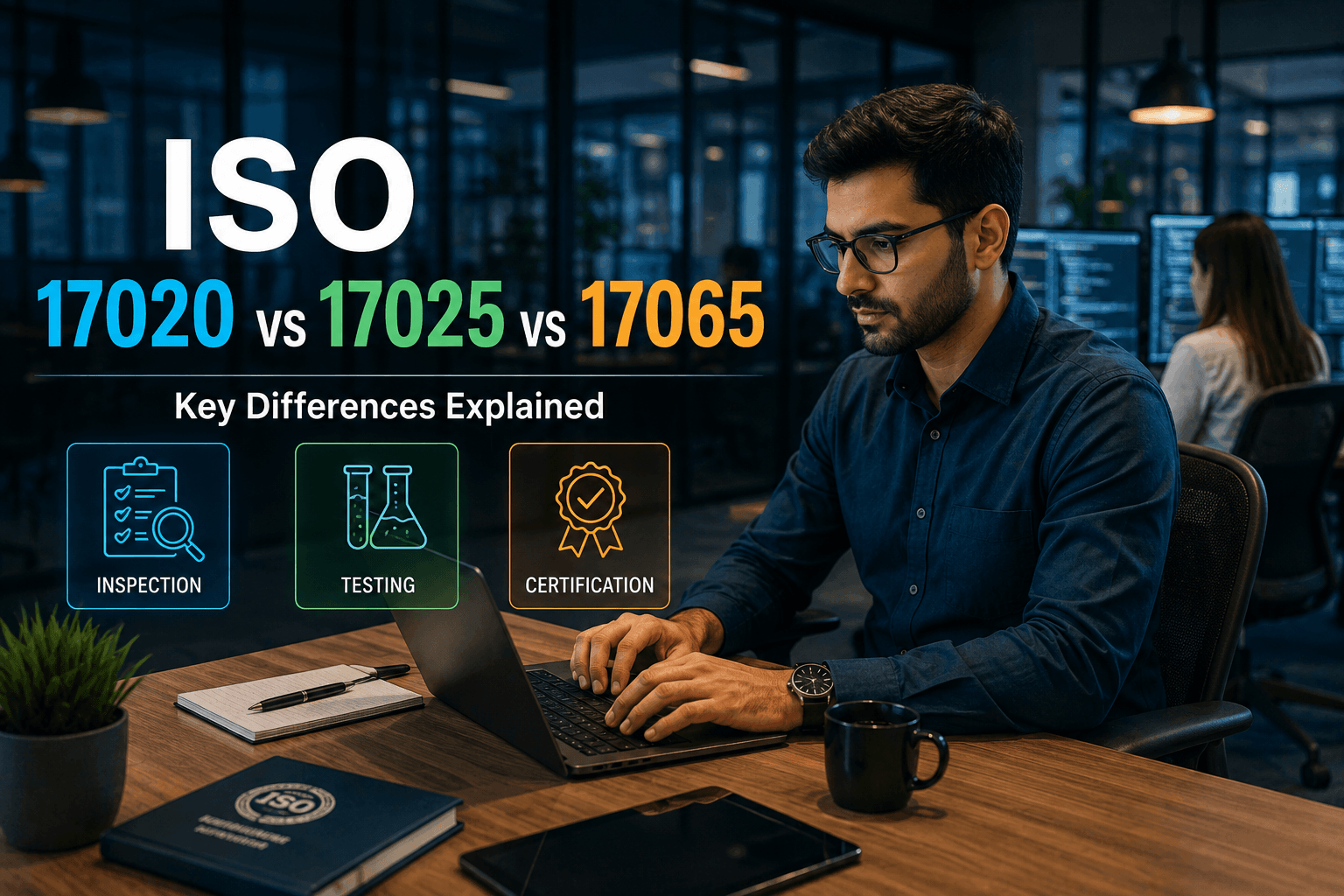
When professionals compare ISO 17020 vs 17025 vs 17065, the similarities may be confusing. In fact, all three are internationally recognized conformity assessment standards developed by ISO and IEC. Yet, they serve completely different purposes. That means one standard focuses on inspection, another emphasizes testing and calibration, and the third deals with product, process, or service certification. Choosing the wrong standard can be like using the wrong key for the right lock. It simply won’t open the right opportunities.
Here, you’ll discover the real differences between ISO 17020 vs 17025 vs 1706. In addition, you can know where they will overlap and identify which one best suits your organization, laboratory, inspection bodies, or certification business.
Jump ahead to
ISO 17020 vs 17025 vs 17065- Quick Comparison
| Standard | Primary Purpose | Typical Organization | Main Output |
| ISO/IEC 17020 | Inspection activities | Inspection bodies | Inspection Report |
| ISO/IEC 17025 | Testing and calibration competence | Testing and calibration laboratories | Test report or Calibration certificate |
| ISO/IEC 17065 | Certification of product, processes and services | Certification bodies | Certificate of conformity |
At its core, ISO 17020 vs 17025 vs 17065 can be summarized as follows:-
- ISO/IEC 17020 can be evaluated through inspections.
- ISO/IEC 17025 verifies through testing and measurements.
- ISO/IEC 17065 certifies conformity against defined certification schemes.
What is ISO/IEC 17020?
ISO/IEC 17020 specifies the organizations that perform inspection activities. Furthermore, inspection bodies assess products, installations, equipment, processes, or services to determine whether they comply with specific requirements.
It’s not like testing laboratories. On the other hand, inspection bodies combine observations, measurements, technical expertise, and professional judgements to reach a conclusion.
That implies their work often involves evaluating real-world conditions rather than performing controlled laboratory experiments.
Moreover, inspection activities may be one-time, periodic, or continuous depending on regulatory requirements or customer needs.
Common Applications Include
- Construction inspections
- Industrial equipment inspections
- Electrical safety inspections
- Infrastructure inspections
- Manufacturing inspections
- Oil and gas facility inspections
- Vehicle inspections
Key Features of ISO/IEC 17020
- Focuses on inspection competence
- Requires impartiality and independence
- Combines observations with professional judgement
- Production inspection reports
- Applies across a wide range of inspection activities
Hence, if your organization evaluates products or installations through inspection rather than laboratory testing, ISO 17020 is the appropriate standard.
What is ISO/IEC 17025?
ISO/IEC 17025 is widely regarded as the global benchmark for laboratory competence. It establishes the requirements for testing and calibration laboratories to produce technically valid and traceable results consistently.
In fact, laboratories are not like inspection bodies. They depend upon validated methods, calibrated equipment, measurement traceability, and robust quality systems. Here, the point is that every system must be scientifically defensible. This is because even the smallest measurement error can influence crucial decisions.
Precise, reliable decisions rely upon reliable measurements. This makes ISO/IEC 17025 a cornerstone of laboratory credibility across industries.
Laboratories commonly accredited to ISO/IEC 17025 include:-
- Chemical testing laboratories
- Environmental laboratories
- Food testing laboratories
- Calibration laboratories
- Materials testing laboratories
- Mechanical testing laboratories
- Pharmaceutical testing laboratories
Key Features of ISO/IEC 17025
- Demonstrates technical competence
- Requires measurement traceability
- Addresses measurement uncertainty where applicable
- Validates or verifies testing methods
- Produces test reports or calibration certificates
Generally, organizations that generate analytical or measurement-based results pursue ISO/IEC 17025 accreditation. This aids them in strengthening their confidence in laboratory data.
What is ISO/IEC 17065?
ISO/IEC 17065 specifies the requirements of bodies that certify products, processes or services. Concisely, certification bodies evaluate whether an item complies with the requirements of a defined certification scheme before issuing a certificate. This makes it different from inspection bodies or laboratories.
In addition, certification decisions are based on objective evidence collected through assessments, audits, inspections, testing, or other evaluation activities. In fact, this depends upon the certification program.
Moreover, this distinction is central to understanding ISO 17020 vs 17025 vs 17065. This is because of the fact, certification bodies often review evidence from multiple sources before granting certification.
Organizations using ISO/IEC 17065 include:-
- Product certification bodies
- Consumer goods certification organizations
- Agricultural certification bodies
- Electrical product certification agencies
- Service certification bodies
- Sustainability certification organizations
Key Features of ISO/IEC 17065
- Issues certificates of conformity
- Operates certification schemes
- Requires impartial certification decisions
- Reviews evidence from multiple assessment activities
- Supports ongoing surveillance when required by the scheme
Certification bodies usually do not perform every inspection or test themselves. As a matter of fact, they evaluate the available evidence to determine whether certification requirements have been met.
Detailed Comparison ISO 17020 vs 17025 vs 17065
| Feature | ISO 17020 | ISO 17025 | ISO 17065 |
| Primary purpose | Inspection | Testing and calibration | Certification |
| Main users | Inspection bodies | Testing and calibration laboratories | Certification bodies |
| Main output | Inspection report | Testing report or calibration certificate | Certificate of conformity |
| Assessment basis | Professional judgement and observations | Scientific testing and measurements | Conformity to a certification scheme |
| Primary evidence | Inspection findings | Laboratory data | Multiple sources of objective evidence |
| Typical industries | Manufacturing, Infrastructure | Food, pharmaceuticals, engineering, environments | Consumer products, Manufacturing, Agriculture |
| Focus | Inspection competence | Laboratory competence | Certification competence |
| Accreditation | Accredited by the national accreditation body under internationally recognized accreditation arrangements |
This comparison makes ISO 17020 vs 17025 vs 17065 easy to understand because each standard addresses a distinct state of conformity assessment.
How do these Standards Work Together?
It is true that ISO 17020, ISO 17025, and ISO 17065 serve different purposes. Yet, they frequently complement one another within the same quality context.
You can imagine a manufacturer introducing a new electrical appliance.
The conformity assessment process could involve:-
- An inspection body accredited to the standard ISO/IEC 17020 evaluating the production facility or the installation.
- A laboratory accredited to ISO/IEC 17025 performing electrical safety and performance tests.
- A certification body operating under ISO/IEC 17065 reviewing all relevant evidence before issuing certification.
Certification bodies may rely on inspection reports from ISO/IEC 17020, and they may test results from ISO/IEC 17025-accredited laboratories. This, in fact, depends upon the certification scheme.
You can think of these standards as three gears working together in the same machine. In that, each performs a different function. Yet, they together build confidence in products, processes, and services.
Which Standard Applies to You?
If you are still wondering about ISO 17020 vs 17025 vs 17065, you can start by identifying what your organization actually delivers.
Choose ISO/IEC 17020 if you:-
- Perform inspection activities
- Evaluate equipment, installations or infrastructure
- Issue inspection reports
- Make decisions based on inspections and observations
Choose ISO/IEC 17025 if you:-
- Operate a testing or calibration laboratory
- Generate scientific or measurement-based data
- Require traceable and technically valid results
- Issue test reports or calibration certificates
Choose ISO/IEC 17065 if you:-
- Certify products, processes or services
- Operate a certification scheme
- Review multiple forms of objective evidence
- Issue certificates of conformity
A simple way to remember ISO 17020 vs 17025 vs 17065 is:-
- Need an inspection report- ISO/IEC 17020
- Need a test report or calibration certificate- ISO/IEC 17025
- Need a certificate of conformity- ISO/IEC 17065
Choosing the correct standard from the outset is always beneficial. It actually saves time and simplifies accreditation while strengthening confidence among customers.
Wrapping Up
Understanding ISO 17020 vs 17025 vs 17065 does not have to be complicated. In fact, rather than competing, these standards complement each other and often work together to build trust across industries. “A chain is only as strong as its weakest link”, and every stage of conformity assessment contributes to that chain. Furthermore, if you are planning to implement any of these standards, methodological training on these standards can be beneficial.
ISO 17020, ISO 17025, or ISO 17065 Training can aid you in understanding requirements, strengthen compliance practices, and prepare confidently for accreditation assessments and practices.
Choose wisely today, and let your commitment to quality speak louder than words tomorrow. After all, true excellence is not just about meeting standards; it’s about setting them.
FAQs
ISO/IEC 17020 applies to inspection bodies, ISO/IEC 17025 to testing and calibration laboratories, and ISO/IEC 17065 to certification bodies.
Yes. An organization can hold multiple accreditations if it performs separate inspection, laboratory, or certification activities and meets each standard’s requirements.
Not necessarily. ISO/IEC 17025 requires rigorous laboratory controls and technical validation, while ISO/IEC 17020 emphasizes inspection competence and impartiality.
No. ISO/IEC 17065 complements rather than replaces ISO/IEC 17025, as certification bodies may use test results from accredited laboratories.
Organizations that perform inspection activities and issue inspection reports should implement ISO/IEC 17020.
Testing and calibration laboratories seeking technically valid and traceable results benefit from ISO/IEC 17025 accreditation.
Certification bodies that certify products, processes, or services use ISO/IEC 17065.
They can, but many rely on accredited ISO/IEC 17025 laboratories or ISO/IEC 17020 inspection bodies, depending on the certification scheme.
ISO/IEC 17065 enables certification bodies to issue certificates of conformity after evaluating objective evidence.
Choosing the right standard improves compliance, builds customer trust, and supports successful accreditation.