With the evolution of Information Technology, there is a constant need for improving the IT processes. Various businesses have instilled Information Technology Infrastructure Library (ITIL) framework for standardizing IT processes in businesses. Although, even ITIL’s best practices cannot ensure that the services of IT are delivered effectively and efficiently.
Jump ahead to
What is ITIL?
The Information Technology Infrastructure Library describes a set of practices that helps in service management of IT, thereby improving the business value for organizations. However, it is important to apply the guidelines specified in the framework according to the parameters of business as well. As it is not a standard, businesses are free to adapt the guidelines as they seem fit. Instilling such practices has helped various organizations to reduce costs, optimally use resources, improved delivery of services and customer satisfaction.
What is Lean?
Lean management is the technique followed by manufacturing businesses to minimize wastages and maximize the value of products whilst maintaining quality. The service industry has recently started applying lean principles to services in order to constantly improve processes and reduce costs. IT service providers constantly look for ways to adopt lean principles for delivering a more valuable service to customers.
What is the connection between ITIL and Lean?
Various organizations have implemented ITIL guidelines to improve their processes. However, improvement processes cannot be instilled without making organizational changes. This is when IT professionals discovered the need of applying lean principles to IT processes. Applying the lean methodology to IT processes that are according to the ITIL framework has helped various organizations in delivering better services and enhanced customer satisfaction levels.
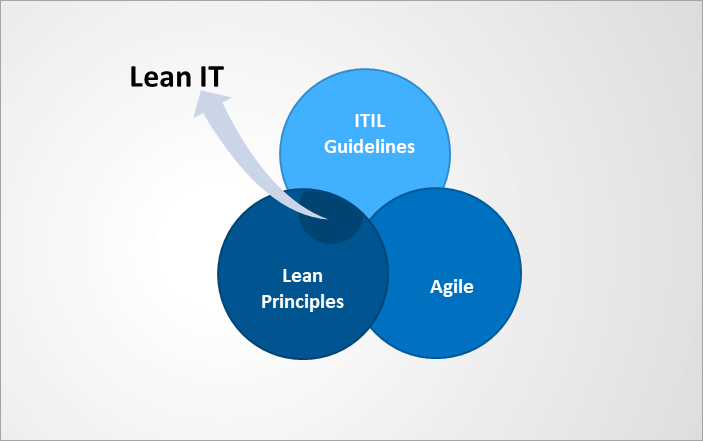
To reap the benefits of ITIL and Lean principles in the IT industry several organizations have proposed to establish Lean ITIL. The Lean ITIL is a combination of ITIL’s best practices and lean methodology which will assist organizations in creating processes that are based on both the frameworks for delivering improved services to customers.
Advantages of Lean ITIL:
- Lean ITIL helps in defining the metrics needed for improving IT processes. Using the relevant metrics helps in eliminating the wastages arising out of processes. Also while allocating the metrics, IT professionals should remove non-value adding processes unless they are essential for carrying out services.
- The combined framework of Lean and ITIL helps IT professionals, to create a detailed course of action for the processes which are to be improved. This helps in implementing the right solution out of various alternatives by aligning it with business needs and customer requirements.
- Lean ITIL helps businesses to understand what they perceive as value and non-value. Segregating such processes helps in reducing processes that are a waste of effort. This further helps IT professionals, to complete a process with fewer resources as mentioned in Lean Methodology.
- With the implementation of Lean ITIL, businesses can also evaluate whether the process has improved from the previous state or not through a wide range of metrics. The comparison helps in determining whether the required value will be delivered to clients through the improved processes.
- Changing only the required processes for implementation of Lean ITIL helps Lean IT professionals to focus on only those value-added services which require improvement. This saves time and effort for the organization as the entire structure of IT processes is not changed.
With the application of Lean ITIL, it was evident that organizations can reduce a significant amount of wastages while delivering services to clients. This further, motivates IT professionals to deliver quality-oriented services to clients whilst meeting customer satisfaction levels. In order to sustain in the IT industry, businesses need to instill Lean ITIL and stand out from their competitors by delivering top-notch IT services.
Summary:
Lean ITIL combines Lean principles with the structured service-management approach of ITIL to enhance the efficiency and focus of IT operations. It helps organizations remove unnecessary processes and make better use of resources without compromising service quality. By concentrating on value-adding tasks and setting clear performance metrics, teams can deliver IT services more quickly and reliably. Continuous improvement is fostered by identifying inefficiencies and streamlining workflows according to business and client requirements. This approach boosts customer satisfaction, lowers costs, and strengthens overall service delivery. Professionals can develop these skills through the Lean ITIL Certification Training Course, enabling them to optimize IT services and drive operational excellence.
FAQs for Lean ITIL Concepts:
1. What is Lean in ITIL?
Lean applies efficiency and waste-reduction principles to IT service management. It helps IT teams deliver faster, smoother processes that focus on what truly matters to customers.
2. How does Lean ITIL improve traditional ITIL processes?
It combines ITIL best practices with Lean methods to remove unnecessary steps and streamline workflows. Teams can deliver high-quality services more efficiently.
3. What are the four main principles of Lean?
They focus on defining customer value, mapping workflows, creating smooth process flow, and continuously improving. These principles guide IT teams to work smarter, not harder.
4. What are the five stages of the ITIL service lifecycle?
The stages are Service Strategy, Service Design, Service Transition, Service Operation, and Continual Service Improvement. They provide a complete roadmap for planning, delivering, and enhancing IT services.
5. Which Lean tools are commonly applied in ITIL?
Tools like value stream mapping, Kanban boards, Kaizen, 5S, and visual management help identify waste and optimize IT processes. They make work more organized and efficient.
6. Why is waste reduction important in ITIL?
Removing unnecessary tasks, delays, and redundancies saves time and resources. It allows teams to focus on activities that directly improve service quality.
7. How can Lean ITIL help in continuous improvement?
By combining Lean’s focus on perfection with ITIL’s service improvement practices. Teams can iteratively enhance processes for long-term efficiency and value delivery.
8. Can existing ITIL users adopt Lean ITIL without disruption?
Yes, Lean ITIL supports gradual improvement. Teams can optimize key workflows without overhauling processes that are already working well.
9. Which IT roles benefit most from Lean ITIL?
Service delivery, support, and operations teams gain the most. Lean ITIL helps them work faster, reduce errors, and provide better service outcomes.
10. How does Lean ITIL align IT services with business needs?
It emphasizes delivering what customers value most and removes nonessential tasks. This ensures IT services directly support organizational goals.
11. How is performance measured in Lean ITIL?
Metrics track process efficiency, waste reduction, and service quality improvements. Teams can see tangible results and adjust practices for better outcomes.
12. Is there a certification for Lean ITIL, and why is it useful?
Yes, Lean ITIL certification demonstrates expertise in combining ITIL with Lean principles. It helps professionals stand out and advance their careers in IT service management.