There has been a significant increase in the number of organizations applying the Agile framework recently. This has necessitated businesses to realize that it is important to integrate stakeholders and developers. Applying Agile methodology required stakeholders and the project team to work together closely while executing a particular project. As a result, several roles have been designated with the project team to ensure a smooth flow of communications. One of the critical roles within the agile project team is that of the Agile Product Owner and his roles and responsibilities.
Jump ahead to
Who is an Agile Product Owner?
Agile product owners are considered to be the central part of the agile product development team. One of the major roles to be performed by product owners is to maintain the product backlog. In addition, product owners become the point of contact with stakeholders and note their requirements. On the other hand, these requirements are further communicated to the development team. Let us have a detailed look at the various roles taken up by the product owner.
Product Owner Roles and Responsibilities
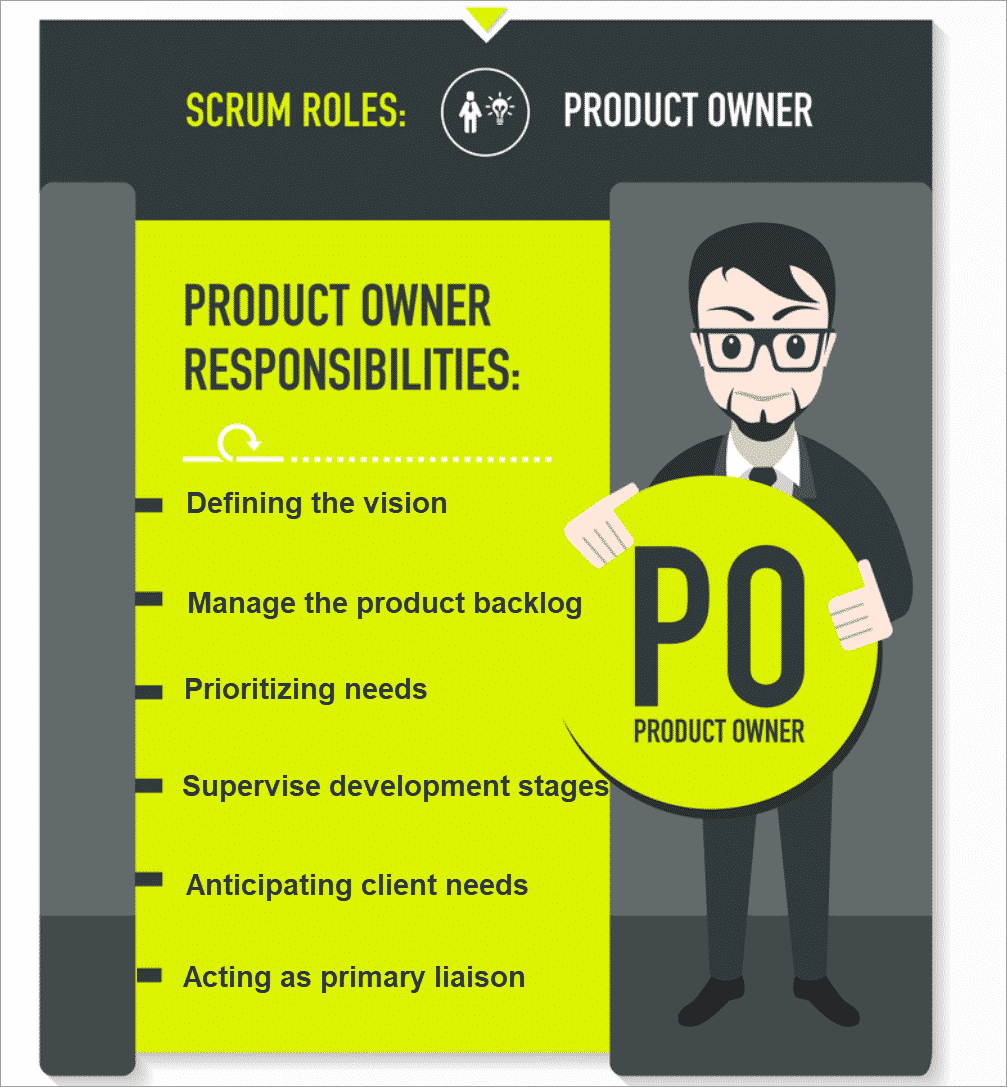
Defining the vision
Product Owners is the main person who engages in defining the vision of the project. Defining the vision helps the team to know the expected results out of the product. Product Owner further indulges in communicating with the team and assists them in understanding the needs of the product. Besides, it is important to know that the vision for the product is finalized over various iterations.
Manage the product backlog
The crucial role of an agile product owner is to maintain the product backlog. While performing this role, the product owner engages in creating a list of backlog items. The list is further rearranged based on the goals of the business. In addition, the dependencies of project tasks are analyzed to draw the sequence in which activities have to be performed. Product owners create a live document to list the activities to continuously update their status.
Prioritizing needs
Product owners constantly look at the scope, budget, and time for analyzing the requirements of the project and stakeholders. In addition, product owners look at the whole environment in which the product is being developed. Various factors affect the requirements of the product. This necessitates prioritizing the needs regularly.
Supervise development stages
Product owners are required to forecast the time needed for developing a product. This entitles product owners to carefully interpret the vision and priorities during each development stage. Effective communication should be planned regularly with the development team to analyze the progress and possible deviations. Throughout the development stage, a product owner is required to supervise and take necessary action.
Anticipating client needs
Product owners are considered to be efficient in predicting the needs of clients. Comprehending these needs further helps product owners to manage the development process of the product. To effectively foresee these needs, product owners need to have an in-depth understanding of the product. In addition, this process also helps in determining the problems that may arise out of the product.
Acting as primary liaison
Product owners are the primary point of contact between the development team and stakeholders. This empowers them to be effective communicators in order to make the right decision. Having effective communication with the team helps in understanding the deliverables clearly for the team. Product owners are necessitated to use the latest means of technology while communicating effectively with the team.
Evaluating the progress of the product
Product owners are required to evaluate each stage of product development. Using advanced metrics, product owners indulge in monitoring and measuring each development stage. The final call regarding the performance of the product is taken up by the product owner. Having feedback from the product owner assists the development team to go ahead with required modifications to the project tasks. This allows the team to know whether the task has to be performed again or take up new activities.
Conclusion
Looking at these intense responsibilities it is evident that product owners play a crucial role in handling agile projects. Each role taken by product owners directly affects the outcome of the product. In addition, a product owner is required to have sufficient knowledge of every domain and industry. Furthermore, product owners are required to possess up-to-date skills for effectively managing agile projects.
Individuals willing to get trained with such competencies can take up PMI’s Agile Certified Practitioner Certification(Check the Eligibility for Agile PMI-ACP Certification). PMI ACP credential is designed to validate professionals who are well-versed in understanding the agile environment completely. Individuals can enroll in PMI ACP Certification Training course to master such competencies. Pursuing the ACP Certification further assists professionals to be industry-ready and stand out from the crowd of regular professionals. This in turn boosts the salaries of certified professionals and their credibility in the field.
Summary
The Product Owner (PO) is the core decision-maker in an Agile/Scrum team, responsible for maximizing the value of the product resulting from the work of the Development Team. The Product Owner serves as the primary liaison between stakeholders (customers, management) and the team, translating the product vision into concrete, prioritized tasks.
FAQs on Agile Product Owner
1. What is the main responsibility of an Agile Product Owner?
To maximize the business value of the product resulting from the work of the Development Team.
2. What is the Product Owner’s role in the Product Backlog?
The Product Owner is solely responsible for creating, managing, refining, and prioritizing items in the Product Backlog.
3. Is the Product Owner a managerial role?
No, the PO is a strategic and value-focused role; they focus on what to build, not how the team works.
4. What is the difference between a Product Owner and a Project Manager?
The PO focuses on the product’s vision and value, while a Project Manager traditionally manages constraints like schedule and budget.
5. Does the Product Owner attend the daily Scrum?
The PO may attend the Daily Scrum, primarily to listen and answer clarifying questions from the Development Team.
6. Who defines the Product Vision?
The Product Owner is primarily responsible for defining and communicating the overall Product Vision to both stakeholders and the development team.
7. How does a Product Owner prioritize user stories?
They prioritize based on business value, strategic goals, dependencies, and risk to achieve the highest return on investment.
8. What is Product Backlog Refinement?
They prioritize based on business value, strategic goals, dependencies, and risk to achieve the highest return on investment.
9. Does the Product Owner write User Stories?
Yes, a key part of their role is translating high-level requirements into clear, understandable, and testable User Stories.
10. What certification is best for a Product Owner?
The CSPO (Certified Scrum Product Owner) or PMI-ACP (Agile Certified Practitioner) are highly regarded certifications for this role.