One Storm, Two Captains. Which one should you become? PMI-RMP vs CRISC!!
It holds that every organization faces uncertainties. At the same time, not every professional is fighting the same battle. Yet, think of one certification that could become the turning point in your career?
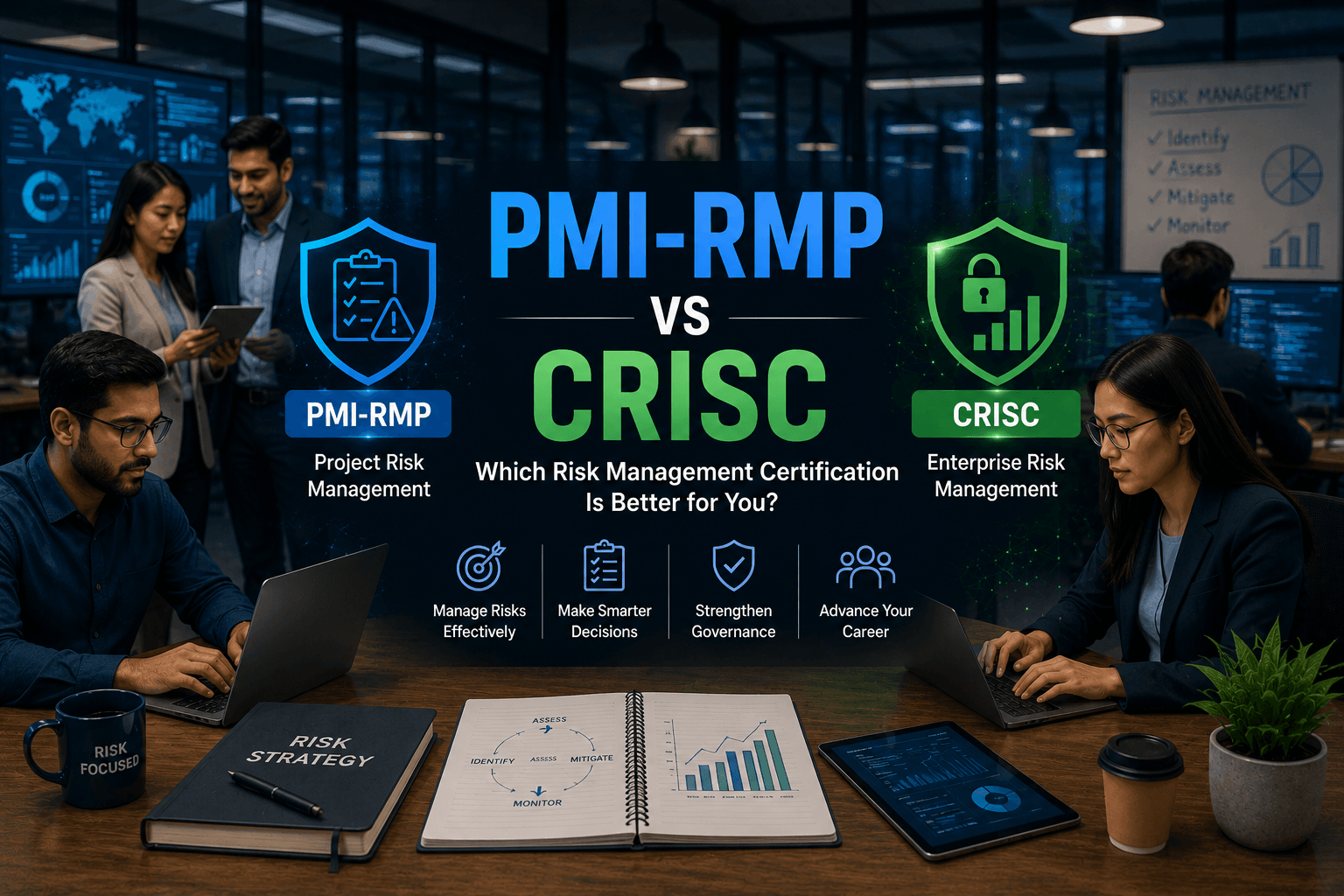
Now picture yourself at a crossroads. One path leads you to administering uncertainties, ensuring deadlines, staying intact, and keeping budgets from going out of control. The other takes you to the world of enterprise IT. This is actually where safeguarding digital assets, ensuring compliance, and strengthening information systems becomes your daily mission. Both roads reward promising careers, but which one truly matches your ambitions? This is exactly the debate behind PMI-RMP vs CRISC.
Jump ahead to
What is PMI-RMP?
The Project Management Professional Risk Management certification(PMI-RMP) is offered by the Project Management Institute. This is a credential that validates your ability to identify, assess, prioritize, and respond to risks throughout a project’s lifecycle. In fact, instead of merely reacting to problems, PMI-RMP professionals act differently. They anticipate uncertainties and create strategies that keep the project on schedule, within budget, and aligned with organizational goals. After all, prevention is better than cure.
- They focus on Project-level risks across the full project lifecycle
- Align closely with PMBOK risk management knowledge areas
PMI-RMP is ideal for:-
- Project Managers
- Program Managers
- PMO Professionals
- Project Risk Managers
- Risk Consultants
- Operations Leaders managing project risks
The certification primarily focuses on project-level risk management. Moreover, this makes it valuable across industries such as construction, manufacturing, healthcare, engineering, finance, and information technology.
Why Professionals Choose PMI-RMP
- Builds expertise in evaluating and identifying project risks
- Strengthens decision-making throughout the project lifecycle
- Improves stakeholder confidence and communication
- Aids in balancing threats and opportunities effectively
- Enhances credibility in project management roles
Here is something to think about:-
Would you rather react to project failures, or do you prefer preventing them before they happen? If the answer is the latter, PMI-RMP could be your next career milestone.
What is CRISC?
Now let’s shift gears.
Projects are not the only things exposed to risk. To make it clear, we know that today’s organizations heavily rely on technology, cloud platforms, digital infrastructure, and sensitive information. Therefore, a single gap or weak control can disrupt entire business operations.
That’s where CRISC steps in.
If you are asking what CRISC is, it stands for Certified in Risk and Information Systems Control. Furthermore, this is a globally respected credential offered by ISACA. In addition, this certification validates your ability to identify, assess, manage, and monitor enterprise IT risks while designing effective information system controls.
Hence, instead of concentrating on one project, CRISC takes a broader perspective. That means it aids organizations in aligning risks associated with technologies to business goals.
CRISC is best suited for:-
- IT Risk Managers
- Security Analysts
- Information Security Professionals
- IT Auditors
- Governance, Risk and Compliance(GRC) Specialists
- Compliance Managers
With cyberthreats and regulatory expectations growing every year, organizations increasingly value professionals capable of protecting their digital information systems.
Why Professionals Pursue CRISC
- Strengthens enterprise IT risk management capabilities
- Develops expertise in information system controls
- Supports governance and regulatory compliance
- Improves business resilience against technology risks
- Opens opportunities across cybersecurity and risk leadership roles
Ask yourself this.
Would you enjoy managing the risks of a single project or protecting a firm’s complete technologies?
Your answer can always reveal which certification can align with your aspirations.
PMI-RMP VS CRISC- A SIDE-BY-SIDE COMPARISON
Choosing between PMI-RMP vs CRISC is not, in fact, about finding a winner. On the other side about finding your success formula.
Here is a quick comparison to simplify your decision.
| Feature | PMI-RMP | CRISC |
| Issuing Organization | Project Management Institute | ISACA |
| Primary Focus | Project Risk Management | Enterprise IT Risk Management |
| Best Issued for | Project Managers, Program Managers, Operations Leaders | IT professionals, Security Analysts, Auditors |
| Risk Scope | Individual projects | Enterprise Information Systems |
| Core Objective | Mitigate project risks and maximize opportunities | Design, evaluate, and monitor IT controls |
| Industry Focus | Construction, engineering, healthcare, manufacturing, IT, | Cybersecurity, finance, banking, technology, compliance |
As a matter of fact, both PMI RMP and CRISC certifications revolve around managing uncertainties. Yet, they tackle entirely different challenges.
Here, think of PMI-RMP as the expert who keeps a project sailing smoothly despite rough waters. On the other hand, CRISC is a guardian protecting an organization’s digital fortress.
Both are invaluable but for different missions. Therefore, don’t pull all your eggs in same basket. Also, it is not clever to choose a certification just because it is popular. It may not give the career growth you are looking for.
Eligibility Requirements
Before registering for the exam, candidates should follow one of the following eligibility pathways.
PMI-RMP Eligibility
| Educational Qualification | Experience Required | Risk Education |
| Secondary Degree | 36 months of project risk management experience | 40 hours |
| Four-Year Degree | 24 months of project risk management experience | 40 hours |
CRISC Eligibility
It is not like project-focused certifications. On the other hand, CRISC emphasizes practical enterprise IT risk experience.
Candidates need:-
- Minimum three years of cumulative IT risk management experience
- Experience across specific CRISC domains
- Relevant work experience should be verifiable
Here, in fact, experience matters because CRISC validates professionals already working with enterprise IT risks and controls
Exam Structure- PMI-RMP vs CRISC
| Exam Component | PMI-RMP | CRISC |
| No of questions | 115 | 150 |
| Duration | 150 minutes | 4 hours |
| Question style | Scenario-based | Multiple choice with enterprise risk scenarios |
| Primary focus | Project risk management | IT governance and information system controls |
PMI-RMP vs. CRISC- Skills You Will Gain
PMI-RMP Skills
- Risk identification
- Risk analysis
- Risk response planning
- Opportunity management
- Stakeholder communication
- Project monitoring
CRISC Skills
- IT risk governance
- Enterprise risk assessment
- Information system controls
- Regulatory compliance
- Governance frameworks
- Business resilience
PMI-RMP Salary vs CRISC Salary
One of the biggest questions professionals ask is:-
Which certification pays more?
- PMI-RMP holders typically report salaries in a range that reflects a strong demand for expertise in project risk management. Certified professionals are often citing double-digit percentage salary gains over non-certified peers.
- CRISC Certification owners who are at career levels such as IT risk managers, GRC professionals, Information Security Leaders, etc earns premium salaries. This is actually due to the increased demand for cybersecurity and governance.
Generally, CRISC salaries tend to be at a higher level because enterprise cybersecurity and IT governance skills remain highly sought after worldwide. However, if your career revolves around project delivery, PMI-RMP salary growth can be equally rewarding.
In fact, grass is greener when you water it.
Career Opportunities After Certification
After PMI-RMP
- Project Risk Manager
- Risk Consultant
- Senior Project Manager
- PMO Risk Analyst
- Program Risk Manager
- Enterprise Project Risk Specialist
After CRISC
- IT Risk Manager
- Governance Risk and Compliance(GRC) Analyst
- Information Security Risk Analyst
- Compliance Manager
- Risk Assurance Consultant
- IT Controls Specialist
Maintenance and Renewal Requirements
It is a fact that keeping your certification active is as important as earning it.
| Requirement | PMI-RMP | CRISC |
| Renewal Cycle | Every 3 years | Annual maintenance |
| Continuing Education | 30 PDUs | 20 CPE credits each year |
| Additional Requirement | Maintain PMI certification status | Annual maintenance fee |
PMI-RMP vs CRISC- Key Differences
| Comparison Area | PMI=RMP | CRISC |
| Risk Perspective | Project-centric | Enterprise-centric |
| Main Objective | Deliver successful projects | Protect business information assets |
| Decision Making | Project teams | Executive leadership and governance |
| Control Focus | Project risks and opportunities | Information system controls |
| Typical Environment | Projects and programs | Enterprise IT infrastructure |
| Business Focus | Scope, schedule, quality, cost | Compliance, security, governance |
Final Thoughts
It is important to understand that choosing between PMI RMP vs CRISC is not finding a universally superior certification. Before the final choice, ask this simple question. Where do you want to make the difference? Do you want to guide projects safely through uncertainties pr protect a firm from evolving digital risks? In fact, the answer is not hidden in the certification name. It is in your career aspirations. As the saying goes, fortune favours the prepared.
Therefore, you can choose PMI-RMP or CRISC. With that, you are investing in skills that aid organizations in making smarter decisions. Your certification is more than a line on your resume. It is a statement of your expertise and your commitment to your continuous learning.
FAQs
It depends on your background. Project managers often find PMI-RMP easier, while IT and cybersecurity professionals generally prefer CRISC.
Yes. Many professionals pursue both certifications to gain expertise in project and enterprise IT risk management.
CRISC salary is often higher due to cybersecurity demand, while PMI-RMP salary remains competitive across project-driven industries.
No. PMP is not a prerequisite, although many professionals earn both certifications.
Both are internationally recognized. PMI-RMP is respected in project management, while CRISC is valued in IT governance and cybersecurity.
PMI-RMP is a PMI certification that validates project risk management skills throughout the project lifecycle.
CRISC is an ISACA certification focused on enterprise IT risk management and information systems controls.
PMI-RMP eligibility requires project risk management experience, a qualifying degree, and 40 hours of risk management education.
CRISC eligibility requires at least three years of verified experience in IT risk management and information systems control.
Choose PMI-RMP for project risk management and CRISC for enterprise IT risk, governance, and cybersecurity. The better certification depends on your career goals.