Every single major project shaping our world, building smart cities, launching global tech products, and beyond, is led by a project manager. Yet shockingly, PMI’s Talent Gap Report reveals the world needs nearly 25 million new project professionals by 2030. The gap between supply and demand is growing. But for us, that’s a massive opportunity.
But here’s the thing. Experience alone isn’t enough to stand out. Employers & organisations worldwide are looking for professionals backed by credible, globally recognised bodies. That’s exactly where project management professional organisations come in.
These organisations do far more than issue certifications. They set the standards industries operate by, build communities of practice, publish research, and shape the future of the profession. Aligning with the right one is one of the most important decisions a project professional can make in 2026.

Jump ahead to
Top Project Management Organizations & Associations Worldwide
This listicle covers the most important Project management organisations worldwide, what they stand for, who they serve, and why you should care.
Project Management Institute (PMI)
HQ: Newtown Square, USA
Founded: 1969
Reach: 214 countries
For project management, PMI is the name that comes up first, and for good reason. It’s the world’s largest and most recognised project management body with over one million certified professionals globally, and it publishes the PMBOK Guide – the foundational reference used across industries from construction to technology. Beyond publishing, PMI actively shapes how industries ranging from construction and healthcare to technology and finance approach structured project delivery.
Why PMI stands out:
- Largest global membership and widest certification portfolio
- Recognised across virtually every industry and geography
- Globally adopted research, standards, and resources
- Active local chapters worldwide
- Training and exams are kept separate, authorised providers like Unichrone handle training, and PMI administers the exam, preserving credential integrity.
PMI Certifications at a Glance
| Certification | Ideal For | Key Requirement |
| CAPM (Certified Associate in Project Management) | Beginners and students | Secondary degree + 23 contact hours of PM education |
| PMP (Project Management Professional) | Experienced project managers | 4 year degree + 36 months experience OR secondary degree + 60 months experience + 35 contact hours |
| PgMP (Program Management Professional) | Senior managers leading programs | 4 years project management + 4 years program management experience |
| PMI-ACP (Agile Certified Practitioner) | Agile and hybrid practitioners | Secondary degree + 24 months agile experience + 28 contact hours |
| PMI-RMP (Risk Management Professional) | Risk management specialists | Secondary degree + 4,500 hours risk experience + 40 contact hours |
| PMI-SP (Scheduling Professional) | Project schedulers and planners | Secondary degree + 5,000 hours scheduling experience + 40 contact hours |
| PMI-PBA (Professional in Business Analysis) | Business analysts in project environments | Secondary degree + 7,500 hours BA experience + 35 contact hours |
A Closer Look at Key PMI Certifications
- CAPM (Certified Associate in Project Management): the natural starting point, with no prior experience required. Builds a foundation rooted in PMBOK principles and is a well-respected entry-level credential.
- PMP (Project Management Professional): the world’s most sought-after project management certification. Validates your ability to lead across predictive, agile and hybrid environments.
- PgMP (Program Management Professional): built for high-level practitioners leading multiple related projects as part of a larger strategic program. Not an entry-level pursuit
- PMI-ACP (Agile Certified Practitioner): covers Scrum, Kanban, Lean & SAFe in a single credential, making it more versatile than single-framework agile certifications.
- PMI-RMP (Risk Management Professional): recognises specialists in identifying, assessing, and managing project risk proactively, particularly relevant in construction, defence, & large scale IT.
- PMI-SP (Scheduling Professional): designed for professionals managing complex timelines, resource planning & schedule performance, a niche, specialised and highly respected path within project controls.
- PMI-PBA (Professional in Business Analysis): Bridges Project Management & Business Analysis. Suited for those who define, shape and connect stakeholder needs to measurable outcomes.
International Project Management Association (IPMA)
Headquarters: Zurich, Switzerland. Founded: 1965.
Presence in 70+ countries through national associations.
Many people are unaware, but IPMA actually started before PMI. This organisation also works differently since it is an umbrella of various national associations rather than one central body. Therefore, practitioners are affiliated with their national association but still receive the international accreditation by IPMA.
What sets IPMA apart:
- Competence-based – not knowledge-based exam
- Assesses technical skills, behaviour, and context
- Multiple methods for certification, including written tests, interviews and portfolios
- Highly recognised in Europe, the Middle East and the Asia Pacific
IPMA Four Level Certification (4-L-C)
| Level | Title | Target Professional |
| Level D | Project Management Associate | Those beginning their project management journey |
| Level C | Project Manager | Professionals managing moderately complex projects |
| Level B | Senior Project Manager | Those managing complex projects independently |
| Level A | Project Director | Leaders managing programs and portfolios strategically |
If you are looking for something other than a single exam that measures your skill as a professional, consider IPMA due to its holistic and multi-level assessment.
Association for Project Management (APM)
Headquarters: UK.
Founded: 1972.
Members: 42,000+ individuals, 470+ corporate partners.
APM is the only organisation on this list that has the unique privilege of being a Chartered Institution through a Royal Charter that was awarded in 2017, much like the Charter in law, medicine or engineering.
APM Qualification Pathway
| Qualification | Level | Best For |
| Project Fundamentals Qualification (PFQ) | Introductory | Those new to project management |
| Project Management Qualification (PMQ) | Intermediate | Practising project managers |
| Project Professional Qualification (PPQ) | Advanced | Senior-level delivery professionals |
| Chartered Project Professional (ChPP) | Highest recognition | Established professionals seeking chartered status |
What APM offers to its candidates:
- Pathway from entry level to advanced certification
- The highest possible level of UK certification: ChPP status
- APM Body of Knowledge used throughout the UK
- Active community and professional development through events and research activities
Australian Institute of Project Management (AIPM)
Headquarters: Sydney, Australia.
Founded: 1976.
Reach: Australia and the Asia Pacific.
AIPM is the leading organisation for project managers in this region and has been representing public and private sector practitioners since 1976.
What AIPM offers:
- RegPM certification has five levels, following a progressive certification scheme.
- This organisation aligns with the Australian Qualifications Framework.
- The national IPMA member in Australia and New Zealand allows one central body for IPMA certification.
- Membership offers both national and international acknowledgment simultaneously.
Project Management South Africa (PMSA)
Headquarters: Johannesburg, South Africa.
Reach: Sub-Saharan Africa.
As a national member association of IPMA, PMSA administers local IPMA-aligned certification examinations and represents its members internationally.
What PMSA does for the profession:
- Locally provided internationally recognised IPMA-aligned certification programs
- Professionalisation advocacy of project management across all industries in South Africa
- Services for construction, mining, infrastructure and government industries
- Provides access to IPMA’s global network with over 70 associations worldwide
- Builds knowledge sharing within the region through conferences and events
Global Alliance for Project Performance Standards (GAPPS)
Type: Global standards alliance.
GAPPS works differently from other organisations in this list in that, instead of providing certifications, it develops world-class standards against which professional project managers can be measured.
What GAPPS does:
- A network of governments, professional organisations, and industries to collaborate on standards for project management competence.
- Develops The GAPPS Framework of Project Manager Competence.
- Bridges international differences in standards and project management practices.
- Ensures national standard comparability and interoperability.
- Does not train or certify but only develops standards.
International Association of Project Managers (IAPM)
Headquarters: Liechtenstein.
Founded: 1997.
Reach: 169 countries.
IAPM is a global, non-profit organisation dedicated to professionalising project management through accessible and cost-effective certification programs.
What makes IAPM noteworthy:
- As a non-profit, all revenue goes toward advancing the profession
- Lifetime certification with no renewal fees
- Fully online examination – test centres not required
- Pricing varies according to the GDP of the candidate’s home country
- Approved by government bodies, including Germany’s Federal Ministry of the Interior
- The United Nations relies on certified project managers with IAPM credentials
- The quality management system is certified to ISO 9001 standards
The IAPM offers the following certification levels:
- Junior, standard and Senior Project Manager
- Junior, standard
- Senior Agile Project Manager
- Certified International Project Manager.
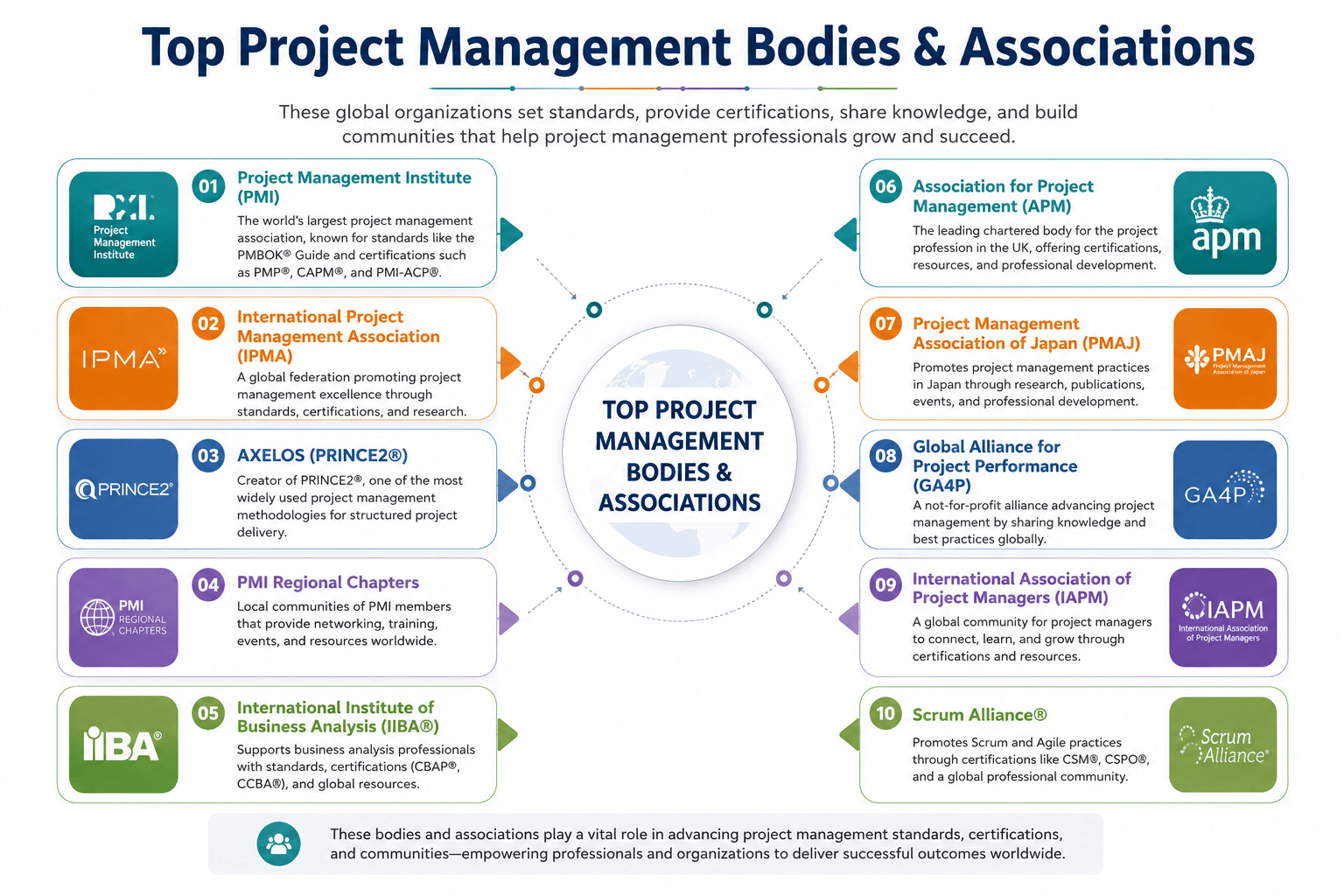
How the Major Organisations Compare
| Organization | Headquarters | Type | Best Suited For |
| PMI | USA | Professional organization | Global recognition across all industries |
| IPMA | Switzerland | Federation of national associations | Competence-based, holistic assessment |
| APM | UK | Chartered professional body | UK professionals and chartered status |
| AIPM | Australia | Professional organization | Australia and Asia Pacific practitioners |
| PMSA | South Africa | IPMA affiliated professional body | Sub-Saharan African professionals |
| GAPPS | Global | Standards and alliance body | Benchmarking and standards development |
| IAPM | Liechtenstein | Non-profit association and certification body | Lifetime valid, internationally accessible certifications |
Factors to Look For When Choosing the Right Organisation
Which body to align with depends on a number of factors. Here is a quick guide to choosing between them:
- Location: APM is dominant in the UK, AIPM in Australia and Asia Pacific and PMSA across Sub-Saharan Africa. PMI is recognised more widely globally.
- Exam: Do you prefer a structured exam? PMI or IAPM would be ideal. If you prefer interviews and a portfolio, consider the IPMA.
- Long-term cost: For professionals trying to avoid recurring recertification costs, the IAPM lifetime-valid certifications without fees would be best.
- Stacking credentials: It’s common for senior professionals to hold multiple certifications. The PMP and an IPMA assessment combine global mobility and skill validation. For example, adding the PMI-ACP to your PMP certification combines conventional and agile strengths.
Summary
Here are the main benefits of the bodies discussed above.
- PMI: broadest recognition worldwide and widest range of certifications. The first option for nearly all countries and industries.
- IPMA: a competence-based federation examined via tests, interviews and portfolios. Its recognition is greatest in Europe, the Middle East and the Asia Pacific.
- APM is the only Royal Chartered PM body in the UK, providing Chartered Project Professional accreditation.
- AIPM is Australia’s certifying body, in alignment with the AQF, and offers a gateway into IAPM certifications.
- PMSA: an affiliate of IPMA in South Africa; serves Sub-Saharan Africa with globally recognised, local certifications.
- GAPPS: develops the standard, unlike other bodies.
- IAPM: most user-friendly, with lifelong credentials and GDPGDP-based payment scales.
Conclusion
Project management professional organisations are the backbone of a profession like project management that now shapes outcomes across virtually every industry on the planet. They define standards, build knowledge frameworks, connect practitioners globally, and give individual professionals a recognised and credible place within their field.
In 2026, aligning with the right organisation is not simply a career move. It is a long-term strategic decision that shapes the kind of professional someone becomes and the range of opportunities available to them throughout their working life.
The right path looks different for every professional. That said, one thing holds across all of them: getting aligned with a recognised professional body is always a step worth taking. The earlier that step is taken, the better.
FAQs
The PMI is universally acknowledged across most countries and industries. Its certifications hold massive international value for practitioners.
PMP Certification validates an individual’s ability to lead projects across predictive, agile, and hybrid environments. Organisations worldwide prioritise this certification when hiring senior delivery professionals.
It is designed specifically for beginners entering the field. It establishes a strong foundational knowledge of core project management principles.
IPMA assesses practical competencies through holistic interviews and portfolios rather than just theoretical exams. It operates as a global federation of independent national associations.
This organisation holds a Royal Charter, elevating the profession alongside law and engineering, offering candidates a clear pathway to achieving Chartered Project Professional status.
AIPM serves the public and private sectors in this zone. It aligns its certification levels directly with the Australian Qualifications Framework.
PMSA actively supports the Sub-Saharan region. It administers localised, internationally recognised frameworks as an affiliate member of IPMA.
Unlike certifying institutions, this alliance solely develops independent competency standards. It helps governments and industries benchmark different framework systems globally.
Leading professional associations regularly update their foundational standards to heavily integrate hybrid methodologies, cloud computing, and cybersecurity protocols. It guarantees that international practitioners remain fully equipped.
Most bodies separate official training operations from testing processes to preserve credential integrity. Independent registered training providers like Unichrone handle the preparation courses instead.